
Rare dinosaur skeleton sold for tens of millions of dollars
Rare skeleton of nanotyrannus sold at auction in New York for $47.3 million
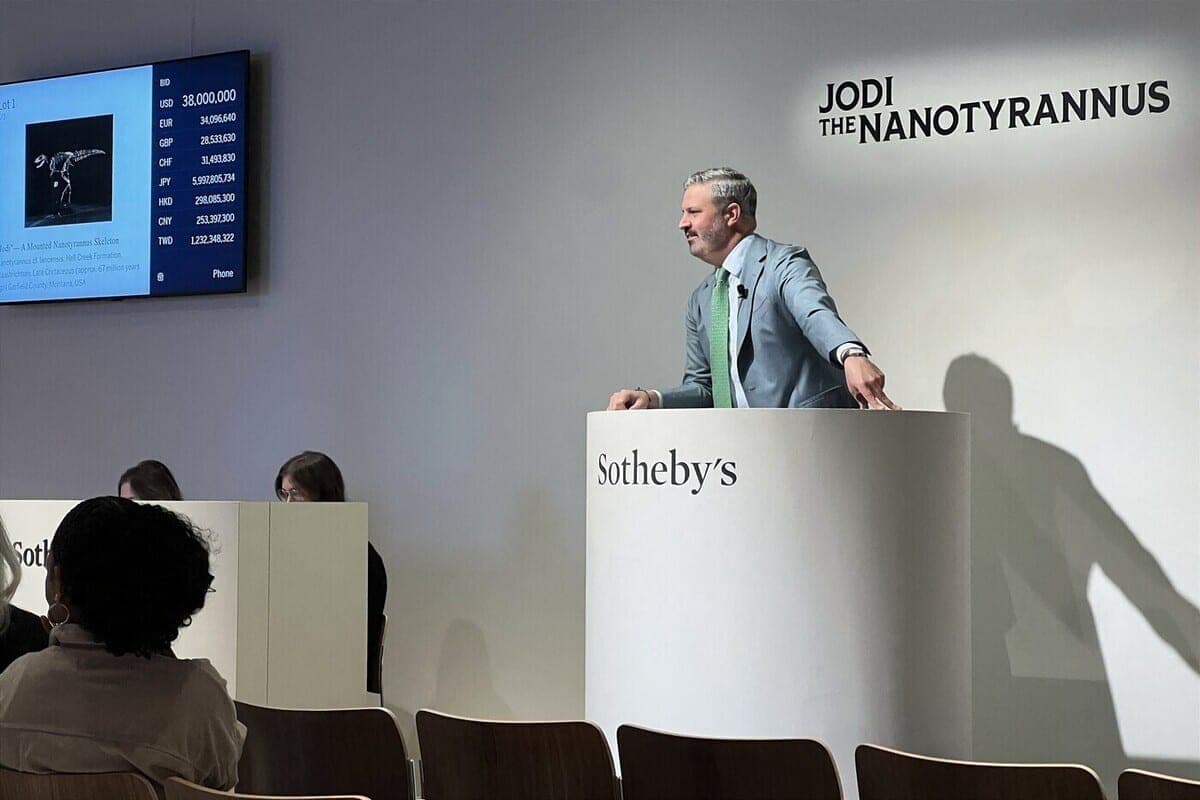
The extremely rare skeleton of a nanotyrannus, a smaller relative of Tyrannosaurus rex, was auctioned off in New York this week for $47.3 million, making it one of the most expensive fossil remains in the world.
The skeleton, named “Jodie” after the man who found the prehistoric remains in 2019, was sold at Sotheby’s on Tuesday for $47.3 million, “after a twelve-minute bidding session in which six entrants competed online and over the phone before eventually searching for it over the phone,” Sotheby’s said in a statement.
Sotheby's initially estimated that the skeleton would sell for $6-9 million. Tuesday’s auction results make Jodie “the second most valuable dinosaur ever sold at auction,” Sotheby’s said. The buyer has not yet been named publicly.
The skeleton, which was unveiled at an auction in Manhattan earlier this month, was discovered by Jodie Pearson in 2019 on her private land in the Hell Creek Formation in Garfield County, Montana, near the town of Jordan. According to Sotheby's, the skeleton length from nose to tail is 19.6 feet (approximately 6 meters), and the frame height is about 9.6 feet (an ear 2.9 m), and it "consists of about 191 fossil bone elements.".
In a statement released Tuesday, Cassandra Hutton, vice chairman and head of Sotheby’s international science and natural history department, thanked the team who helped in the “excavation and rescue of Jodie.”.
“Their passion and experience were foundational to Jodie’s story,” Hutton said. “Beginning with discovery and excavation, their commitment to understanding and preserving this remarkable specimen has helped us reach this point, a testament to the fact that we can all make a significant contribution to science. This exceptional result is a perfect recognition of the work done and the enduring interest in nanotyrannus.”.
Jodie is one of “three large nanotyrannus skeletons known to science and the first to hit the market since the genus was confirmed last fall,” Sotheby’s said in a statement. Judging by the overall size and development of the bones, “it can be determined that the skeleton belonged to an adult,” according to a description on Sotheby’s website.
Auction house Sotheby's described the nanotyrannus as a "fast, highly specialized carnivorous tyrannosaurid that lived side by side with Tyrannosaurus rex in the late Cretaceous, about 67 million years ago." Some have previously suggested that the nanotyrannus is a young Tyrannosaurus, but it has been shown to have more than 150 morphological differences from its much larger relative.
The sale and value of the fossil has drawn criticism from some members of the scientific community.
Thomas R. Holtz Jr., author and principal lecturer in vertebrate paleontology at the University of Maryland, said that as a "tyrannosaur researcher," he is "concerned about selling Jodie as much as all these multimillion-dollar fossil sales.".
“At the same time as this sale has continued, some museums are closing (the Drexel Academy of Natural Sciences in Philadelphia) or in danger of closing (the Sternberg Museum of Natural History at Fort Hayes State University) because of cost overruns that are literally 1/10 of the final cost of Jodie.” Thus, a person with a genuine interest in paleontology could do far more good by supporting the current operations of several museums than by selling a single specimen. Indeed, the total cost of excavating, preparing, and installing a skeleton like this is probably no more than $1 million, and perhaps much less. In this way, a well-funded museum would be able to assemble some good skeletons for the price of one trophy
He added that “potentially scientifically significant fossils” such as Jodie “could be lost to research and the public when they are in private hands.”.
“Now, perhaps, an as-yet-unknown buyer will donate it to a museum or similar institution where the public can see it and where scientists of present and future generations can measure bones, take samples and scan fossils, and apply modern analytical procedures (as well as procedures that no one has yet dreamed of) to help us better understand the biology of these ancient animals.” But if it merely adorns the lobby or ballroom of one of a billionaire's mansions, invisible and inaccessible to all but their friends, servants, and so on, it is effectively lost to both the public and the scientific community. In fact, at this point it's no different than if it were just left in the ground, he said.
Linda Ivani, a professor of evolutionary paleoecology at Syracuse University, expressed similar feelings in an interview with the New York Times: “These amazing fossils must remain in the public eye so that scientists can study them, so that children experience awe and inspiration, and so that everyone can admire long gone worlds.”.


