Felt dialogue
In Almaty, for two days, felt masters met, shared experiences and got acquainted with each other's traditions
Meetings and master classes were held on the initiative of the Embassy of Hungary in Astana, the Consulate General of Hungary in Almaty and with the support of the lecturer of the Hungarian language of the Eurasian National University named after L.N. Gumilev Jofya Siraki.
At the invitation of the Hungarian side, Kara Marton-Szőnyegi Károly came to Kazakhstan - a young Hungarian master of folk felting, winner of the Junior Prima award, holder of the honorary title "Young Master of Folk Art" and a scholarship holder of the Hungarian Academy of Arts (MMA). In his creative and research activities he refers to the traditions of nomadic felting and the ancient Hungarian peasant culture. His work is based on the study of traditional costume and historical craft techniques, which he reinterprets and embodies in contemporary products. A special place in the work of the master is occupied by Hungarian felt cloaks of figures, as well as household items in which traditional ornaments and forms receive a new artistic sound. In her works, Kara uses natural wool, embroidery, application and decorative elements, paying special attention to preserving the identity and symbolic meaning of folk motifs. In addition to creative activities, the master conducts training courses and master classes, contributing to the preservation and transfer of traditional craft skills.
Feeding is an important part of the cultural heritage of both Kazakhstan and Hungary. Historical ties with nomadic culture, the use of natural wool and original ornamental traditions create the basis for professional and cultural dialogue between the two countries. Feeling is one of the oldest technologies that unites the peoples of the Great Steppe Belt from Central Asia to the Carpathian Basin.
The first meeting of the master from Hungary was held at the Alatau Creative Hub in the Qazaq-Oner space, where the Kazakh ethnodesigner, master of art history, president of the National Association Qazaq-Oner Aigul Zhanserikova introduced the guest to the main traditions of felting in Kazakhstan. Also for him and representatives of the Consulate of Hungary, national Kazakh instruments were presented, among them such an ancient one as zhetygen.
In turn, Karoy Marton-Senegi introduced Kazakhstani designers and craftsmen to the traditions of Hungary. He also told about his family, which included shepherds, shared his memories of how he first saw the use of felt in everyday life. Ancient documentary photographs allowed to enhance the impression.
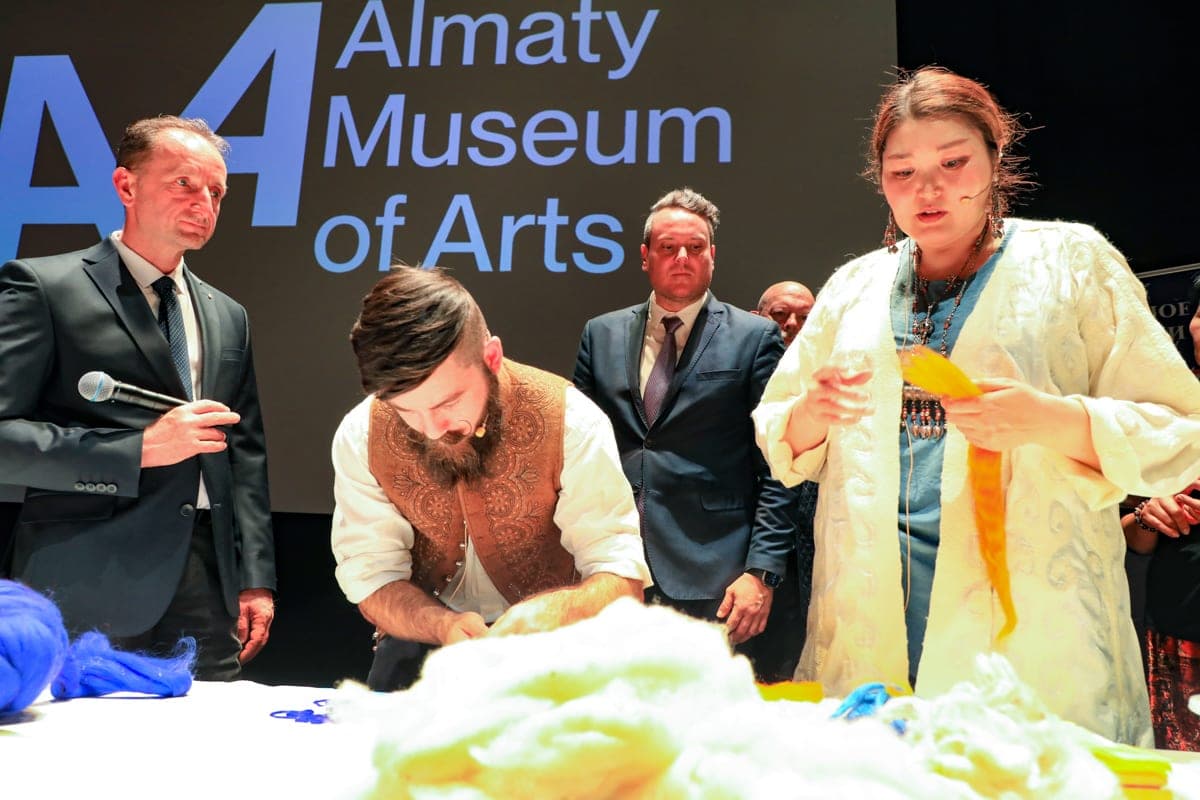
The second meeting was held at the Almaty Museum of Arts with the participation of Mr. Sabolc Kara Seke, Consul General of Hungary in Almaty. It was an open event, “Steppe Archive: Nemez, Kiiz, Namad”, dedicated to felt as a universal material of nomadic civilization and a living medium of modern art. All three words in the title mean felt - in Hungarian, Kazakh and Farsi.
The program consisted of two parts: a theoretical panel and a live demonstration of felting, during which the masters in real time in front of everyone created the author's felt panels - each in their traditional technique.
From Kazakhstan, the master class was held by Azhar Altynsak, a textile artist, a researcher of Kazakh textile traditions. Azhar specializes in techniques such as embroidery, weaving, weaving, patchwork sewing and felt. She is also the founder of a platform for preserving and rethinking living traditions in partnership with traditional knowledge holders.
Karay Marton-Señegui not only presented a master class in the museum, but also introduced visitors to the traditional clothes of Hungarian shepherds. The costume, which is part of the historical and cultural heritage of Hungary, always makes a strong impression with its originality and expressiveness. This unique work of folk art has two names - sur and suba (the latter is consonant with the Russian word "coat"). This is a traditional heavy fur cape or sleeveless cloak, made of sheepskin, often from sheep skins of the Hungarian Ratzka breed, characterized by thick and long hair.
Suba was truly a universal item of clothing and everyday life. In cold weather it was worn with fur inside, and in the rain - fur outside. It could serve not only as a protection from bad weather, but also as a bed, bedding, tablecloth or shelter.
Wealthy shepherds ordered especially luxurious subs, for the manufacture of which dozens of carefully made sheep skins were used. Such products were decorated with skillful leather application and embroidery, turning practical clothes into a real work of folk decorative and applied art.
The initiative of such meetings is always aimed at strengthening cultural ties between Kazakhstan and Hungary.