Composer Festival: Contemporary music to be played in Irkutsk
In Irkutsk you can listen to the works of contemporary composers live – the second festival “Point of Light” begins in Irkutsk on October 29
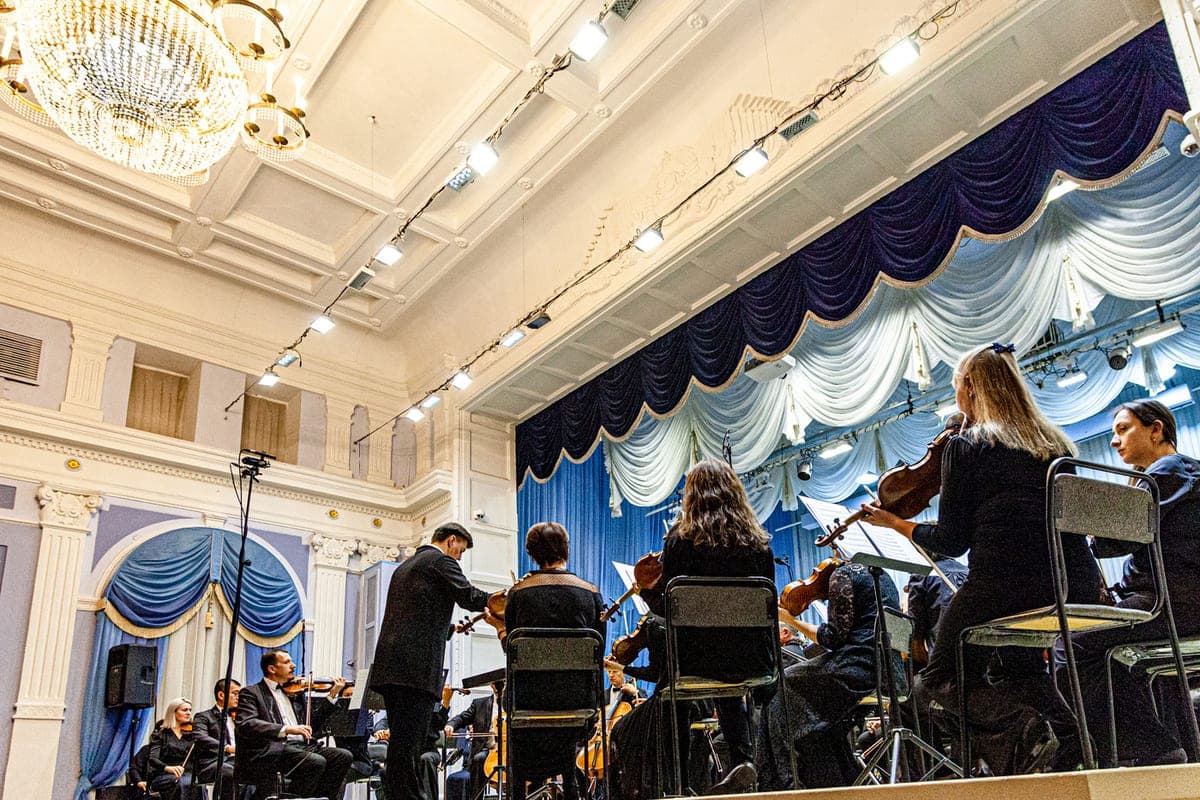
This is a composer's project - the listener will get acquainted with the original works of modern authors, both already famous and young. Irkutians are waiting for four musical days, in which more than 30 works by authors from Irkutsk, Moscow, Krasnoyarsk, St. Petersburg, Novosibirsk, Yekaterinburg will be performed.
The head of the Irkutsk branch of the Union of Composers Jan Krul, who two years ago invented and launched the “Point of Light”, tells why this festival is needed and according to what principles it works.
What is the concept, the idea of the festival?
- It has a long history. Everything was born from Irkutsk hooks (hooks are signs of the ancient Russian lineless musical notation, which were used to record church singing, in particular, the iconic chanting). - Editor's note. We first deciphered hooks, translated them into modern musical notation. Performed works. I sent them to different composers. And the composers were so inspired that they began to create compositions based on these hooks, including for the piano, for the symphony orchestra. All this sounds so fresh and unusual that it became clear that these compositions should be performed. They are original, based on Irkutsk music, which is more than three hundred years old. Although it is clear, of course, that spiritual music was recorded with hooks, a certain genre of the iconic chanting, it is, in fact, singing – and we do this in an instrumental version. But we are not the first in any case: Rachmaninoff did it, and many others are doing it now.
Suddenly everyone supported the idea. Irkutsk poet Artem Mors proposed the name “Point of Light”. It is such a kind of tuning fork of what is happening.
One of the main objectives of the festival is to create a universal platform where both aspiring authors, young composers and respected ones, whom the whole country knows, could express themselves. For example, the music of Elmir Nizamov, a young talented composer from Kazan, will be performed. He this year on the First channel just starred choral number. Composer, pianist and musicologist Ivan Glebovich Sokolov will come and even conduct a conference at two concerts and read lectures. Topics such as “From avant-garde to romanticism”, “What is beauty in music?”.
- Who will perform the works of contemporary composers? Is this festival as important to musicians as it is to composers who want their works to sound? Will there be many performers?
- Good artists today have a thirst for new compositions. They are looking for musical material, which will be in demand among the public, because there is always a special triple union of the composer, performer and listener.
Of course, we have a shortage of performers. Most of the performers are associated with the Irkutsk Regional Philharmonic. And it is good that such a possibility exists at all, because there is no music university in the region, and this complicates the matter.
There will be a lot of musicians at the festival. The first concert is a string quartet from Moscow, on the second day there will be the largest concert, where the Siberian quartet of saxophones will play under the direction of Andrei Puchtia. There, by the way, will be the premiere of my work “Bird Homon”, dedicated to the Irkutsk “Bird’s Harbor”.
There will be a governor's symphony orchestra, there will be our chamber choir. I would like to point out that the choir is also experimenting a lot. The choral movement in general is actively developing in Russia, modern music is performed.
- Is there a mandatory program for festival participants? Like Irkutsk-related?
- If possible, from performers – at least one composition associated with the Irkutsk hook. We usually put it at the beginning of every concert. Why, if possible? Original works are expensive to write, and from what is written, we have already performed almost everything. There's something, of course. Next year we will cherish the work of Olga Viktorova from Yekaterinburg. She composed a piece for a male choir with a string orchestra. Denis Khorov wrote for the domra with a symphony orchestra – at the end of September his composition was performed at the Moscow Conservatory, although the premiere was to take place here. But I hope that next year we will be able to do it too.
- There is a stereotype that modern composer music is something incomprehensible to a simple listener, something closed, only for intellectuals and connoisseurs, a thing in itself.
- The focus of this music is always on the listener. Vladimir Martynov and Nastasya Khrushchev, who will be played here, are very popular among the public modern composers. Martynov, by the way, wrote for films – for Pavel Lungin’s Russian film “The Island”, for the Oscar-winning “Great Beauty” by Italian Paolo Sorrentino (“The Beatitudes Commandment” for the string quartet will be played in Irkutsk). So it's not a thing in itself. But this does not mean that such music is sweet and flattering to the listener. She is in an active dialogue with him.
Many contemporary music festivals are made for the composers themselves. But we, as a platform, take a pretty universal stance. On the one hand, they are not tied to the ultra-avant-garde, on the other hand, we can afford very traditional compositions. Next year, a rather cardinal, specifically avant-garde young composer from Kazan Roman Parkhomenko will come to us. On the other hand, this year Vladimir Kobekin, who, for a moment, under the age of 90, prepared three Russian songs – a fresh and vivid look at folklore material. He will have a world premiere in Irkutsk for saxophone and orchestra.
- How do the works of contemporary composers reach musicians?
- It's never easy. Often someone has to be a tuning fork. This is a matter of trust and responsibility: on the one hand, the performers must trust the composer – they play it to the public, on the other hand, the composer must make it convenient and interesting to perform. We composers can write such an adage that only single performers can play it. You need to write so that the music can be performed. It should be borne in mind that musicians do not just create a picture - it is a creative, musical process, and it must be alive. This is the main advantage of the festival of modern music: everything happens before your eyes, in the hall. Because right now there's a wave of what the neuron is generating. And that's not fair, that's not really there.
- Is it possible to talk seriously, as an art, about what the neuron pours on us? Is there a lot of music composed by neural networks? Does it compete with composer music?
- I think that, unfortunately, in some genres, especially near-pop and cinematic, it somehow works. I don't listen to that kind of music. I know composers who even post somewhere in their home: they say, arrangers, rest, I arrange the AI in three minutes. It actually costs $50,000 to commission a composer.
- Well, it's actually a cliché. It's just algorithms.
- The public can't hear it. She's unprepared. That is why the festival is a real, lively, unique sound, which is made with you by a professional. This is valuable now and will be even more valuable every year, including because of the same neuron.
- That is, the value of the real increases.
- Yes, the real thing, and so it matters what happens here and now. Not what was once done by someone, but what exists in the moment.
One of the main reasons for this festival. We have festivals going on for 25 years. But what will we write about them, for example, in a music textbook? That they play 25 years of the same Rachmaninoff?
On the other hand, for example, a man worked for 35 years in a music college, wrote concerts, wrote preludes – a full bouquet of compositions. Something done, but a little bit. He passed away. What's next? These works are almost not played, notes are not published. Where do you put those notes, who needs them? We – the Union – have nowhere to store them due to lack of premises, libraries do not take manuscripts – everything must be published and must be assigned a number. If the manuscript is in the archive. And in order to take the archive, you need to prove the artistic value. And if they proved and took the archive, it is forever sealed there, we can’t take it. As it turns out, the composer left - and ends in the water. No man, no notes. And none of these works - genuine, real - play.
But, of course, the main thing is that they were. It is necessary to nurture, water the young growth from the leechka, which then, in 10-15 years, will bear fruit. Otherwise there will be a scorched desert - there will be no one. This happened in the 90s. And the guys are graduating, they're interesting, you know? And they should have an opportunity.
In general, all this is a systemic work. And the festival is a part of it, a platform where masters, young people, the capital, and regions can sound.
- Let me clarify again: there is no regulation of what will sound like? Can music sound of any direction, the main thing is that it was a composer, bright, fresh?
- We always have a big question: what is the way forward for music? At the same time, there are entire universes, streams of different things – simultaneously, so much valuable – and people do not know. That’s why the festival should exist to make it obvious that it exists.
With this in mind, we do not take the position that we are a European festival and will play only intellectual European music (in parentheses – incomprehensible). We can play avant-garde music, we can play ultra-traditional, we can play almost Soviet. Young people write their own, neoclassicism so-called – for example, one of the young composers works with Tchaikovsky’s music: on the basis of the classics, a mix of Tchaikovsky’s own, minimalism and Russian rock is obtained. It has a crowd of fans and a crowd of haters. You have to decide if you can listen to this music or not. It can cause discomfort. But already a whole school has appeared, in St. Petersburg clubs already exist on the basis of this musical technique.
And yes, maybe not all music will appeal to the listeners, but it is so sharp and bright that at least one composition should elicit a response. When there is at least an element of provocation (in a good way), the audience comes to life. The audience craves bright, lively, often just joyful music (and this is often children's music). This is the time.
In this sense, collaborations with poetic and plastic art are promising. I think it would be very interesting if the festival expanded into interdisciplinary spaces, neatly but professionally. Moreover, in Irkutsk there are such great creative forces that you can just take and do.