Reply to Malevich
In Almaty, the National Museum of Arts of the Republic of Kazakhstan named after Abylkhan Kasteev presents 34 works by Georgy Makarov, united in the theme “Conversations with Malevich”
What if after 111 years, the conversation with Kazimir Malevich is just beginning? In 1915, he presented the world “Black Square” – a work that changed the idea of the boundaries of art and opened a new page in the history of the avant-garde. This was not just an artistic gesture, but a challenge to the usual view of the world. The questions raised by Malevich continue to be heard today.
Decades later, Georgy Makarov enters this dialogue. His exhibition “Conversations with Malevich” is an attempt to re-read the ideas of the Russian avant-garde, to see new meanings in them and to trace how the artistic discoveries of the past acquire a new sound in the present.
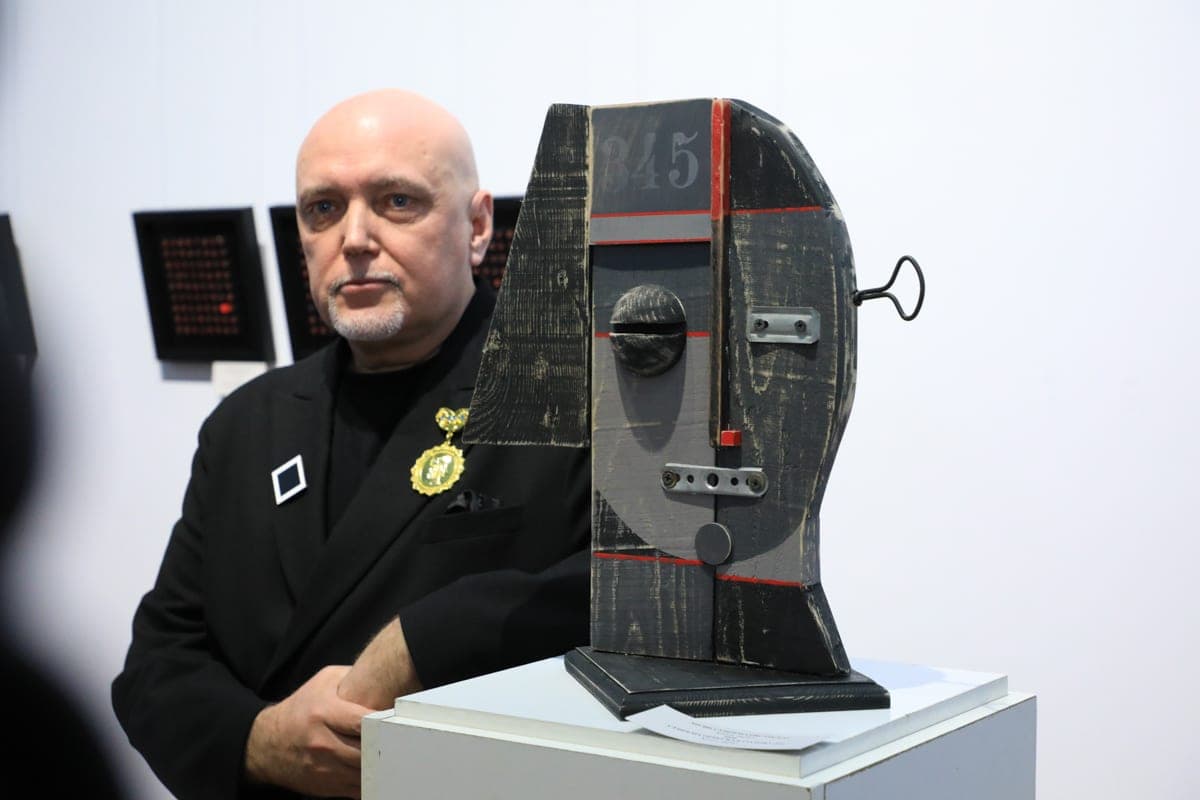
Thirty-four works are graphics made with acrylic and art objects created in the aesthetics of engineering suprematism. They become a meeting place for the artist and the viewer with Malevich. Here geometry becomes language, form becomes movement, and art becomes a territory of questions, experimentation, and rethinking.
But is it possible to talk in a century? And what can Malevich say today to the artist of our time?
Perhaps the answers begin exactly where the usual ideas about art end.
The question arises: why are 34 works presented and the number 34 is often repeated in them? The fact is that the number 34 in this case is not just a number of works, but a historical reference, behind which lies a whole artistic era. It was so many graphic sheets of Suprematism that Kazimir Malevich presented in Vitebsk in 1920, offering the world a new view of art.
More than a century later, this figure becomes the key to a new exhibition and an invitation to take a fresh look at art.
Today, this number takes on a new sound. Thirty-four works become a space of artistic collision: painting argues with graphics, the plane tends to reach volume, abstraction meets figurative, color captures space, and geometry seems to set its own laws of the universe.
This exhibition is about boundaries that exist only to break them. But there's another number, 56. It is often found in the works of Georgy Makarov next to 34. This is probably the age of the artist. But that's an assumption.
The curator of the exhibition was Ekaterina Reznikova, candidate of art history. In her opinion, Georgy Makarov refers to the artistic universe of Kazimir Malevich not so much quoting her as entering into a dialogue with her and rethinking her images in his own coordinate system. In acrylic graphics and reliefs, the artist creates a special reality, where geometry acquires volume, the form seems to be freed from the usual laws of space and gravity, and in the weightlessness of space, geometric bodies soar, folding into mysterious compositions. Flat figures resembling targets evoke associations with Malevich's post-suprematic cycle, and bizarre architectural designs refer to his constructivist aesthetic. Circles, squares and other elements of geometry appear here in their utmost clarity and conciseness.
Thus, the contemporary artist Makarov seems to return to the point where art begins from scratch, to the absolute simplicity of form, beyond which an infinity of new artistic possibilities opens.
At the opening of the exhibition came from Russia, his friend and in many respects colleague Vladimir Korkunov – a poet, literary critic, publisher, who created and published the book “The Address of Silence” with Georgy Makarov. He noted:
Georgy Makarov is a man of endless search, amazing openness and high creative productivity, who offers us truly high samples of painting in a variety of forms and formats. It is a painting of search, discovery and rediscovery. He appeals, for example, to the forms of Malevich, bringing his own voice into them, rethinking what has already been created and showing how modern and relevant the works of the past can sound today.
A true artist should not be afraid of courage. He must be on the edge, not afraid to be ridiculed or misunderstood, criticized or even condemned. After all, creativity is always a borderline state, a constant attempt to go beyond the usual, to be where no one has been before.
What George is doing is really great! This is true artistic fearlessness, freedom of search and the ability to discover new meanings in the already known.