
Economists – how the policy of the Central Bank should respond to one-time price jumps
So that one-time price jumps do not depreciate savings, Central Bank economist Andrei Sinyakov suggests always responding to them with a rate increase, even if expectations are stable. Other experts object: borrowers and the economy will pay for it
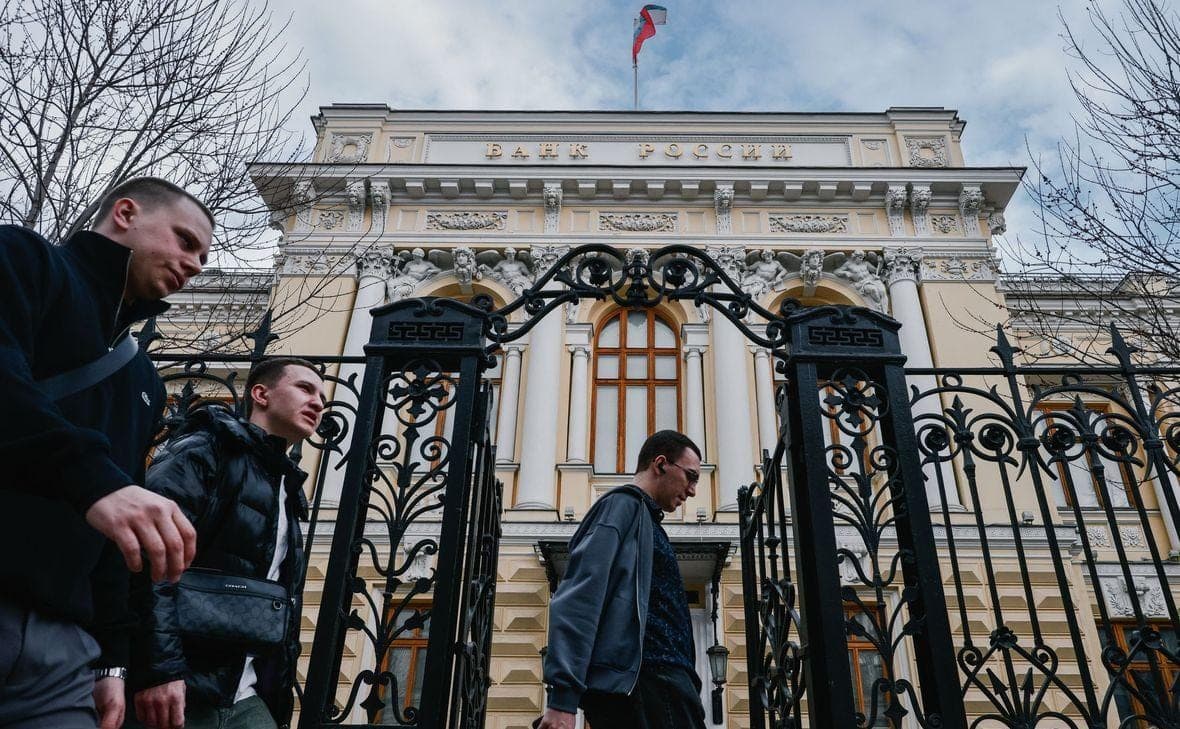
Andrey Sinyakov, Deputy Head of the Research and Forecasting Department of the Bank of Russia, suggested raising the key rate in response to one-time pro-inflationary shocks, regardless of whether inflation expectations are anchored, and almost not responding to one-time price reductions. He described this approach in his article “Incentives to household savings in nominal contracts: the role of inflation targeting”, which was studied by RBC.
The goal is to protect ruble savings: one-time price jumps in Russia are almost not balanced by the subsequent decline in prices, and two or three such shocks are enough to save about a third of purchasing power, the author writes with reference to historical data. Therefore, the Central Bank should apply an approach of asymmetric inflation targeting, reacting more rigidly to temporary price spikes. To keep the incentive to save in rubles, the nominal rate in the long term, according to the author, should be at least 8.5% per annum. Sinyakov’s article reflects his personal opinion, not the official position of the Bank of Russia.
The representative of the regulator told RBC that the Bank of Russia strictly adheres to the principles set out in the “Main directions of monetary policy for 2027-2029”. According to them, the Central Bank does not react to the deviation of inflation from the target if it is caused by temporary factors, and inflation will steadily return to the target without additional measures. However, the regulator takes into account such factors if they significantly increase inflation expectations.
What other economists think about Sinyakov's ideas - in the material of RBC.
Is the approach of asymmetric targeting different from the current policy of the Central Bank?
Oleg Shibanov, Professor of the Russian Economic School:
The current policy of the Central Bank does not imply an automatic increase in the rate when prices rise. The jump in gasoline prices and the rise in the price level due to it in 2026 did not lead to an increase in the key rate. This proposal is therefore new.”.
Alexander Isakov, Head of the Sbera Center for Macroeconomic Research and Chief Economist at VEB.RF:
The regulator already reacts so harshly to one-time upward shocks, explaining this by the unanchored expectations. The novelty of the supply lies in motivation: not a decrease in inflation expectations, but the safety of ruble savings.
Sergey Zaversky, Head of Analytical Research Department of the Institute for Comprehensive Strategic Studies:
In essence, this is a proposal to maintain the approach already applied by the Central Bank, even when inflation expectations stabilize. At present, inflation expectations in Russia are not considered anchored.”.
Does the Central Bank need to respond to a rate increase even for one-time price jumps?
Evgeny Goryunov, Head of the Monetary Policy Laboratory of the Gaidar Institute for Economic Policy:
According to the basic theory, the Central Bank should not raise the rate in response to one-time pro-inflationary shocks: it will still not be able to contain the inflation caused by them, because the rate acts with a delay, and this will hit economic activity. However, this logic works only if one-off shocks push inflation up and down and, on average, offset each other. In Russia, they almost exclusively push inflation up. As a result, over the years, a significant deviation of inflation from the target is growing, and this problem must be solved.
It does not have a good solution, but perhaps the best option is to modify targeting so that after one-off inflation shocks, the Central Bank keeps rates higher for a longer period. It also has a disadvantage: the consequences of such shocks for the economy will be more painful.”.
Rodion Latypov, chief economist at VTB:
The Bank of Russia’s response to one-off shocks should still depend on the anchoredness of inflation expectations. If they are really low and fixed at the target level, then the Central Bank’s reaction to one-off shocks is not required. If, as the author believes, the lack of a reaction of the Central Bank can lead to a permanent and increasing decrease in the purchasing power of citizens, this just means that inflation expectations are not anchored.
Sergey Zaversky:
“The author’s proposal is not quantitatively substantiated: it is not clear about the leaps of what scale we are talking about, how much and for what period the rate should increase. There is no real-time way to distinguish a one-off shock from a sustained rise in prices. The author points out that this is not about constantly higher stakes, but about a reaction to one-off shocks, but these shocks, according to him, can occur quite often. And with frequent shocks, the asymmetric rule turns into a permanent premium to the bet. The asymmetric response could be discussed in response to the risk of inflation persisting, but not in response to depositor losses per se.”.
Oleg Shibanov:
It is difficult for me to imagine the Central Bank raising rates because of a one-time price jump. For example, the sharp rise in gasoline prices this summer was caused by capacity problems. In such a situation, the increase in the rate will not reduce the difficulties with prices, but may worsen the condition of borrowers who urgently need to restore production capacity. As for the losses of depositors and bondholders, volatile inflation is already embedded in long-term rates: on OFZ they are now 16% and above.
Does saving protection justify the costs of a higher rate?
Alexander Isakov:
“Most households are both savers, borrowers and workers. Sinyakov’s work examines only one side – savings – and does not assess the relationship between the rate and borrowing costs, credit risks, and employment. In our estimation, an additional 1 percentage point rate withheld for an extra year is worth 0.3-0.5% of GDP over the two-year horizon.”.
Sergey Zaversky:
“The benefits of savers are always paid by someone, namely the borrowers — the budget, the corporate sector, citizens. But the Russian economy is not ready for this, especially at the current stage. The ratio of the financial result of unprofitable companies to profitable ones increased in January-August 2026 to 33.5%, which is significantly higher than the crisis value of 2020 (28.7%). Budget expenditures on debt servicing are expected to grow from 3.9 trillion rubles in 2026 to 5.7 trillion rubles in 2029.
Egor Susin, Managing Director of Gazprombank Private Banking:
“Sharp rate movements in response to one-off inflation shocks will increase rate volatility and risk premium sewn into long-term rates – this will create conditions for a tighter PrEP overall.” Therefore, I am not in favour of responding to one-off shocks.”.
Does the key rate need a lower threshold of 8.5%?
Alexander Isakov:
To shift the value of 8.5% to future decisions as a threshold is not entirely justified, because the number is derived from a different inflation regime, when inflation was double-digit at the beginning of the period and 6-9% at the end. Moreover, according to the author’s own arithmetic, revolving deposits for 23 years in real terms did not give an increase, which means that 8.5% is the level of saving, not the level that creates an incentive to them. The stimulus is not broken today: the savings rate of 16.6% in 2025 is a historic record.
Elena Akhmedova, chief economist for Russia at Euler:
“The value of 8.5 per cent is calculated as the threshold for saving purchasing power based on historical inflation values. If multi-year average inflation declines, so will the rates required to maintain savings in real terms.”.
Oleg Shibanov:
In 2020, the key rate reached 4.25%, while the share of savings in cash income by Rosstat was 9.1%, and in disposable income by the Central Bank - about 14%. That is, people continue to save even at low rates.”.
How else can savings be protected from one-off price shocks?
Evgeny Goryunov:
It is possible to switch to targeting average inflation: then, after a period of high inflation, the Central Bank will have to deliberately keep it below the target. In theory, this allows for more sustained inflation, but such policies are far less predictable and transparent than mere inflation targeting and are difficult to maintain.”.
Rodion Latypov:
“A more effective way would be to clarify the neutral key rate [the level at which PrEP does not accelerate or restrain economic activity and inflation. — RBC], taking into account the asymmetry of inflation shocks. If inflation shocks have a clearly asymmetric distribution, then this should lead to a reassessment of the neutral level of the key rate, which compensates for the expected “addition” to inflation.
Oleg Shibanov:
I’m not sure that any rules for the Central Bank are in reality. Most new shocks are of a slightly different nature than the old ones, and whether they can be reacted to in the old way is not very clear. For example, after the pandemic, the central banks of major economies were late to raising rates: prices began to rise in 2021, and they began to raise rates only in 2022, because the previous rules did not warn them about rising prices. Therefore, the Central Bank should have room for judgment, not just following the rule.”.
Natalia Orlova, Chief Economist of Alfa Bank:
In order to protect savings, it is not necessary to introduce a new rule – it is enough that such analytics are reflected in the view of the Central Bank’s board of directors. Rate decisions are made not only on the basis of statistics, but also on the basis of judgment, and often these judgments are based on the desire to prevent the economy from cooling down. The assessment of the low return on savings in Sinyakov’s article reminds us that the interests of savings holders should be taken into account more actively.”.