
Where in the world are the “blue zones” of longevity and what are the principles of the inhabitants
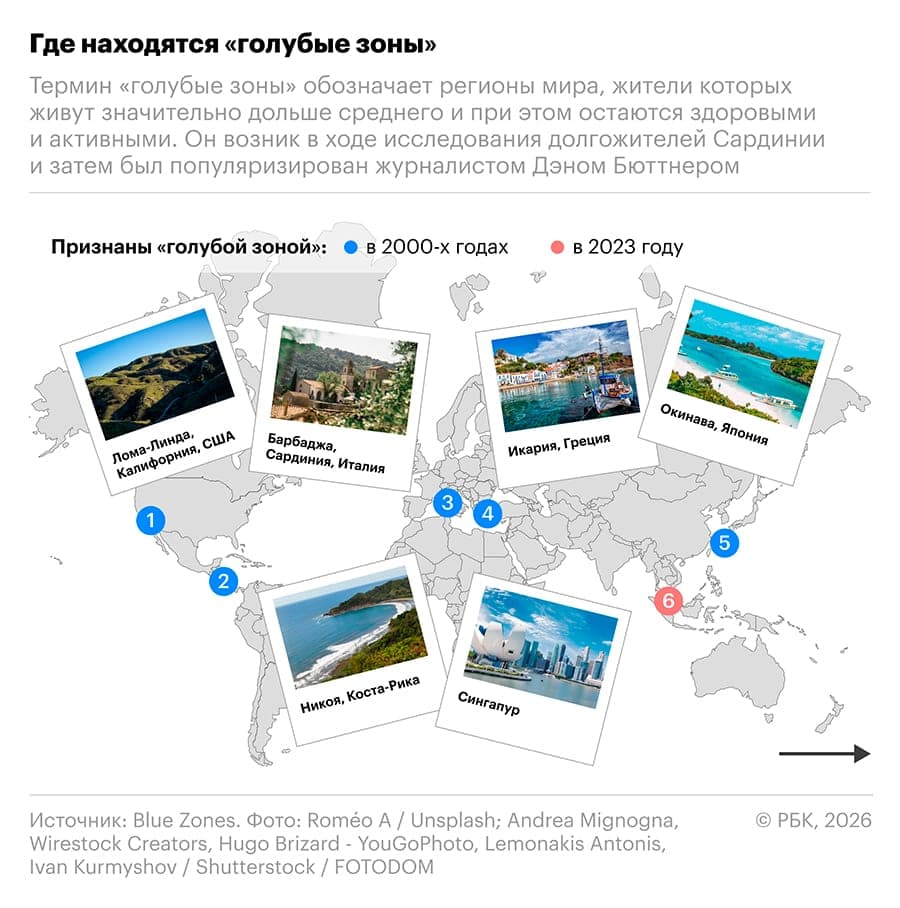
The Sardinian village of Bolotana claims the status of a “blue zone” – an area with a high proportion of healthy centenarians. What other regions are recognized as “blue zones” and what principles their residents follow – in the infographic
The list of “blue zones” can add another territory of Sardinia – the mountain village of Bolotana, writes The Guardian. According to a recent study, 13.8% of local women over the age of 70 can live up to 100 years.
Bolotan is located in the central part of the island, about 110 km from the previously identified “blue zone”. Giovanni Mario Pes, associate professor of medical, surgical and experimental sciences at the University of Sassari, said in an interview with The Guardian that this is the first time in more than 25 years that scientists have discovered the place of residence of centenarians outside the original “blue zone” of Sardinia.
Where did the Blue Zone come from and what does it mean
The term “blue zones” is used to refer to the regions of the world where centenarians live, leading a healthy and active lifestyle. The name was invented by researchers of the Italian island of Sardinia (including the Dog), when they circled the map of places with exceptionally high life expectancy with a blue marker. In 2004, they published a paper that referred to the term in relation to the central-eastern part of Sardinia. "The estimated life expectancy in the blue zone is higher than in the rest of the island, especially among men," the study said.
“The blue zone is a region of the world where, on average, more people live to 100 years of age or older and where people tend to be healthier than in other regions,” the Cambridge Dictionary defines the term.
Then the concept of “blue zones” was developed by journalist Dan Buettner, who in 2004 began to study the territories of the world where people live to old age without suffering from common diseases, and in 2005 registered the trademark Blue Zones in the United States. Buettner described the results of his work on the study of longevity in a 2005 article for National Georgaphic and several books, and in 2023 the documentary series Live to 100: Secrets of the Blue Zones was released on Netflix.
In the 2000s, Buettner identified five blue zones:
the mountainous region of Barbaja (Sardinia, Italy), where the most men over 100 live in the world; the island of Ikaria (Greece) with minimal mortality among middle-aged people and the lowest level of dementia; the Nicoya Peninsula (Costa Rica) with minimal mortality among middle-aged people and the second largest number of men in the world over 100; the islands of Okinawa (Japan), where the longest-lived women in the world live; the city of Loma Linda (California, USA), where there is a large religious community - Seventh-day Adventists who live in North America for ten years longer. Buettner later told The New York Times that Loma-Linda was added to the list because National Geographic asked him to "find the American blue zone.".
In 2023, Singapore became the sixth Blue Zone. As explained on the Blue Zones website, Singapore, unlike other blue zones, was not an isolated region where a longevity-promoting lifestyle was supported by traditional culture for years, and a healthy environment was created purposefully, which allowed to increase life expectancy and the number of centenarians. For this reason, Buettner called Singapore “Blue Zone 2.0.”.
What principles of longevity revealed in the inhabitants of the “blue zones”
Despite geographical differences, the Blue Zones combine the project’s list of nine general principles of longevity:
Regular natural physical activity. A sense of purpose and purpose in life. Daily prevention of stress. Food with a predominance of plant products. The 80% rule is to stop eating when your stomach is 80% full. Moderate alcohol use (except for Adventists) Strong social ties and long-term friendship. Strong family relationships. The presence of religion or spiritual practices in everyday life.
To be recognized as a “blue zone”, the territory must meet three criteria:
reliable data on fertility and mortality; high life expectancy in the country compared to the rest of the world; high life expectancy in the region.
What experts say about the concept
Dr. Walter Willett, a professor of epidemiology and nutrition at the Harvard T.H. Chan School of Public Health, believes that the concept of “blue zones” does not have a strict scientific basis, but its nine principles are broadly consistent with what scientists know about the effects of proper nutrition, physical activity, social connections and emotional state on health and longevity.
Demographer Sergey Chesnakov, in an interview with RBC, described the concept of “blue zones” as debatable: Western authors Steven Ostad and Giovanni Pesh consider longevity confirmed by cross-checking documents. In the West, forgery was also revealed: in Japan, 82% of centenarians were dead, in Costa Rica, 42% indicated their age incorrectly; the goal is pensions and payments.
According to him, strict age validation is important in determining centenarians, including primary records, cross-checking, epigenetic clocks, IDL and GRG databases (the largest authoritative international scientific databases used in demography and gerontology for accounting and verification of the age of supercentenarians).