New engineers: how to train specialists for space
The rocket and space industry of Russia, according to Roscosmos Group of Companies, is currently represented by 110 enterprises in 33 constituent entities of the federation, and 165,000 work in the industry.
The rocket and space industry of Russia, according to Roscosmos Group of Companies, is currently represented by 110 enterprises in 33 regions of the federation, and 165,000 people work in the industry. About 10,000 of them are employees of more than a dozen private commercial space companies.
To preserve and strengthen Russia’s technological leadership, we need production facilities with modern equipment, but above all, people who are able to create new solutions and bring the engineering idea to a working sample. The development of competencies in training personnel for the rocket and space industry is becoming one of the primary state tasks.
By 2030, based on the objectives of the national project “Cosmos”, it is necessary to seriously replenish the industry with young personnel: every third employee from the rocket and space sector, according to the targets of the national project, must be younger than 35 years. Obviously, it is not enough for a young engineer entering the profession to understand how a spacecraft works. It is important that even at the university the student has the opportunity to answer a much more difficult question: how to create it. For a long time, the boundary between education and production was quite clear: the university gave knowledge, and the enterprise turned the graduate into a specialist. But if the engineer first encounters real tasks only after receiving a diploma, it turns out that the industry is forced to spend additional time on its preparation.
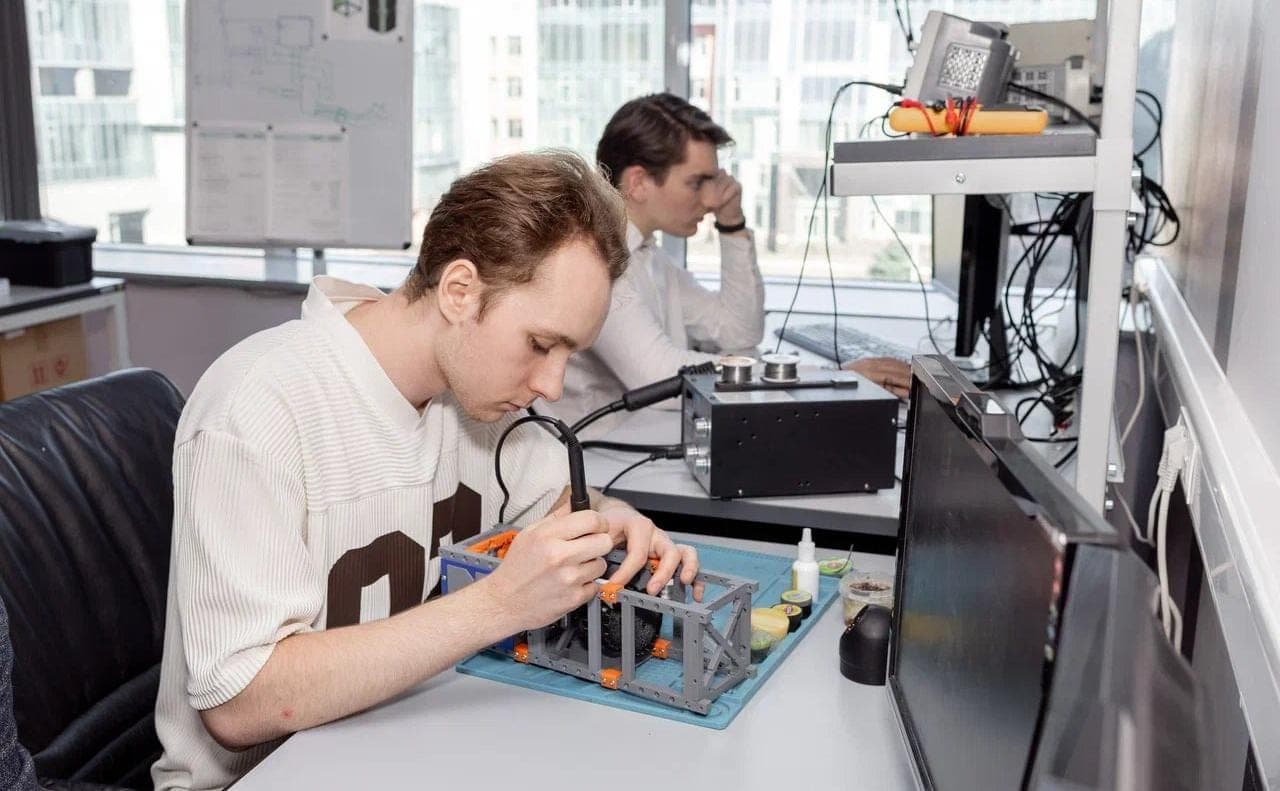
One of the activities of the federal project “Personnel for Space” of the national project “Cosmos” is support for the creation, testing and manufacture of student small spacecraft. This is exciting work: for a student team, participating in the development of small spacecraft becomes a full-fledged engineering school. To make a satellite, you need to go through almost the entire cycle of work on a complex technical product: formulate a task, think through the design and payload, write software, assemble the device, conduct tests, prepare it for launch and subsequent operation. All these opportunities for professional development of a space technology developer are provided by the federal project “Personnel for Space”: university teams can go from a scientific idea and engineering design to testing, launching and operation of the apparatus.
For example, in the Ryazan State Radio Technical University named after V.F. Utkin already in 2026 under the federal project, a student small spacecraft of the orbital segment of the radio telescope is being developed to monitor solar activity. With the help of the student satellite CubeSat 8U, students will be able to observe solar activity and predict geomagnetic storms together with ground-based radio systems.
In turn, NUST MISIS is developing a small spacecraft to assess the performance of promising semiconductor structures and products in outer space, and RTU MIREA is developing two student devices designed to monitor a number of processes in low-Earth orbit.
In total, by the end of 2026, the federal project provides for the implementation of 40 student and school small spacecraft with different payloads for subsequent launch into orbit. By 2036, the number of developed and launched student, school and scientific and educational apparatus, according to the goals of the national project, will exceed 400.
In the process of creating such a technique, the student ceases to be only a recipient of knowledge. He becomes a member of the engineering team, and the university is not only a place of study, but also a development environment. Thus, the distance between education, science and production is reduced.
In addition, in 2026 in 27 universities from 18 regions of the country, more than 20 thousand students, teachers and employees of educational organizations will undergo additional programs on modern space and satellite technologies to strengthen their competencies. Nearly half of programs (47%) are focused on artificial intelligence and digital technologies, reflecting the strong demand for digital competencies in the industry.
Technological leadership is not a set of individual achievements, but a system that begins to work at the moment when a specialist gets the opportunity not only to learn someone else’s technology, but to create his own. Investments in engineering training have a long-term impact, and these opportunities should be increasing.