
The head of Komblaga of St. Petersburg Sergey Petrichenko spoke about new ways to combat snow
No one can predict how snowy the coming winter will be. Road workers and other city officials are considering different scenarios. This winter season in St. Petersburg will be introduced new methods of snow control and involvement of initiative citizens in cleaning. Details of preparation for snowfall with the editor-in-chief of “MK in St. Petersburg” Timofey Shabarshin shared the Chairman of the Committee for the improvement of St. Petersburg Sergey Nikolaevich Petrichenko.
Sergey Nikolayevich, the snow cover is about to begin to appear in the city. Almost every year in the public space, the committee talks about records for the removal of snow from St. Petersburg. But when a person goes outside, he sees the snow debris and does not understand why it happens. What could this dissonance be related to? Does it snow more each year than the previous year, if the volume of its export increases?
- First of all, for readers to understand, I would like to remind you that there are 300 million square meters of harvesting space in St. Petersburg. Some of them – 60 million square meters – belong to the street-road network, which is cleaned by road workers. Another 59 million square meters are green areas. They are removed by garden and park enterprises. And there are about 180 million square meters of harvesting space. Housing agencies and district administrations, private territories - shopping complexes and other business structures are responsible for the maintenance of intra-quarter territories. And if you do not know about this division, there may be a misunderstanding.
I'll explain who cleans what. The street network and sidewalks along the streets are the responsibility of organizations subordinated to the improvement committee. These are four state budgetary institutions and four organizations that are involved in contracts for work.
Cleaning of intra-quarter areas is carried out by 18 housing agencies, which are called GUZHA. They work in all 18 districts of the city.
The private area is cleared of snow by the owners. In this case, we are talking about areas given for parking and other needs to large chain stores, shopping centers and so on.
There are also areas that are being removed by municipalities. These are, for example, small streets and driveways on the territory of one-storey buildings: in Strelna, Lysiem Nosu, Pargolovo and so on.
It is clear that all these zones are removed in different ways, hence the dissonance, misunderstanding. We, speaking of records for the volume of snow exported, report on the cleaning of the road network.
It is impossible to predict how much snow will be in winter, so we are preparing equipment, assuming the most serious scenarios with heavy snowfall. The equipment at our subordinate enterprises is used all-season, but by winter it will be converted.
This year, more than 1,670 units of equipment of various types were prepared for the winter cleaning of the territories: utility vehicles, dump trucks, foot loaders of snow, tractors with dumps and so on. This number of machines allows us to use them in two shifts. In fact, in winter, more than a thousand units of equipment go daily to clean the city.
Organizations subordinate to the improvement committee clear the carriageway of highways to the borders of intra-quarter territories. Then there is the area of responsibility of housing agencies, the work of which is supervised by the Housing Committee.
Snow goes to the snow smelting and snow receiving complexes, of which there are 18 in the city. All of them are objects of Vodokanal and convert snow masses into water. It goes to the sewer, then to the sewage treatment plants and after that to the reservoirs.
Back to work schedule. Along with cleaning the highways, we begin cleaning the sidewalks and stop complexes. In the early morning, gardeners go out for cleaning to clear the hiking routes passing through gardens, parks, squares and other green areas.
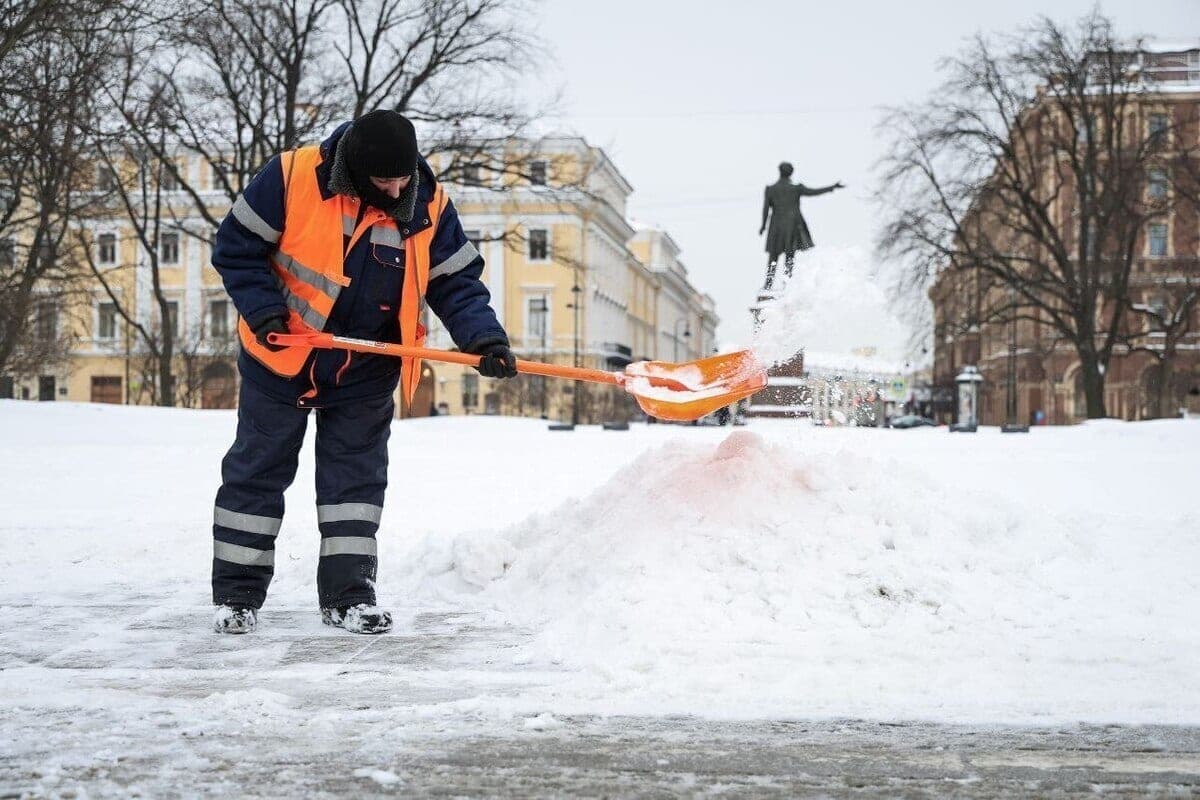
In addition, about a thousand manual workers go daily to clean the snow from the pavements and narrow sidewalks, where mechanical cleaning is impossible.
And if we talk about the volumes and records, then every year from city streets the enterprises of the improvement committee take out for recycling from 1.5 million to 4 million cubic meters of snow.
- And how often do you interact with the districts and other institutions on cleaning matters? Residents of the city witness when the snow falls on a clean sidewalk, then in the parking area and eventually ends up on the road.
- Interaction happens regularly. Every manager in the housing industry counts winters. I will have my third winter as chairman of the committee. Initially, when Governor Alexander Dmitrievich Beglov decided to assign me these duties, certain tasks were set. After that, various proposals were made, which then I and Vice-Governor Evgeny Nikolaevich Razumishkin tried to implement. And we keep doing that.
There are different situations when there is an imbalance in snow removal. The first is related to the work of management companies and private owners operating residential buildings. There are many buildings in the city, the facades of which border the sidewalks. Every winter, GATI obliges the Criminal Code and private individuals to clean the roof from snow and naledi and, identifying violators, resorts to penalties. As a result, we often see specialists hired by management companies or building owners dumping snow from the roof onto the newly cleared sidewalk and road. As a result, we, together with the district administration, begin to look for an organization that cleaned the roof, it collects the dropped snow into a pile and hires transport for its removal to the snowmelter. It also happened that the management company “cleaned up” after itself, shoved snow to places for disabled people in the paid parking area.
To minimize the number of such cases, we organized the interaction of our cleaning organizations with district administrations. We held joint meetings, created working chats in the Max messenger. Management organizations, profile employees from district administrations, our GBU, Nevsky Environmental Operator, parkers, representatives of other interested services are connected to them. All of them have information when, during what period will be the cleaning of sidewalks, street and road network. So that first the snow was thrown, then the pavement was cleaned. Taking into account this schedule, roof cleaning schedules are formed.
There are some rough spots, but hopefully there will be fewer of them this year. We'll try to synchronize the work. It will also help that management companies with city participation have concluded contracts for snow removal with our Central URDiB GBU. We hope that the exchange of information will eliminate double cleaning work and, on the contrary, will increase the optimization of resources used and help to ensure clean sidewalks.
- In your opinion, what are the most problematic streets and districts of St. Petersburg, when viewed from the point of view of cleaning?
- If the answer is monosyllable, there are no problem places in the city. There are no streets that cannot be cleaned in a certain period of time.
The difficulty is in the other. We are glad that the residents of St. Petersburg are steadily improving their well-being and growing private fleet of cars. But in the Central areas, these cars can become a problem, leading to a lot of parking. In other areas, there are signs restricting parking at certain times of the day, in central areas they are not. In large snowfalls, snow under cars sometimes do not have time to remove, and it rolls away, you have to remove it manually, use ice rockers to clean everything to the asphalt.
Since the summer, we have discussed this situation, worked through the project, requested funds for its implementation, and they were partially allocated. We are talking about the installation of permanent road signs 3.27 - "Stop prohibited" - with the designation of time periods. This should be done so that in winter we can not manually and in places, but mechanically and completely clean the paid parking area.
We are working on the issue of installation and time signs 3.27 in order to change signs in the most difficult areas through the paid parking service and, after informing drivers about the period of the restriction, clean up the territory.
- Let's talk about money. According to the publication “Business Petersburg”, the cost of winter cleaning in the central areas has increased about twice in a year. What caused this growth?
- I do not know how Delovoy Petersburg came to this conclusion, the cost of winter cleaning has not increased at state-owned enterprises. A state task is issued, according to which enterprises receive subsidies for cleaning the road network in a certain period. Annual contracts come after the budget is formed, it will only be considered. As of today, the cost of cleaning has not increased.
- Recently, Vice-Governor Razumishkin said that in the near future manual workers and machine operators will increase wages. What is the forecast of vacancies in the field of manual labor?
- There really is a need for staff. The rates for the driver-mechanizer position are filled by 92%. The average salary, excluding payment for work on holidays, is about 120 thousand rubles. When going out on the January weekend and certain processing, the wages of drivers reach 200 thousand rubles.
The tractor staff is 85% full. The salary of those who work at enterprises subordinated to the improvement committee is 100-110 thousand rubles.
The manual workforce is 82% full. Their wages range from 75 thousand to 90 thousand rubles, depending on the volume of work performed. We are now recruiting people to work in winter. Job seekers are coming.
Thanks to the decision of the Governor Alexander Dmitrievich Beglov, now in the districts allocated premises for janitorial. They have a bathroom, a shower room, a room with drying cabinets and a washing machine, lockers for storing personal belongings, a place for inventory, meals. A person comes, changes clothes, and after work can wash and dry clothes, drink tea or coffee, have lunch. Several such premises have already been opened, the issue of creating new ones in all districts of the city is being considered.
An example is the resort area, where the staff of manual labor for the winter is filled by 100%. Retired residents are waiting for this period. They end the summer season with beds and blanks, they rest in the fall, and when it gets cold, they come and write a statement: “Please accept me for the post.” The management of the GBU “North-West” accepts them and determines their place of work practically near their home. That is, a certain distance on the same street or the adjacent block. A person takes inventory, does work, returns home, sends photos of the cleared territory to the general chat, receives payment.
Difficulties with the recruitment of manual workers are also not in the territory of Kronstadt, Sestroretsk, Zelenogorsk and Petrodvortsov district. There are difficulties with the occupancy of the state in the Central district. We try to fill it with residents of our city, and those who come to St. Petersburg for work.
- Not so long ago, I spoke with representatives of the regional trucking company and learned that there are a lot of women drivers of buses. It is no longer considered a male job. What about tractor drivers?
- In Russia, until 2021, women were somewhat infringed on the right to obtain a tractor driver’s license, since this work is one of the most difficult. Since 2022, the situation has changed. But so far there are only three women working as tractors in our factories. Although, of course, tractors change: now everywhere hydraulics, electronic control. In fact, the tractor driver controls the equipment using a joystick. And yet women are not so active in this position.
- Another issue that comes up every winter is the use of salt. The city then refuses, then buys again. Periodically, talk begins about reagents and granite crumb. What is more effective in the fight against ice?
- To discuss this issue, you need to know and understand three facts. St. Petersburg is the northernmost metropolis in the world. The climate here is a temperature swing: plus or minus or plus or minus. The city was founded more than 300 years ago, and during its construction, a drainage system was created, which was not adapted to the ingress of sand, granite chips and other substances. In the future, of course, it was modernized. But to date, no such drainage system has been developed that would make it possible to use granite crumb to combat ice. It just doesn't exist.
Granite crumb can be used to reduce slipperiness only in the presence of snow cover. And in St. Petersburg, at a temperature swing, such a cover melts, and the crumb can only turn into a dangerous pollution of roads, it will clog the elements of the drainage system - it will need to be urgently removed.
Therefore, salt for today is the best option. Over the past two years, we have been buying salt from Belarus. It is mined in mines at a depth of 960 meters. After cleaning, it, by the way, becomes food and is sold in ordinary stores. We buy raw with small inclusions in the form of sand and remnants of rock. It is most effective for interaction with ice.
The Committee on Environmental Management, having conducted appropriate studies of the use of other reagents, revealed their negative impact on the soil. Therefore, we decided to use this Belarusian salt in reasonable quantities in accordance with the standards.
Previously, the improvement committee was accused of causing dust storms in the spring. Last year, we used only salt, not a sand-salt mixture. Together with the snow, she was removed from the streets and out on the snowmills. And this spring, taking into account the early start of the city’s closure, the issue of dust storms from residents’ appeals disappeared.
We do not stop there in our search for the best solutions for the city. If in the winter period of 2025-2026 we used 136 thousand tons of salt, this year we buy with a reserve of 139 thousand tons, as we plan to use it a little differently. We want to pay more attention to saline solutions in the processing of the roadway, pedestrian crossings, stop complexes and sidewalks. They do not allow snow to freeze to a solid surface, and we get the opportunity to thoroughly clean it.
However, we cannot completely abandon the use of natural salt. It is effective, and its cost is much lower than that of other reagents.
However, we understand that salt is only good in certain doses. To prevent soil salinity, we strictly observe GOSTs and other requirements. And we saw in the spring that in the territories adjacent to the road, grass grows, dandelions bloom. This means that the soil is not saline, it is alive.
- We know that when difficult situations arise, people organize themselves, go out to clean up the surrounding areas. What are the plans of the committee to involve St. Petersburg volunteers in cleaning, for example, sidewalks? And in general, how can people help the city, say, during abnormal snowfalls?
- We are sincerely grateful to the people of St. Petersburg for their initiative and patience during periods of heavy snowfall. We all understand that it is impossible to simultaneously perform a large amount of work on 60 million square meters of the street and road network.
Helping the city is easy. First, if there is a desire to perform cleaning of urban areas, you can apply for employment either in the housing agency or in our budgetary institutions. Second, you can take a part-time job. This year we will use the Yandex Smena service to search for temporary employees. We've already started testing it. Any resident of the city can go to the application, choose the territory next to the house and, having received the inventory, perform cleaning work. The master must confirm the quality of the work, and the money is transferred in accordance with the contract, which is concluded in electronic form directly through Yandex Smenu. This is a mechanism that will attract initiative residents at a convenient time for them to perform paid cleaning work.
Saturdays and Yandex Changes have different goals. We all understand that there are regulations and employees who will remove foliage from the lawns at the allotted time, and on Saturdays we achieve that people begin to communicate.
Yandex Changes has another task. This service is needed so that residents who really care about our city can not just do the work, assisting janitors, but get a monetary reward for it.
Of course, we never refuse to help. We are sincerely grateful to the guys from the student detachments, volunteers who turn to our enterprises, go out during volley snowfalls and say that they are ready to clean this or that area. We are always ready to provide equipment for cleaning and snow removal.
The people of St. Petersburg are very active. How many snow removal complaints do they make to the committee in an average season? And how many of them are confirmed during the inspection?
- I would like to note right away that the Committee and our enterprises are absolutely normal about complaints from residents. We try to understand the situation, to understand what caused the treatment. On average, the city receives from 50 to 90 complaints per day. Most of all – 105 complaints – we received during the volley snowfall.
And, for example, on October 29, we received one request from a resident to clean the street network. There were 22 more from traffic police officers, who after the registration of the accident informed the committee that some parts of the cars remained on the roadway, you need to clean, wash, in general, restore order.
- How do you personally check the quality of city services? What is your personal criterion for a good cleaning?
- Like everyone else in the city, I walk the streets. Criteria for the decoration of the city in the winter period are the lack of slipperiness and the ability to safely, freely get from point A to point B.
On the street-road network should not be snow roll, porridge, on the pedestrian part – naledi, because of which people may suffer.
The winter of 2023-2024 brought about 10,700 cases of injuries to our residents. Governor Alexander Dmitrievich Beglov was tasked with reducing the number of injuries on the road network. Together with our colleagues, we have revised the winter cleaning rules. And already in the winter of 2024-2025, injuries decreased by 24%. If we compare the past winter period with the same winter period of 2023-2024, then there is a decrease of 63%.
We have already worked out the route maps. We consider in more detail the problematic aspects that are identified by the foci of injuries. Our goal is to reduce the risks to a minimum.
The fact that the quality of work of our enterprises has changed for the better is evidenced by the reduction in the number of appeals from residents.
In addition, now to identify ice, icicles and snow piles actively helps artificial intelligence. Technical and housing inspections provide information on the state of the road network identified by their systems. All this allows us to regulate the work of our enterprises to bring the city into a regulatory state.


