Care for families and children: what is being done in Belarus to develop demographic potential
Told you. President of Belarus Alexander Lukashenko: The reason is not always economic measures. I often repeat: we will not force money to give birth. And...
TOLD YOU
President of Belarus Alexander Lukashenko:
- This is not always due to economic measures alone. I often repeat: we will not force money to give birth. The experience of the last decade has confirmed this. The most difficult thing is to work with stereotypes imposed through the Internet, movies and advertising. It is necessary to take into account how the image of a successful business person, not burdened with a family, affects the consciousness of young people. We will not break these global trends, we will not close ourselves to them. Fashion for non-traditional families is the same topic. It looks like a global project against humanity. But what prevents you from creating your own national stereotype? We've been through this before. Belarusian. We need to put the image of a mother back on the pedestal. Today it can be both businesslike and successful even with three or more children. There are examples. And in politics, in sports, in other areas.
Address to the Belarusian people and the National Assembly, December 18, 2025. The list of state programs of Belarus for 2026-2030 includes 24 programs. They cover all spheres of life: from economics and science to health, education and social protection. Each of them is a clear plan of action, where the state makes specific commitments to people, regions and industries. Schools and hospitals are being built, transportation is being updated, digital services are being introduced, businesses and families are being supported. It's a massive systemic effort. How's it going? And most importantly, what changes for the average person? In the new section, we launch a test drive of state programs to compare the declared with the actual and show the dynamics. Our pilot is the state program “Development of demographic potential” for 2026-2030.
Plan - what should be done in a particular year and what results are planned.
FACT – what has already been completed by the target date, what projects have been launched and what indicators have been achieved.
Resources – how much funds are provided and how they are used.
EFFECT – what has changed for citizens, businesses, regions and the economy.
Control Point – what remains in the work and what tasks to perform next.
Demographic policy is a case where the outcome of government decisions cannot be measured in months. The baby is born nine months after the onset of pregnancy, and the change in population and age structure becomes noticeable on the horizon of several years. Nevertheless, the five-year state program has annual benchmarks by which it is possible to understand whether the implementation of the planned course has begun.
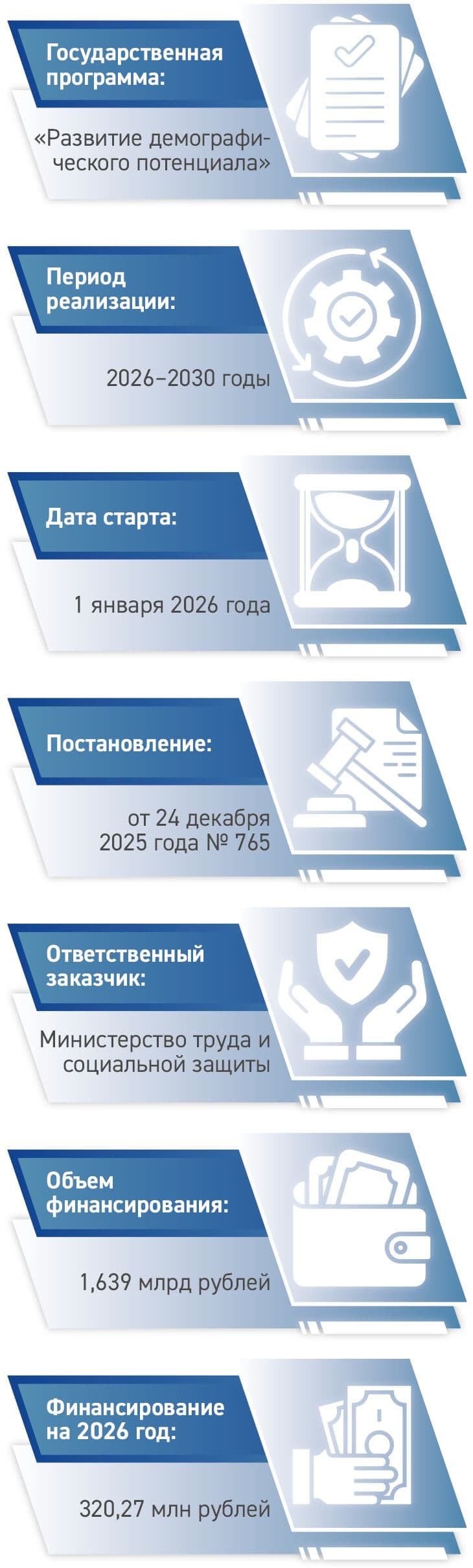
From January 1, 2026, a new State Program “Development of Demographic Potential” for 2026-2030 is in force in Belarus. It became one of two new state programs approved for the next five-year plan, and replaced the demographic block of the previous one – “People’s Health and Demographic Security” for 2021-2025.
This programme focuses on the family, material support for parents, the creation of conditions for combining parenthood and employment, the formation of family values and the preservation of reproductive health. What was planned at the start and what has already appeared in practice? The State Program “Development of Demographic Potential” was approved by the Resolution of the Council of Ministers of December 24, 2025 No. 765 and entered into force on January 1, 2026. The responsible customer is the Ministry of Labor and Social Protection. Among the customers are also the Ministry of Education, the Ministry of Health, the Ministry of Architecture and Construction, the Ministry of Information, the regional executive committees and the Minsk City Executive Committee.
The program is designed until 2030. For its implementation, 1.639 billion rubles are provided. Of these, about 1.4 billion rubles account for the republican budget and about 239.5 million rubles for local budgets. For 2026, 320.27 million rubles are provided, including 279.93 million from the republican and 40.33 million from local budgets.
Thus, the first year of the program is not just a period of preparation. Financially, it accounts for almost a fifth of the five-year total.
As of January 1, 2026, 9 million 56.1 thousand people lived in Belarus. The share of the population younger than the working age was 16.6 percent, the able-bodied - 58.4 percent, older than the able-bodied - 25 percent. The main challenge the developers of the program called the birth rate. The demographic situation in Belarus largely reflects the pan-European trends associated with low fertility rates, population aging and natural decline. In 2025, 54.3 thousand children were born in Belarus (the birth rate is 6.0 per 1000 population), while for a number of years the mortality rate remains within 12.8.
In terms of mortality, a number of European countries are ahead of Belarus. Thus, according to the latest data of Eurostat, in 2025 the mortality rate in Croatia was 12.9, Lithuania - 13.0, Latvia - 14.1, Serbia - 14.5, Bulgaria - 15.5.
The continuing decline in the number of births gives rise to natural loss, which is not compensated by migration growth. However, both increasing natural decline and declining population is a global trend that has swept most developed and developing countries. So, according to the United Nations Population Division, the countries with the largest natural decline are China and Japan, in addition to them, in the top ten are European countries: Germany, Italy, Spain and Poland. The main summary indicator of the state program is the total fertility rate. At the start of the program, its base value was 6.1 births per 1,000 population. For 2026, a benchmark of 6.2 ppm is set, then the indicator should increase annually: to 6.4 in 2027, 6.6 in 2028, 6.8 in 2029 and 7.0 by 2030. In other words, the first test of the program has already been determined by the document itself: by the end of 2026, the coefficient should not be lower than 6.2 ppm. It is important to understand the specifics of the indicator. This is not the number of children born, but the number of births per 1,000 people. Therefore, it is impossible to compare it with the absolute number of newborns directly. Annual data on this criterion, according to the program, should be provided on the basis of statistics of natural movement of the population, which is maintained by Belstat. Therefore, the final answer to the question of whether the indicator reached 6.2, will appear after the end of 2026. The program is built around three projects.
The first is “Promoting the material well-being of the family”. It includes the modernization of the mechanisms of state benefits for families with children, the development of guarantees for workers with children, the improvement of housing and credit policy, the development of family capital, the expansion of pre-school education services for children under two years old, support for young families where one or both spouses receive their first higher or secondary special education, as well as regional measures to support families with children.
The second project is “Time of Family Values!” Here we are not talking about direct payments, but about the formation of the public prestige of family and parenthood, large families and multigenerational families. The information strategy of family policy, the Family of the Year contest, regional initiatives, expansion of pro-family media content, family festivals and marathons, as well as educational and educational projects are provided.
The third project is called "You're going to have a baby!" It is dedicated to preserving reproductive health and helping families who are planning to have children. Among the measures envisaged are the development of family planning counselling centres and women's health centres, new forms of preparation for parenthood, medical and psychological support for women after childbirth, evaluation of reproductive health as part of medical examinations, modern methods of infertility treatment and the development of assisted reproductive technologies. First Months: Support is already working One of the most understandable tools for the family is the family capital. From January 1, 2026, its size is 35,505 rubles. This amount is assigned to the family at the birth or adoption of a third or subsequent child in 2026. In total (since 2020) as of October 1, 2026, 103.8 thousand decisions on early disposal of family capital funds were made. Initially, according to the classical concept of the program, large families can use a large state subsidy only after the majority of the child, in connection with the birth of which an account was opened. The money had to mature in the bank for 18 years. However, from January 1, 2020, the state expanded the horizons of the program and allowed to unfreeze funds ahead of schedule - at any time after the capital assignment, if the family needs to solve the most acute and basic tasks.
The figure proves that family capital in Belarus has ceased to be a deferred bonus for the distant future. It has become a living, working tool that helps parents with many children here and now, when children grow up and expenses are maximum.
Family capital is not a new measure, but its further provision and development is directly included in the activities of the state program for 2026-2030.
Another direction that has already received a very specific expression in 2026 is the expansion of preschool education opportunities for children under two years old. For 2026-2030, it is planned to open such groups with a working mode of 10.5 and 12 hours, taking into account the needs of parents.
During the first half of the year, about 500 groups for children under two years old were opened throughout the country. They are formed according to the needs of parents: when there are statements, a group opens. The development of such a network indicates not only the availability of preschool education, but also the support for the employment of women and families with young children. A separate section of the program is related to reproductive health. The document establishes an indicator: the coverage of medical examinations of the population aged 18-39 years should be at least 90 percent of the number of citizens subject to medical examination in each year of the program.
Another indicator is an increase in the number of IVF cycles performed by the state health organization for medical reasons. The basic value of the program is 1300 cycles. It is planned to conduct 1348 cycles for 2026, then the number should increase to 1398 in 2027, 1450 in 2028, 1504 in 2029 and 1560 in 2030.
Operational statistics of the Ministry of Health on the number of IVF cycles performed for the first months of 2026 are not published in the public domain, since the indicator is calculated strictly by the end of the year. However, experts note that the bar of 1,348 cycles for 2026 will be guaranteed to be achieved thanks to the effective Decree No. 100, which increased the number of free attempts for citizens from one to two.
Another area is the opening of new inter-district family planning counselling centres and women's health centres. At the end of 2026, it is planned to open a city center for women’s health in Minsk. In the Gomel region, a similar center on the basis of the Mozyr central city polyclinic is planned to open in 2027. Demographic policy in the new five-year plan is not limited to economic and medical support. In 2026, the implementation of the information strategy of the state family policy was launched. It provides for the formation of the public prestige of the family, parenthood, large families and multigenerational families, as well as information campaigns and regional initiatives.
Within the framework of the program, the republican contest “Family of the Year” is also planned, the final of which was held on October 10 in Minsk.
Thus, in the first year of the program implementation, not only financial and infrastructure measures, but also information projects envisaged by the document have already appeared. As already mentioned, the main indicator is the birth rate. But the demographic outcome cannot be achieved with one decision or one payment. The programme itself contains a system of measures that simultaneously affect the financial situation of families, housing, preschool education, labour guarantees, family capital, reproductive health and the information environment. Therefore, the first year of implementation is more correct to assess not as an attempt to immediately change the demographic situation, but as a period of launching mechanisms that should work throughout the five-year plan.
Behind each figure in this material is a specific family: those who have already received family capital, who brought the child to a new nursery group, who plan treatment and believe that everything will work out. It was for this reason that the state launched this five-year route. In the next test drive, we will go back to the numbers and see what has changed.
The main target is the total fertility rate of 6.2 per 1,000 people in 2026 and 7.0 by 2030.
Four more programme guidelines:
the share of benefits paid to families in connection with the upbringing of a child under the age of three – 81.2 percent in 2026 and 85 percent by 2030;
meeting the needs of parents in preschool education services for children under two years of age – 76 percent in 2026 and at least 80 percent by 2030;
coverage of medical examination of the population of 18-39 years - at least 90 percent annually;
The number of IVF cycles in public health organizations is 1,348 in 2026 and 1,560 by 2030.
What you can already see in 2026:
family capital is set at 35,505 rubles;
103.8 thousand decisions on early disposal of family capital funds were made as of october 1;
On June 25, a decree on the free provision of a second attempt of IVF came into force;
there are about 500 groups for children under two throughout the country;
The "Family of the Year" contest was held.