The role of psychologists and the development of stress resistance. How Schools Care About Children’s Mental Health
A comprehensive system of moral support for students has been built in Belarusian educational institutions, in which the key role is played by students.
A comprehensive system of moral support for students has been built in Belarusian educational institutions, in which qualified specialists play a key role. This was told to journalists on October 8, the head of the center for social, educational and ideological work of the Academy of National Education Lyudmila Filippovich, reports the correspondent of the agency “Minsk-Novosti”.
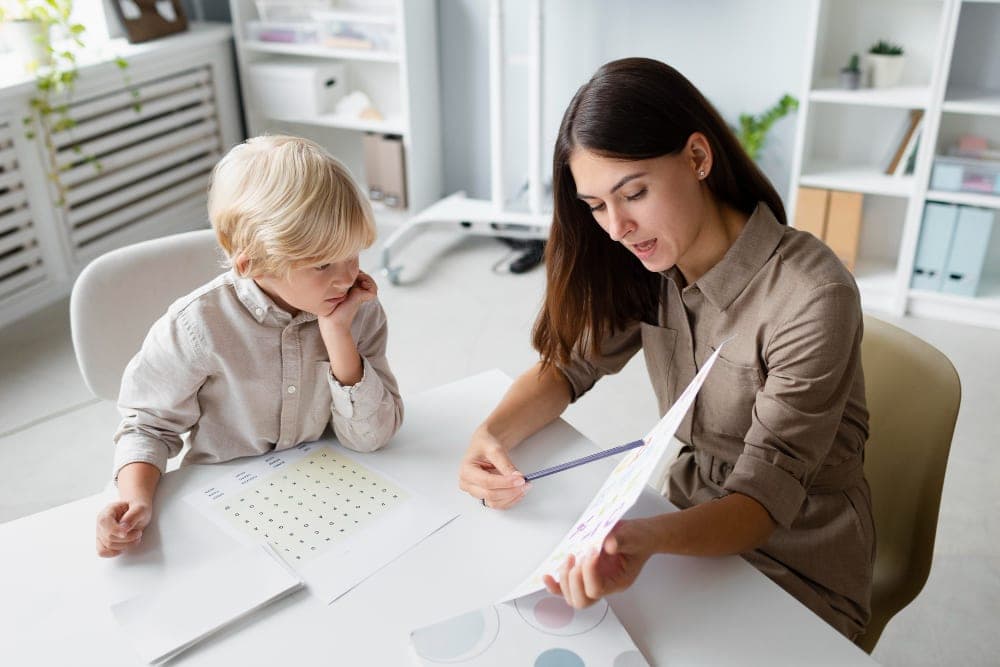
Photo is illustrative, freepik.com
According to L. Filippovich, every educational institution has social teachers and psychologists who, according to their official duties, are primarily engaged in education and prevention. Also, specialists conduct diagnostics, as a result of which they conduct consulting and coordination work.
The expert stressed that education today means working with all participants in the educational process. These are not only students, but also teachers, as well as legal representatives of children. Each of them has a legal right to support and qualified assistance.
L. Filippovich specified that the foundations of stress resistance and self-knowledge are already laid within the framework of the basic school curriculum. For this purpose, the possibilities of several training subjects are used at once. For example, in biology classes, students study neuropsychic processes, and in social science they analyze the concepts of personality and conflict, learn to express their opinion and defend their position. The subject of OBJ (“Fundamentals of Life Safety”) helps to form the skills of safe behavior and self-regulation.
- An important addition to the lessons are optional classes, the programs of which are constantly updated, said L. Filippovich. Parents and children have a wide range of courses. For students of 3rd and 7th grades there are classes “Learning to understand ourselves and others” and “Learning to help ourselves and others”. They are aimed at developing competencies of self-knowledge, emotional regulation and communication. In addition, for the second year, a new elective “My psychological well-being and help to peers in a crisis situation” is being implemented in schools. It is designed for students of 5-7 and 8-11 grades. This is a product of the Maxim Tank Institute of Psychology, with which we work closely.
From September 2026, schools and gymnasiums are implementing a program to prevent suicidal risks in adolescents.
- We educate teachers, parents and children, explained L. Filippovich. We are familiar with the concepts of bullying and conflict, teach how to get out of crisis situations, form a friendly environment, teach the rules of communication and mutual respect. This program is not designed for one year. I hope that it will be constantly replenished with pedagogical experience and implemented on an ongoing basis.
According to the representative of the Academy of National Education, the Parent University project plays an important role in the formation of a healthy environment. At parent meetings, adults are told what aggressive or deviant behavior is, how to recognize suicidal risks in time, and what behavioral markers in children should pay close attention.
- Most importantly, we teach children to understand that they are always ready to help in school, said L. Filippovich. If support is needed outside the educational institution, it is medical institutions, the Republican Scientific and Practical Center for Mental Health, as well as the Republican Center for Psychological Assistance (RSPP). All helplines, which the child can call at any time of the day or night, are freely available in each school and stored in the mobile phones of students.
L. Filippovich added that parents of students are actively involved in preventive work. A large-scale 45-minute online project “Conversation with adults” was organized for them. The first meeting was attended by representatives of the Ministry of Internal Affairs and mobile operators.
“The main topic was ensuring the safety of children in social networks and preventing the appearance of a negative digital footprint,” she said. The first air caused a great response, collecting 25 thousand views and 1.5 thousand likes. The second lesson is scheduled for December 17. It will be devoted to an extremely acute topic – the digital exploitation of minors in social networks. In the future, we plan to hold another large online meeting dedicated to computer games. We will examine in detail the line between the concepts of “addiction” and “hobby”.