Problems of collective management of copyrights discussed in Minsk
On October 9 in Minsk within the framework of the International Scientific and Practical Conference “Intellectual Property in the Modern World: Challenges of Time and Prospects of Human Rights”.
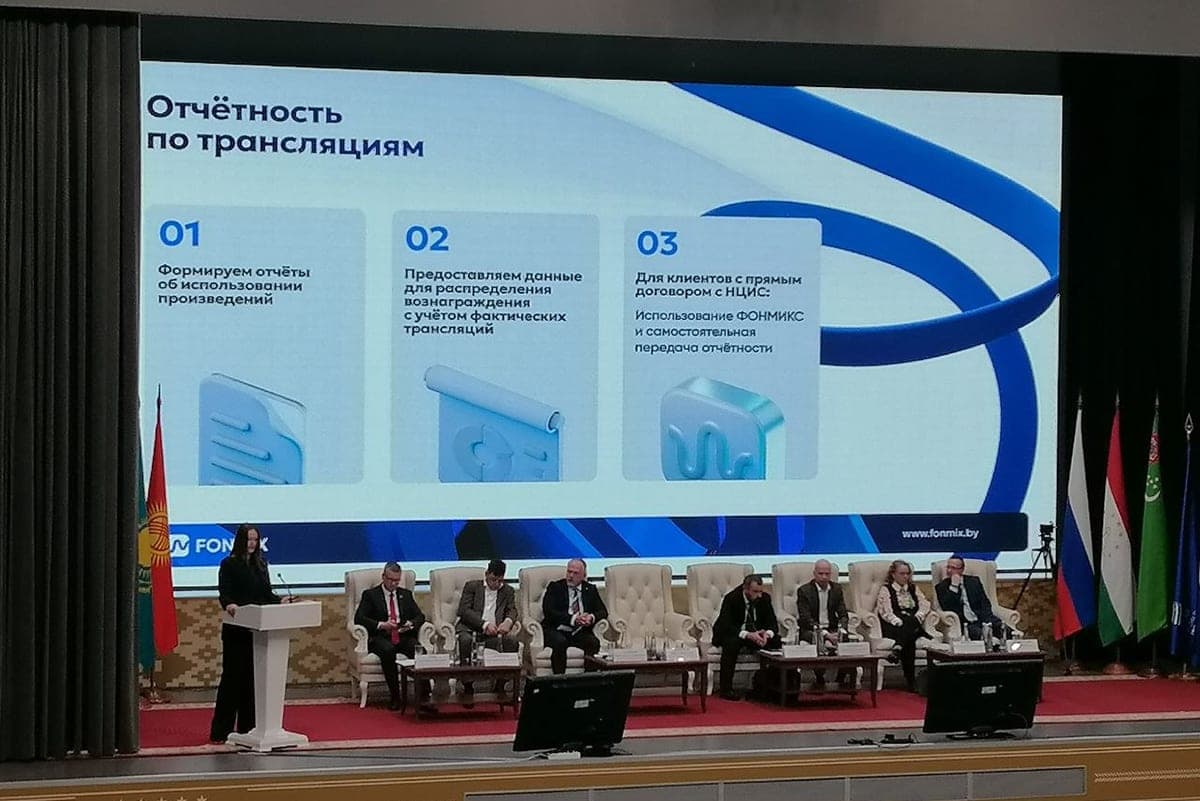
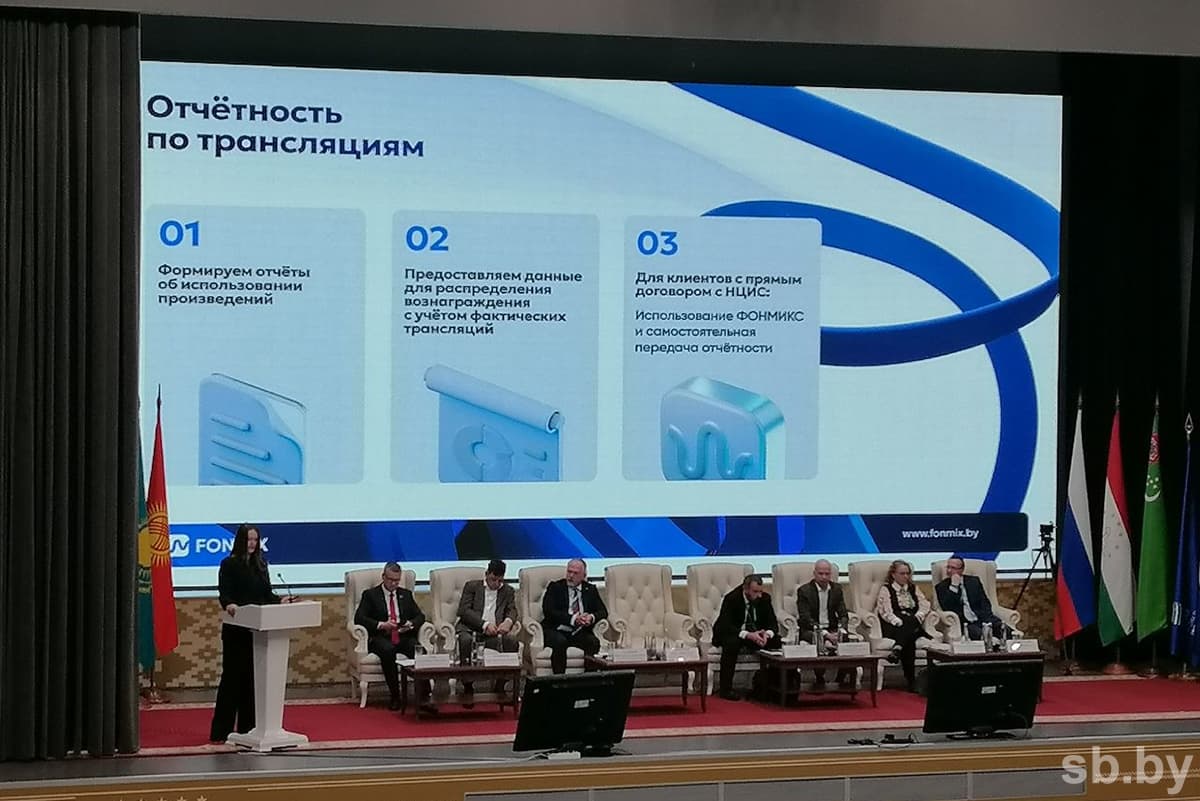
On October 9, within the framework of the International Scientific and Practical Conference “Intellectual Property in the Modern World: Challenges of Time and Prospects for Development”, a thematic section “The interests of authors, right holders and users: finding a balance” was held in Minsk. The participants discussed both future legislative innovations and practical experience of their application by broadcasters and organizations for collective management of property rights.
New Legislative Mechanisms: Compulsory License and Free Use of Music Chief Advisor of the Department for Drafting Bills and Interaction with the Standing Commission on Education, Culture and Science of the House of Representatives of the National Assembly of the Republic of Belarus Pavel Biryukov presented the key provisions of the adopted law on changing laws on legal protection of intellectual property objects.
The last comprehensive correction of legislation in this area was launched two years ago and successfully completed this year.
First of all, the administrative procedures carried out by the patent authority were optimized. According to Biryukov, the implementation of these approaches will significantly reduce the time for obtaining security documents and quickly introduce into civil circulation both industrial property objects and products made with their use.
The next innovation of the law was the possibility of free use of musical works when creating and distributing TV programs and TV films included in the publicly available mandatory package of television programs. The list of such TV programs and TV films will be established by the Ministry of Information. At the same time, payment of remuneration to copyright holders of musical works through the organization for collective management of property rights is provided. The amount of remuneration, the procedure for its collection and payment will be established by the Government.
Biryukov explained the need for this norm by the fact that musical works of domestic and foreign authors are used in the creation of a number of television programs and television films, and the process of television production itself is quite prompt and requires a quick settlement of the issues of the use of works. However, obtaining the consent of rightholders in a short time is not always possible for objective and subjective reasons.
The Law on Copyright and Related Rights is supplemented by a provision providing for the possibility of free use of musical works when covering in the media not only cultural, but also socio-political, sports, sports and mass events having state, political, historical, ideological, international or social significance, dedicated to public holidays, holidays and memorable dates or important events in the life of the state. The list of such activities is established by the Ministry of Information. The mechanism of payment of remuneration to the rightholder is similar – through the system of collective management. The next important innovation is due to the fact that in practice cases of abuse of rights by individual rights holders have been identified. To prevent such situations in the future, the draft law includes a mechanism of compulsory licensing.
Biryukov recalled that this mechanism is not new for Belarus and is used in the field of patent law in case of non-use or insufficient use of inventions, utility models, industrial designs within three years from the date of publication of patent information. Thus, the emergence of a situation that creates a shortage of relevant goods on the market is pre-empted.
Compulsory license gives the opportunity to use the legally promulgated object of copyright or related rights without the consent of the author or other right holder, but with the payment of remuneration.
The law defines the conditions for issuing a compulsory license. Firstly, the author or other right holder has not transferred to the collective management organization of property rights in the territory of the Republic of Belarus the authority to collective management of such object. Secondly, they refused to conclude or did not consent to conclude a license agreement on terms consistent with established practice. Thirdly, the object will be used in the framework of a wide range of events: socio-political, educational, cultural, sports, mass-sports concerts, performances, festivals, competitions, exhibitions, competitions, as well as in the creation and use of film and television works, the implementation of transmission, broadcasting. At the same time, these events and works have important state, political, social, cultural, historical and ideological significance and are financed in whole or in part at the expense of the republican and local budgets.
The decision to grant a compulsory license will be taken by the State Committee on Science and Technology at the request of the republican body of state administration responsible for holding the relevant event. The recipient of such a license will be the interested state organization. The decision on granting a compulsory license will determine specific ways and cases of using the object, the period for which the license is granted, the amount and procedure for payment of remuneration.
The state organization, which has been granted a license, must notify the author or other rightholder of this, not later than 15 days from the date of the decision, and take reasonable and sufficient measures to pay the remuneration. In case of impossibility of payment for reasons beyond the control of such an organization, notify the patent authority and credit the remuneration to its current bank account, where it will be stored on demand by the author or other right holder for three years from the date of enrollment.
- The use of the mechanism of compulsory licensing in the field of copyright and related rights, in our opinion, has a preventive nature and to some extent will ensure the balance of interests of copyright holders and society, concluded Biryukov. Head of the Legal Department of the National State Television and Radio Company of the Republic of Belarus Dmitry Gorbachev told how the broadcaster uses existing legislative mechanisms and what problems they solve.
According to him, broadcasting organizations are obliged to use intellectual property to promote the preservation, development and dissemination of culture, aesthetic education and education of citizens. However, it is not always possible to obtain the consent of authors and copyright holders.
- Effective mechanisms for the use of works without the consent of authors and right holders are needed. And such mechanisms already exist, he said.
One of them is the Law on Limitation of Exclusive Rights to Intellectual Property Objects 2023. It allows the use of computer programs, musical works, broadcasts of broadcasting organizations whose copyright holders have not consented to use and are citizens or organizations of unfriendly countries. This regulation is temporary: it was adopted for two years and twice extended for another two years.
Gorbaychuk gave a specific example that the broadcaster faced. It was a member of the European Broadcasting Union and was temporarily suspended. The company transferred a large amount for the 2022 World Cup as an advance payment, but no signal was provided.
- We have been trying to recover these funds over the years. Going to court on the territory of the Swiss Confederation is problematic, and the result is obvious – we would not win.
However, the Law on the Application of Restrictive Measures allowed to apply to the court in the territory of the Republic of Belarus. In July of this year, the Supreme Court decided to recover the amount from the European Broadcasting Union in favor of the company.
- We have not received the money yet, but measures are being taken, Gorbachev added.
He also described the mechanism provided for by law. The interested organization shall contact the rightholder; if consent is not obtained, it shall contact the Ministry of Information, which shall include the event in the list. This allows the broadcasting organization to use a broadcast, such as a sports broadcast, and the remuneration is transferred through the National Intellectual Property Center.
- It is symbolic – 10 basic values. It is clear that under normal conditions, the copyright holder would have received much more, the speaker said.
In 2024, the TV and radio company used this mechanism twice: for the 2024 Beach Football World Cup (right holder – the International Federation of Football Associations, FIFA) and a friendly match with the participation of the national team of the Republic of Belarus (right holder – the Union of European Football Associations, UEFA).
- I would not like to abuse this mechanism, because someday the sanctions will be lifted, and we will normally work with these rights holders, he explained a small number of cases.
Speaking about the plans, the speaker said that the TV and radio company intends to use the mechanism provided for by paragraph 2 of Article 41 of the new edition of the Law on Copyright and Related Rights - the use of musical works as part of television programs and television films included in the public package. The mechanism is similar to the previous one: a proposal is submitted to the Ministry of Information on the inclusion of a TV show or TV movie in the list, after which the musical works are used, and the remuneration is paid through the National Intellectual Property Center.
- The difference is that the Limitation of Exclusive Rights Act requires consent. In this case, it can be used without consent, without asking, because the use of musical works in entertainment TV programs, somewhere live, occurs, that is, it is necessary to quickly make a decision. Therefore, it is not always possible to negotiate with the author, Gorbachev explained.
In addition, he said, the authors are not always known. Some authors and their heirs prohibit the use of musical works, may prohibit the use of specific artists, may unreasonably overstate the amount of remuneration.
- It is too early to talk about the practice of using the mechanism, its effectiveness, since we have not yet used it, and the changes will come into force in January 2027, the speaker concluded. Currently, regulatory legal acts are being developed aimed at implementing these norms of the law, including those that will determine the amount of remuneration. Konstantin Galimov, Head of the Department of Copyright and Related Rights of the National Intellectual Property Center, dedicated his speech to the practical problems faced by the only collective management organization in Belarus.
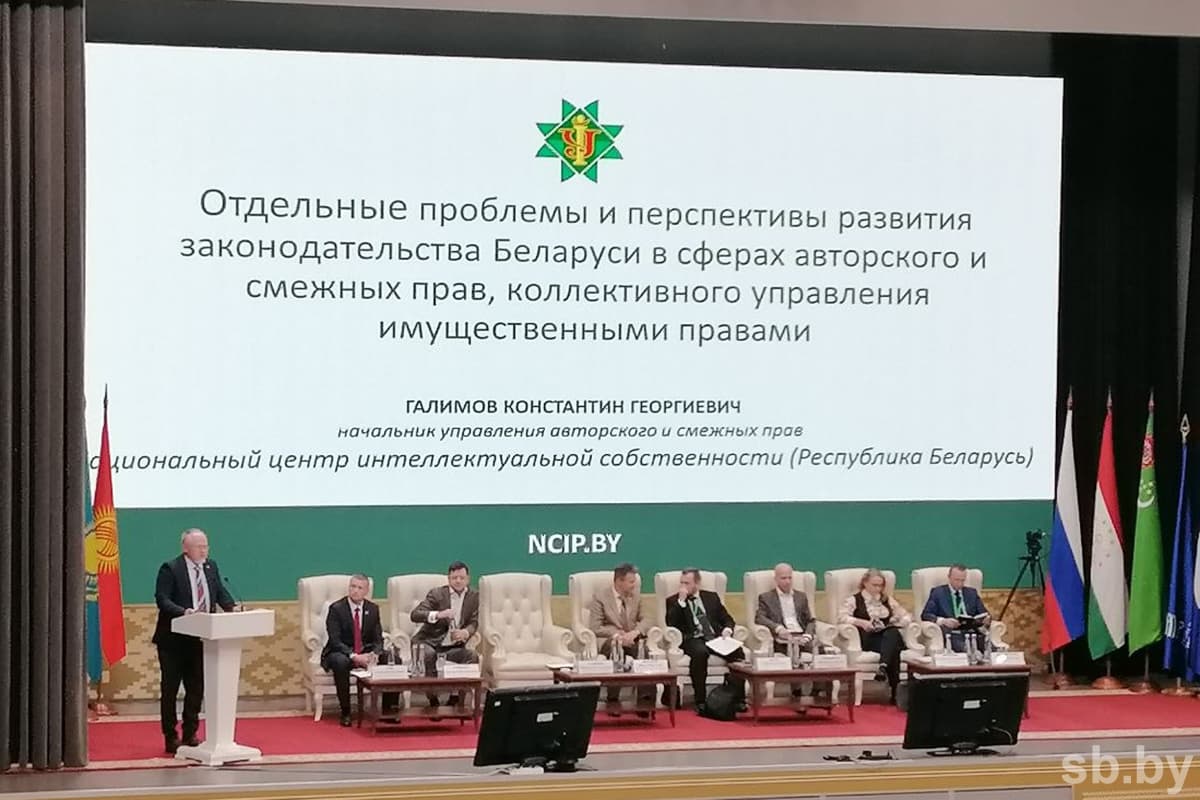
The first problem identified by the speaker is related to the need to identify works for their acceptance into collective management. To understand which work is used by a particular user and who is the author or copyright holder, it is often necessary to obtain a copy of this work, especially for related rights (performances, phonograms). The copyright holder brings a flash drive with its objects, and the organization must copy them to its registry.
However, according to Galimov, the copyright law of the Republic of Belarus directly prohibits collective management organizations from using works transferred to collective management in any way. There is a legal conflict: it is impossible to reproduce – it means that there are difficulties with identification, which generates legal uncertainty, disputes and endless complaints.
- We propose to supplement the copyright law with an exception to the general prohibition, that is, to allow collective management organizations to use objects transferred to it for collective management, in particular for reproduction, so that we can store them for proper identification and removal of possible disputes between authors, right holders, users and the collective management organization, Galimov said.
From this particular problem arises a more general one. According to the requirements of the law, the permission of the right holder is not required and remuneration is not required if the objects of copyright or related rights are reproduced in the case when such reproduction in the aggregate is temporary and is an integral part of the technological process of data transfer.
However, as the speaker noted, now technologies are developing in leaps and bounds, and the indication of a temporary nature becomes doubtful. Large Internet sites — music content aggregators — store records on their servers for a hypothetically unlimited amount of time so that any user at any time from anywhere in the world can access the work.
- Here again we come back to legal uncertainty: what is temporary? Is it a year, is it a month, is it 100 years? According to him, on the one hand, operators have a shaky position, on the other – “particularly greedy rights holders” can claim that records are stored and demand payment of remuneration. On the other hand, the opportunity for ordinary people to listen to their favorite music is lost.
- We believe that indications on the temporary nature of storage should be excluded from the copyright law, the speaker suggested. If we are talking about the technical process of data transmission, then it takes place here, because the record itself, if it is not listened to, if people do not turn it on their smartphones or players, is just a dead load that entails transaction costs for aggregators and does not bring profit. Therefore, we exclude indications of a temporary nature - and the user gets access to his favorite music, the copyright holder and the author receive a percentage for each case of listening, and aggregators receive a deserved share of the reward.
The next problem is the interaction of collective management organizations with authors, right holders and users. Galimov noted the urgent need to exclude from the law the prohibition for collective management organizations to terminate the contract unilaterally with authors and rights holders. Today, such an opportunity is provided only for authors and right holders: they can at any time notify the organization of the termination of the contract in whole or in part (with respect to certain works, scope of use or territory), giving six months’ written notice.
Why does the organization need the same right? Because in practice there are cases of unfair behavior by authors and copyright holders. Galimov referred to the provisions of the Civil Code: Article 9 does not allow abuse of the right in various forms, and Article 291 allows unilateral refusal to perform an obligation, unless otherwise follows from legislation or contract. Thus, the Civil Code as a normative act of higher legal force allows for the consolidation in the legislation of the possibility of unilateral termination of the contract.
As valid grounds for unilateral termination are offered: abuse by the author or other rightholder of their rights (for example, when the use of works is necessary for a state-significant event, and the rightholder prohibits the use only because he does not like the performer); the creation of obstacles to the activities of the organization, including the failure to provide reliable or false information necessary for the distribution and payment of remuneration; a significant violation of the contract, resulting in the impossibility of its further execution (for example, when the rightholder under an assignment contract transferred the rights to the work to the performer, and then transferred the same work to collective management).
A similar situation exists with users. According to the rules of the copyright agreement, users of works transferred to collective management are obliged to conclude an appropriate agreement with the organization. An organization cannot refuse to conclude a contract, since its main mission is to collect remuneration for the benefit of authors and right holders, distribute it and pay it. However, in practice, the user enters into a contract, agrees to the terms, but does not fulfill them: pays late or does not pay a fee at all, or does not provide the documents necessary for the correct and accurate distribution of remuneration.
- This situation can last for years. Formally, we seem to have no reason to hold him accountable, but in fact it is very difficult to exercise these powers, especially when authors and copyright holders call and say: Where is my money? There was a concert, there was an event, and we were not paid for it, Galimov complained.
The organization proposes to supplement the copyright law with rules that it has the right to unilaterally terminate the contract with the user if he systematically does not pay remuneration or systematically does not provide information about the actual use of works. An important nuance is that in the future, a contract with such an unscrupulous user can be concluded only after full repayment of the previous debt.
- All these changes, I must emphasize, in no way contradict the international obligations assumed by the Republic of Belarus, including the Agreement on the Procedure for the Management of Copyright and Related Rights on a Collective Basis of December 11, 2017, Galimov said.
In general, such changes will ensure legal certainty and transparency of interaction of collective management organizations with both authors and other right holders and users, enhance stability and efficiency of activities, and protect interests from possible abuses by unfair counterparties. Copyright in the field of AI and protection against counterfeiting on marketplaces discussed at a conference in Minsk