The year of shocks: REW participants about the new reality in the global fuel market
The authorities and business summed up the results of the “year of shocks” in the energy sector and told what is needed for the sustainability of energy markets. RBC gathered the main opinions of participants of the Russian Energy Week
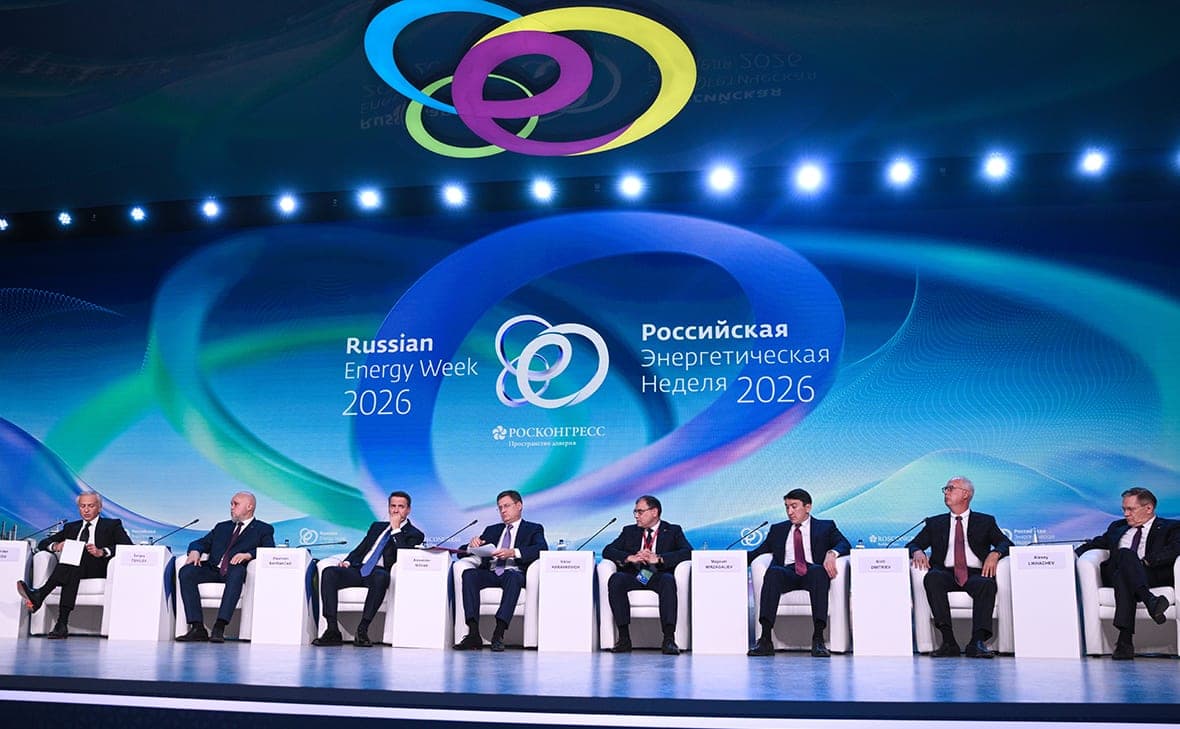
Geopolitical conflicts, attacks on energy infrastructure, disruptions in logistics, sanctions and technological restrictions are forcing the industry to reconsider the very concept of sustainability, said participants of the plenary session of the Russian Energy Week 2026. Now energy companies prioritize spare capacity, protection of facilities, ensuring the reliability of export routes, and access to technologies becomes a matter of industry survival.
Opening the plenary session “Sustainability as a Response to Geopolitical Shocks”, Deputy Prime Minister Alexander Novak said that the global energy market has faced several successive shocks over the past 15 years – from underinvestment in traditional energy amid decarbonization policies to the COVID-19 pandemic, geopolitical conflicts and the rise of protectionism. The latest such challenge, he called the situation in the Middle East and disruptions in navigation through the Strait of Hormuz, one of the key arteries of the world market, through which up to 20% of world oil and more than 30% of liquefied natural gas were transported until March 2026.
Novak said the situation showed how vulnerable global supply chains are. The Strait of Hormuz showed that at the moment <...> about 10 million barrels per day can leave the market and significantly affect the change in both transport flows and costs in the economies of countries that are not only exporters, but also consumers. Therefore, the main factor is reliability, it is the availability of physical access throughout the chain: from production and delivery, processing and delivery to the final consumer, the deputy prime minister said.
Security and technological independence
Alexander Dyukov, Chairman of the Board of Gazprom Neft
The current crisis in the global oil market is different from the previous ones: if before the industry had to cope primarily with falling demand and overproduction, now the main challenges are physical blows to infrastructure, disruptions in logistics and the decline in the reliability of traditional supply routes.
In previous crises, financial efficiency was the key to sustainability. “It was necessary to avoid high levels of debt, to be as financially efficient as possible. The lower the cost of your production, production and processing, the easier you went through the crisis. Excess capacity, on the contrary, was considered by companies as factors that reduced economic and financial efficiency, said the Chairman of the Board of Gazprom Neft.
Now oil workers need to create an additional margin of safety, even if it requires additional costs. This will require spare capacity in production and processing, additional storage and tankers, as well as pipelines with protection from physical attacks and cyber threats, said Dyukov.
Russian companies faced similar risks before many foreign counterparts. The reorientation of supplies to new markets allowed Russian oil companies to maintain the scale of activity without losses.
Another condition for sustainability Dyukov called technological independence. In the past, the company’s own development and production of equipment may have seemed like an “unacceptably expensive luxury” compared to purchases abroad, but the sanctions showed that access to technology can be lost at any time. Sanctions against Russia have become an additional incentive for the development of domestic solutions. In particular, the country created its own fleet for hydraulic fracturing, established the production of rotary-controlled systems, and the share of Russian software in the industry grew from about 14% in 2014 to 90%.
Dyukov also addressed the concept of “antifragility” by Nassim Taleb, author of Antifragility. How to profit from chaos.” Own technologies allow companies not only to withstand external shocks, but also to become stronger under their influence. Every new technological challenge and sanctions restriction can strengthen the industry. He stressed that while the development of sustainability requires additional costs, without it the industry has no future.
Cooperation and sanctions
Alexander Novak, Deputy Prime Minister of Russia
The world is in a state of energy crisis, a separate problem is observed with the shortage of diesel fuel. Russia traditionally accounted for about 10% of global trade in this type of fuel, and now the market is facing a shortage, which Novak estimated at about 25% of world trade. According to him, the price of diesel in terms of per barrel reached about $ 200 with the cost of oil at $ 100-120. According to Novak, coordinated deliveries of Russian diesel should help increase supply in the world market: in November and December, Russia plans to increase exports and by the end of the year to return to the previous level of about 3.5 million tons per month.
At the same time, the shortage of diesel and rising prices are increasing the costs not only of the oil industry, but also of related sectors – from petrochemicals and fertilizer production to agriculture. Novak also noted that since 2022, Russia has supplied energy resources to Europe for $ 320 billion, and for the nine months of 2026 - for another $ 21.3 billion. He called the decision of European countries to abandon Russian energy resources political and not in the interests of consumers.
Kirill Dmitriev, Special Presidential Envoy for Investment and Economic Cooperation with Foreign Countries, Head of RDIF
Dmitriev said that the US Treasury asked the Russian Direct Investment Fund (RDIF) to facilitate payments under the deal on the supply of Russian diesel. According to him, the American administration is increasingly aware that sanctions are harmful to the United States. Dmitriev called the diesel deal an important project for the world market.
The US Treasury has asked the Russian Direct Investment Fund to help in the diesel deal, including in terms of making payments, in terms of solving purely such tactical issues on this deal. RDIF will be involved at the request of the US Treasury, Dmitriev said.
According to him, Moscow and Washington are discussing other joint projects in the field of energy, the Arctic and the construction of data centers, including using nuclear power plants. RDIF has a list of such initiatives and expects to announce new projects soon. Dmitriev also said that the sanctions could hinder their implementation, as they create difficulties with payments, insurance and freight.
Separately, he criticized the bill of U.S. Senator Lindsey Graham, which, according to him, can actually prohibit economic and investment cooperation between Russia and America. I hope that the US side will take into account the possible negative consequences of the document for bilateral projects and global energy markets.
“I want to joke that the next deal will be for the supply of Russian kvass, but this is a serious forum,” Dmitriev said.
Reserve capacity
Andrey Ryumin, head of Rosseti
Against the background of growing demand for electricity, including from data centers and electric transport, the electric power industry needs to develop at a faster pace. According to Ryumin, the construction of power grid infrastructure requires a lot of time, so the industry needs early investments in networks and substations.
“The data center can be built in two years, and the creation of the network infrastructure takes much longer,” Ryumin said. According to him, if the power grid is developed following demand, it can lead to problems with the reliability of electricity supply.
One of the promising directions Ryumin called energy storage systems. According to him, last year in the world introduced more than 100 GW of storage capacity, and their growth for the year was about 40%. Such systems can become an important element of energy systems not only in energy-deficit regions, but also in large cities, including Moscow and St. Petersburg.
On predictability and diversification
Alexey Likhachev, head of Rosatom
One of the main results of recent months, Likhachev called the confirmation of the correctness of the course chosen by Russia for the development of nuclear energy. According to him, against the background of instability of world energy markets and rising prices, nuclear technologies allow to ensure predictable supply and reduce fuel costs.
“We are discussing the possibility of reducing contract prices by 20% due to the new MOX fuel technology,” Likhachev said at the plenary session of the Russian Energy Week. According to him, he is discussing this possibility with the Minister of Energy and Natural Resources of Turkey Alparslan Bayraktar. Rosatom expects to reduce fuel costs throughout the life cycle of the nuclear power plant.
Likhachev also noted that in recent months there have been more supporters of nuclear energy, and the rejection of it in Europe is now considered a strategic mistake. Russia is ready to continue cooperation with European and American companies.
Magzum Mirzagaliyev, Advisor to the President of Kazakhstan
Supply security is one of the key conditions for the sustainability of the global hydrocarbon market, which dictates the need to diversify routes. In this regard, Kazakhstan is working to reduce dependence on the Caspian Pipeline Consortium (CPC), through which 65 million tons of Kazakh oil (about 80% of the country’s total production) were transported by the end of 2025. Kazakhstan is developing an alternative direction Baku-Tbilisi-Ceyhan. Now the country supplies 1.6 million tons of oil per year and plans to increase the volume to 2.2 million tons.
At the same time, Kazakhstan remains a reliable partner of Russia, Mirzagaliev noted. Every year, about 10 million tons of Russian oil is transported to China through Kazakhstan, the parties discuss an increase in this volume by 25%.
Alparslan Bayraktar, Minister of Energy and Natural Resources of Turkey
Bayraktar, in turn, stressed the need to diversify supply routes and make better use of existing infrastructure. According to him, Turkey is dependent on imports of a significant part of the consumed energy resources, so it is developing pipelines and looking for opportunities to increase the transit of oil and gas.
The minister recalled that the Turkish Stream is not working at full capacity, and also pointed to the possibility of increasing oil supplies from Iraq, Azerbaijan and Kazakhstan through Turkish territory. Amid disruptions in shipping through the Strait of Hormuz, Ankara is ready to offer neighboring countries additional routes for exporting energy resources to world markets.
“We are ready to offer our neighboring markets to export additional volumes through Turkish territory,” Bayraktar said.