Dostoevsky in the old way
Professor Esaulov explained why both in the Russian Empire and in the USSR, the works of the classic were published incorrectly
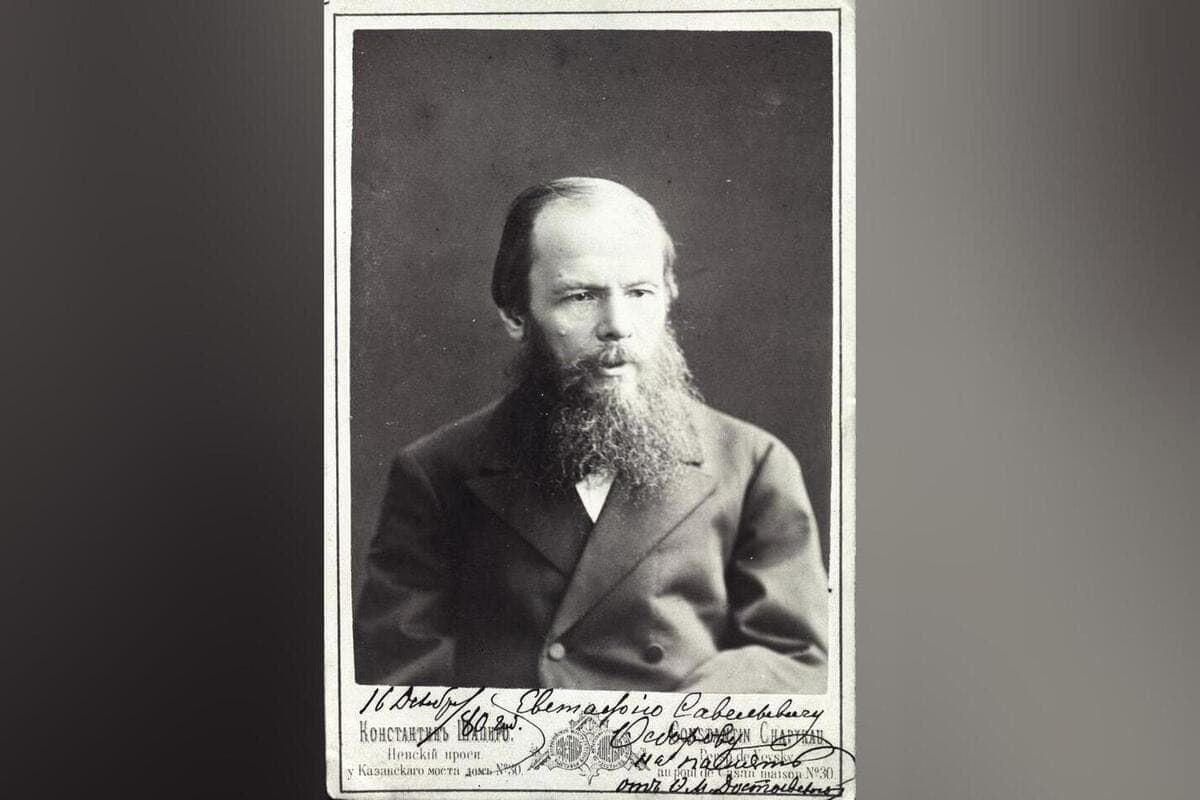
November 11 marks the 205th anniversary of the birth of Fyodor Dostoevsky, a classic of Russian literature, who taught humanity the basics of the universal responsiveness of the Russian people. And yet, in evangelical language, he was unjustly slandered by generations of critics and outspoken haters, in whose interpretation the writer became a “chauvinist” and an “anti-Semite.” Meanwhile, understood to the end, correctly interpreted and published according to the will of the author, Fyodor Mikhailovich was neither “under the tsar”, nor in the times of the USSR. About this and much more, the correspondent of MK talked with a frequent guest on our pages, Doctor of Philology, Professor of the Gorky Literary Institute and MGIMO Ivan Esaulov.
Ivan Andreevich, I know that one of your key books, in which you search for and find the Christian foundations of Russian literature, was published in the mid-1990s in Petrozavodsk - and this city became the foremost center for the study of Dostoevsky's heritage. They publish, for example, a collection of works of the classic in the old graphics, although I do not fully understand the meaning of such a “reprint”.
After all, in this case it is not about the city, but about the person. This person was (and is) a wonderful enthusiast of domestic heritage Vladimir Nikolaevich Zakharov. Professor Zakharov is the first of the Russian scientists (and to date the only one) who was elected president of the International Society of Dostoevsky, which is extremely authoritative among Russianists. He created a real scientific school at Petrozavodsk University, which is engaged in restoring the true spelling and punctuation of Fyodor Mikhailovich. And no, this is not a reprint, not a mechanical reproduction of pre-revolutionary publications, because they do not fully reflect the will of Dostoevsky, who insisted on his freedom from gymnasium “rules”, and the punctuation of his works was intonation and intuitive, not grammatical. As for the Soviet practice of publishing Russian classical literature (including the “academic” complete collection of Dostoevsky’s works), it significantly distorted the author’s will, arbitrarily changed the register of lowercase and uppercase letters.
In general, as Academician D.S. Likhachev noted in his famous report “On Some Advantages of the Old Orthography”, the new orthography encroaches on the most Orthodox in the alphabet, destroys the spiritual connection between Byzantium and Russia, Russia. It is clear that this distorts the understanding of the true meanings of the works of Russian classics. I will give two examples – for better clarity already from the twentieth century. It was very important to Alexander Blok that his "revolutionary" poem "Twelve" - after the decree on the introduction of a new spelling - was published in the orthography of the old. Eventually, he begged Lunacharsky to make an exception for him. But Bunin, despite tearful letters to the editors of the New York “A. P. Chekhov Publishing House” with a request to publish – also as an exception! – his “Life of Arsenyev” in the traditional Russian spelling (the new Bunin simply could not stand!), was refused. And we still read the top work of Bunin in the spelling that the writer himself directly hated. Returning to our anniversary, as a result, in essence, we are dealing with the “translated” Dostoevsky. In the Petrozavodsk edition of Dostoevsky’s “canonical texts” (at present eleven volumes have already been published), from a textual point of view, an attempt is made to return the writer to his own linguistic element.
How many books have you written about Dostoevsky? On the cover of the latter there is a “strange” definition of “contrary Dostoevsky”? Who, when and why escorted the great writer?
- There are three books in total. One is the anthology “Soviet and Post-Soviet Dostoevsky” in the famous St. Petersburg series Pro et contra. Another is the book (co-authored with Boris Nikolaevich Tarasov and Yulia Nikolaevna Sytina) “Analysis, interpretation and understanding in the study of Dostoevsky’s heritage”. The last one is the one you mentioned. In it I try to show that for many decades Dostoevsky seemed to be escorted – let’s make a reference to the title of one of the great novels – a legion of “demons” who deliberately distorted and obscured the meaning of his works. This kind of escort began during the life of the writer, when he was declared a “reactionary”, an opponent of progress, a hater of the “young generation”, etc. In the era of the Silver Age, his legacy seemed to be raised on the shield by our “religious philosophy”, but at the same time Rozanov, Berdyaev, and Karsavin read Dostoevsky very subjectively, in essence, imposing their own views and ideas on him. I tried, so to speak, to free Dostoevsky from such a “convoy”, considering his work in a long time of Russian Christian culture, tried to prove that it is necessary to take seriously the cherished beliefs of Dostoevsky: “the ideal of the people is Christ” (I emphasize, not the “idea” of Christ, but his Personality itself); “the environment” and “circumstances” never determine the essence of man; in the world of Dostoevsky, everyone (even the most inveterate sinnerable), can rise up, be transformed into a new life – and for this spiritual effort you need a special conciliar unity, but no one can sleep.
Dostoevsky, in my opinion, does not “prove” the truth of Orthodoxy, but shows it in his works. An adequate understanding of Dostoevsky is possible only when his basic values are in tune with the values of the researcher: otherwise, a conflict situation is inevitable.
In a recent interview about Turgenev and a number of other classics, we systematically refuted the established myths about them. And to what extent is Fyodor Mikhailovich mythologized?
- Perhaps there are no more myths about anyone in Russian literature than Dostoevsky collected them - from reproaches of "cruel" (or "evil") talent to his designation as a "reactionary", "xenophobic", "chauvinist". In fact, apart from outright slander, of course, these myths arise from the elementary confusion of the phrases of Dostoevsky’s heroes and the position of the author himself. The special weight in his artistic world of the voices of heroes provokes interpreters to attribute their judgment to the author. Even the “Stavrogin sin” (composed of the crimes of the hero of the novel “Demons” Stavrogin, who seduced a young girl who eventually took her own life, – I.V.) individual Zoils are also attributed to Dostoevsky himself.
Dostoevsky, like every Russian, is, of course, broad. However, he reproduces in his work the Russian picture of the world. He admires Pushkin’s universal responsiveness and all-humanity, believing at the same time that this feature is inherent in the Russian people (“to become a real Russian is to become the brother of all people”), insisting that this is our lot: where is “xenophobia” or “chauvinism” here?
Is it possible to explain the phenomenon of Dostoevsky’s extreme popularity in the West? If he seems to be the most Orthodox of our writers, why is he forgiven for his merciless criticism of Catholicism in the Legend of the Grand Inquisitor, for his rejection of “capitalist relations” and Western secularization – the displacement of the Church from all spheres of life? Maybe it's all about translations - how good are they? Did the translators turn Crime and Punishment into a detective novel?
I have some reason to believe that in the West Dostoevsky is read, unfortunately for us, more than in his homeland. It is difficult to say whether he is “the most Orthodox” (and what about Gogol?), but perhaps he, like no one, has penetrated deeply into the “mystery of man.” Thus, Dostoevsky had a huge (perhaps decisive) impact on the entire world literature of the XX-XXI centuries, not only in the West, but also in the East (for example, along with Leo Tolstoy, largely determined the path of development of modern Japanese literature). It is not a question of criticizing “capitalist relations” (many of them in the same West were criticized before and after Dostoevsky, and some were much harsher), not even in highly qualified translations. Part of the point, it seems to me, is that Dostoevsky shows in his novels heroes, each of whom (of course, in his own way) has his own truth. It even has the Grand Inquisitor, Ivan Karamazov has it, Versilov has it (and not only Alyosha, Prince Myshkin or Elder Zosima). In fact, by this “polyphony” of convincing “voices” (remembering our M. M. Bakhtin), Dostoevsky shows the “mystery of man” inexhaustible by any idea, by any ideology. The atheistically oriented Western “existentialists” (such as Sartre or Camus, and after them others) most appreciated Dostoevsky’s “truth” of his “rebels”, consonant with their ideological attitudes. I think that they were not quite right in recognizing the “vertical” (the equality of the “truths” of Dostoevsky’s heroes or their “voices”), but not in recognizing the author’s “horizontal” (the hierarchy of these voices), but I will not overcomplicate and moralize on this issue. Dostoevsky introduces the reader to see in the inexhaustibility of the human personality something "his own" and thereby help to find his place in the world. This obviously determines its popularity.
I can’t help but ask you my favorite question: if there were an opportunity in the world to save two books from complete destruction: the Bible and one of Dostoevsky’s novels, which would you say to keep?
- Of course, the Karamazov Brothers. Along with "War and Peace" Tolstoy's two best novels in the whole XIX century, and in general world literature. For a Russian person, especially, because there opens the real Russia, "there is a Russian spirit, there Rus smells.".
Let’s touch on the topic of Dostoevsky’s school study and the timeliness of the works recommended for children. According to the official lists of the Ministry of Education, the novel “Poor People” and “White Nights” are read by eighth graders, the novel “Crime and Punishment” is read by tenth graders, and the selected chapters from “Teenage” and even the above-mentioned monograph of the great philologist Bakhtin are eleventh graders. Do you agree with the existing canon? Is it possible to try to introduce to children a little younger - as a "bait" for future meaningful reading - other works, the story "Christ's Boy on the Christmas tree", for example.
I am not at all against the existing “canon” or the recommendation of Bakhtin’s book. One has only to bear in mind that Bakhtin himself later admitted that in it he had “taken the form away from the main thing” and could not speak about the main questions – religious, philosophical, the existence of God – about those questions about which Dostoevsky thought all his life. In other words, Bakhtin could not – in Soviet times – say the main thing. This must be borne in mind by the modern teacher of literature.
As for specific works, I would add at least selected chapters from The Idiot, Demons, and especially The Brothers Karamazov. Do not be afraid that students will not understand such complex texts. In general, it does not matter what will be on the list, it is important how it is presented. If you ignore the main thing in Dostoevsky, replace it with some own ideas, alien to Fyodor Mikhailovich, then nothing good will come out of such teaching. I insist that Dostoevsky is not “behind” us, but “ahead” of us, we still reach for him and reach for him. It would be good for teachers and students to understand this.
- How did Dostoevsky become a writer "gracious" by the Soviet power? Okay, "Demons" published four hundred thousand copies in 1990 - of course, the end of perestroika. But here we have the 10th volume of the thirty-volume publishing house “Science” in 1974 – and it contains this very anti-Soviet novel. Paradox! So was there a persecution of the Demons?
- Archival Dostoevsky (in the words of V. I. Lenin) was not only the only one of the writers of the first series of Russian literature - was excluded from the Soviet school programs for a decade and a half, it is the only publication of articles and books about the life and work of which were banned in the short period of Stalin's "patriotism" (1949-1954). Apart from the Collection of Works in Soviet times, neither the Diary of a Writer nor the Demons were ever widely published. With all the sometimes drastically changing twists of the party line, one can still talk about a certain constant – and it did not change in relation to Dostoevsky – Orthodoxy, autocracy and nationality remained axiologically unacceptable until the end of the Soviet decades. If we talk about the dynamics of changes in attitude to Dostoevsky in the USSR, it is similar to the attitude to the Russian classical heritage: the complete rejection in the first 10-15 years of Soviet power, then its adaptation to “pressing tasks”, that is, the reduction of its own meanings (when, for example, Pushkin was declared “the builder of communism” on the eve of 1937), and in the 1960-80s of the last century, they already pushed on the universal “humanism” of Russian literature – and Dostoevsky too (but not on its Christian content).
In connection with The Writer's Diary, I would like to understand whether a real writer can be a journalist - or are these two lines not overlapping? Are the “Diaries...” and the big things of Fyodor Mikhailovich the same artistic value?
The “Diary of a Writer” is not really a diary. It addresses the current problems of Russian society and society itself. During Dostoevsky’s life, The Writer’s Diary caused much more resonance than novels.
Dostoevsky was a brilliant journalist, that is a fact. And with the novels “Diary...” one thing unites: the classic could see in the momentary, historically transient – the eternal, outgrowing “small time” of his own life and the vicissitudes of a particular moment. This volume of vision paradoxically brings Dostoevsky closer to the Russian chroniclers, who in historical events distinguished the reflection of the Holy history. And those who rush to declare that “Dostoevsky’s prophecies have not been justified” would do well to remember that historical time has not yet ended. Perhaps the fulfillment of these prophecies is yet to come