Marble girls in space winds
Since the beginning of the season, Konstantin Bogomolov on Bronnaya one after another releases premieres
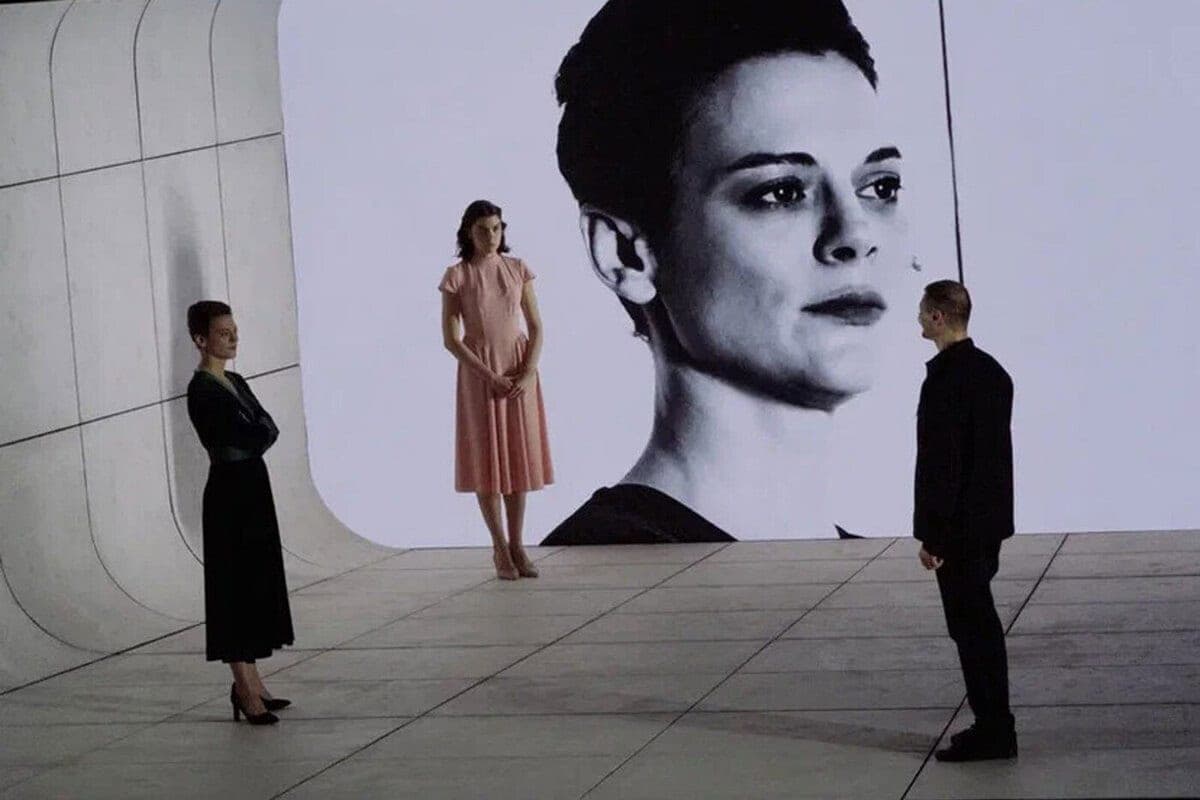
"Marble Girl" is played in three acts: two right in front of the stage, for which part of the rows is removed, and she herself is raised at a certain angle to the floor. The scene with its depth is still covered with white fabric – it works with a screen. Mantis begins his "Marble Girl" in ... the future, more precisely, in 2090.
It seems that this artist today could easily compete with famous science fiction writers who paint in their fantasy the past and future of mankind. The course of Bogomolov’s thoughts is difficult to predict even if one is familiar with his previous experiences. In this case, on the basis of Euripides, he makes a cool mix of scientific information (it is clear from the text that he tracks) discoveries and current trends or events occurring in the world. And, of course, all this accompanied by humor, absurdity and philosophy.
This is how the 2090th appears on Bronnaya, which is unlikely to be the one who watches “Space Wind or Marble Girl” today. It is interesting to see what the descendants will receive. Here, mother does not grieve and will not seem much: the world will finally be divided, if you believe Constantine, into Divine and Deep. The first are women, and they dictate how to live for humanity, which, in fact, is already observed. And Deep men, who are under the heel of the Divine, continue to study the world deeply, getting stuck in scientific and pseudoscientific disputes. The scientific nature of what is happening emphasizes the presence of the lecturer (Alexander Shumsky).
Dominating, of course, the divine. In the “Cosmic Wind” there are four of them and there is nothing divine in them: neither the appearance nor the costumes from God – business pants, a simple dress, and shabby shorts, but their clothes indicate the difference of characters and place in the divine hierarchy of each. Even if they are what they are, they are a force in the world. And together with the Deep Hepats, they try in vain to bring the wind into space. Space - on the screen with a myriad of light points, diagrams, a cool video and cartoon drawings.
However, it is not certain that experts of the work of Euripides, who lived before our era and his tragedy about Iphigenia, the daughter of Agamemnon, who is not so often addressed by modern theaters, as, say, to “Medea”, gathered in the hall. And its plot in the first act, which we conditionally call “scientific”, is not visible. Unless a hint is given in the first scene: two men, in appearance quite earthly, from simple, watch a stereoscopic series on TV, whose heroes from ancient times go beyond the screen and act out a heartbreaking scene right at the feet of a simple spectator. The one in the tunic, the one with the knife, the girls are astonished. The stereoscopic bloody overture will be further developed and not without their participation.
And Eurepidus in Iphigenia: the Greek army led by King Agamemnon is going from Aulides to sail to Troy, in order to, damn it, return Menelaus kidnapped by Paris Helena. But the ships do not sail because the angry goddess Artemis turned off the wind. And in order for him to refill the sails of the warships, Agamemnon must offer a sacrifice - his daughter Iphigenia. The tsar is torn by an internal conflict: both the daughter does not want to lose, and as the ruler to be ashamed. But his daughter Iphigenia is wiser: voluntarily sacrifices for the sake of the parent, the common cause and the glory of the country. That's how traditional values work.
In the plot of Evrepid in the original interpretation of Bogomolov, the reverse course of events - from the future to ancient times - does not lose a rigid rhythm and tension, keeps to the end the intrigue in his stereoscopic cargocult film-performance about sacrifice. Playing actors in the cosmic future is simple and natural, as if they represented the present or the not-distant past. Like, say, Rustam Akhmadeev, who acted as Agamemnon (in 2090 he was Aga), and just played in the pre-war "Event" hapless hero-lover from the late 30s. As from there Denis Gromakov and Vasilisa Pereligina, now acting in the roles of specialists from the future. “This is Matov’s paradox,” the psychologist (Pereligina) broadcasts in an iron voice. - You know about him? Everything in the world is predetermined because no one knows what will happen next. If we don’t know what will happen, there will be uncertainty. That is, if you know ...”.
And so constantly - Bogomolov plays scientific and pseudo-scientific, plays in the surnames - Adov, Gadov, Leprozorov, Shildgrubers ... Easily and jokingly deceives, but, very importantly, does not flirt. And with its Cosmic Wind, produced not by high-tech, but by manual, theatrical means, it will approach the ancient and eternal Eurepides. To the theme of a choice that no one in his life will ever escape, and which ultimately the personality makes a person. Or antipersonality. Or not at all. Who is he today's hero? What do you look like?
In addition to these topics, the director does not leave the favorite object of his research - the theater and its mystical connection with life. “Everything that happens in this world has already been written by someone. And that the wind stopped blowing, and the oracle predicted what it had predicted. It's all part of a play. And also the connection of the theater with its main subject - the actors. And it will sound like a manifesto - an actor without a director, like a man without God. Read - a challenge Bogomolov today's theater, at the head of which, the further, the more often become artists, with a few exceptions bringing the theater artistic success. This is the second act, which we will call “theatrical”.
In the third and final act (let’s call it “antique”), the white fabric will first be replaced by a sheet of paper of the same size, sewn from rectangular sheets. And when they burst and, exactly under the long-awaited wind, fly down, the scene will be completely exposed and will look like a slightly curved diagonally tunnel. It contains static figures of the main characters. Four monologues that sound like a detailed analysis of what happened.
The analysis is not made with an ultra-precise device, but only with a word. As you know, it was in the beginning. It is no longer an irony to use the divine word. It is enhanced by a large BC plan, where the perspective of the characters matters. Pushingly, on the break - about today, Klytemnestra (Darya Zhovner), Menelaus (Eugene Perevalov), Agamemnon (Rustam Akhmadeev) and Ifigenia (Vera Arsich) talk about themselves. Although they could be called anything, their history belongs to eternity. Iphigenia in the monologue pauses from five to ten seconds - probably, this is how a person within himself decides - to go to his death or, or, or..