Smolensk literary critic told about the recipe for immortality from Count Tolstoy
Smolensk Drama Theatre named after A.S. Griboyedov on the eve of the premiere of the play “Anna Karenina” became a platform for deep philological understanding of the great novel. A meeting with Doctor of Philology, Professor, Head of the Department of Literature and Journalism of Smolensk State University Irina Romanova turned from a standard pre-premier lecture into an exciting investigation of the secrets of the text, which everyone knows who did not even open the book.
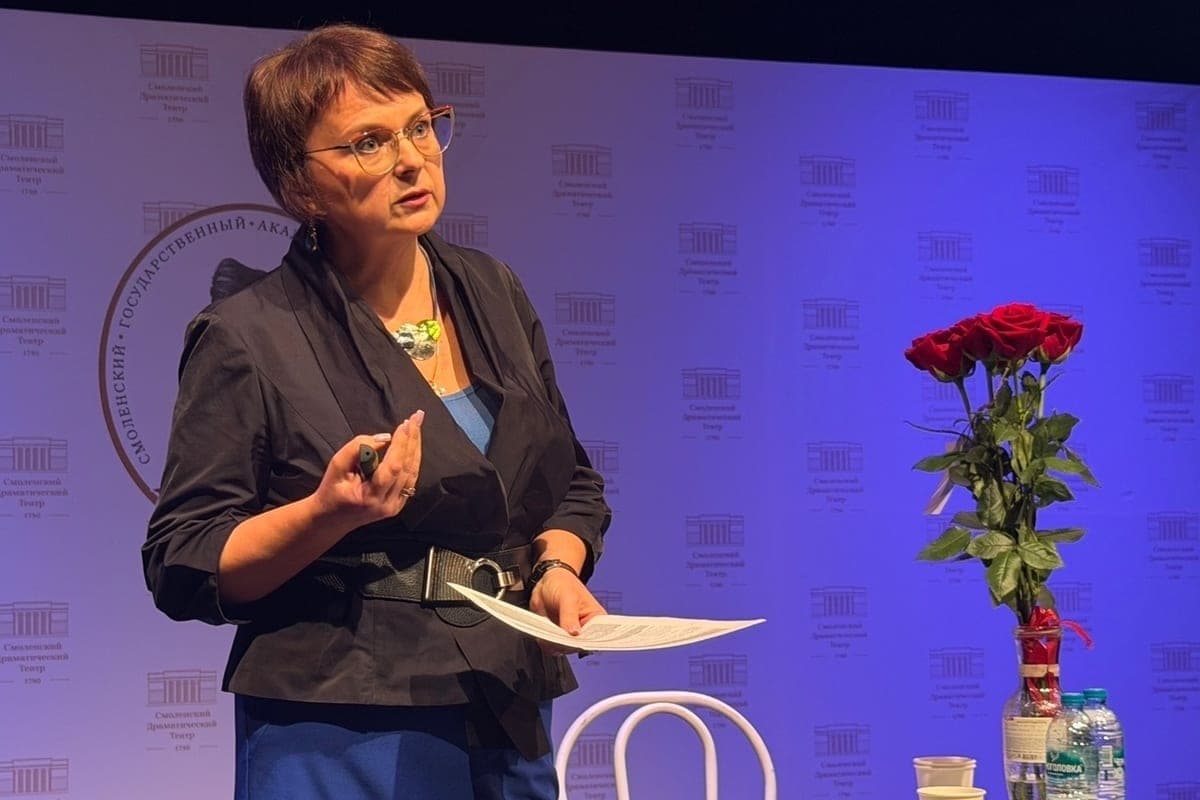
Smolensk Drama Theatre named after A.S. Griboyedov on the eve of the premiere of the play “Anna Karenina” became a platform for deep philological understanding of the great novel. A meeting with Doctor of Philology, Professor, Head of the Department of Literature and Journalism of Smolensk State University Irina Romanova turned from a standard pre-premier lecture into an exciting investigation of the secrets of the text, which everyone knows who did not even open the book.
Pushkin Light and the Poet's Daughter
The lecture of Irina Romanova began with the debunking of the myth that Tolstoy is a heavyweight writer and devoid of aphorism.
- We all know Tolstoy's style, so cumbersome, with long sentences. Tolstoy’s longest sentence is 189 words. What aphorism here, this is not Griboyedov, the professor began with a smile.
However, it was the search for Pushkin’s ease that became the starting point for the creation of Anna Karenina.
- Once Tolstoy took a book of prose of Pushkin, accidentally left in a prominent place by his son Seryozhya, opened it, and there were unfinished passages after Belkin’s stories. He began to read and was absolutely delighted. How could Pushkin so brilliantly start the work with this phrase: "Guests came to the country house." The fact that Pushkin managed to capture the reader’s attention from the very beginning and immediately plunge him into the conflict, incredibly inspired Lev Nikolaevich, and he sat down to write Anna Karenina.
Lesson learned. The first sentence of the novel – “All happy families are alike, each unhappy family is unhappy in its own way” – became an absolute formula.
The second “Pushkin trail” was the appearance of the heroine. Irina Viktorovna shared the story of the high society reception, at which Tolstoy was amazed by the beauty of a lady with refined features.
- He was told that this was Pushkin’s daughter, he asked them to introduce him, and talked to her indecently for a long time. Eyewitnesses recall that Sophia Andreevna, if she were there, would have had reason to be jealous of him. And here are her traits. completeness of the figure, while a small pen, a small leg, an incredibly easy walk and unruly curly hair ... This is what his Anna should look like so that no one can take their eyes off her, the philologist said.
The philosophy of rails
The central metaphor of the lecture, echoing the name of the meeting, was the train. Irina Romanova immersed listeners in the historical context of the 1870s, when Russia was swept by a wave of suicides.
- It was just some kind of natural disaster, all the newspapers wrote about it, and all the newspapers mercilessly placed images of the bodies of these unfortunates in their reports and news notes.
And Anna's literary death could not have been banal.
- If Tolstoy had drowned or poisoned Anna, this novel would not have had such success. And this way of leaving life had a life prototype. Tolstoy had a neighbor in Yasnaya Polyana, landowner Bibikov. A desperate woman in love with him (named Anna Pirogova), threw herself under the wheels of a freight train near Yasnaya Polyana. And Tolstoy saw it happen. Well, more precisely, he had already seen the body and was completely shocked by what was happening, the lecturer said.
But the main thing is the artistic function.
- The train itself is an incredibly winning artistic move. It's a meaningful detail... This is an image of fate that follows the rails and cannot turn away from the path that was intended. Of course, this is an image of passion that sweeps away everything in its path. And this connection of the train and passion was generally entrenched in Tolstoy. The train near Tolstoy becomes such a portal from life to death, says Irina Romanova.
The professor conducted the audience on the stage versions of this finale, showing how the directors fought over this scene: from a real steam locomotive in the Skomorokh theater of the late XIX century, which stopped and destroyed all the drama, to the choreographic decision in the Vakhtangov theater, where the extras rhythmically banged the legs of chairs, burying Anna under their wooden roar.
- We all know how the Smolensk show will end. What are we interested in? How will they put this final scene? – summed up the expectations of the audience Irina Viktorovna.
Mysticism of Iron and a Man with a Beard
The lecturer paid special attention to the end-to-end mystical image of the novel - a man with an open beard.
- It is not clear, he passes from reality to sleep and from sleep to reality. Does he even exist or not? Why is the man in Anna's dreams? Why does he speak French? Well, most likely, society speaks French, and this is, so to speak, an echo of her condemnation. And the fact that it is constantly associated with iron, with the sounds of iron, is a harbinger of that fatal train, the philologist explained.
This surreal character, gnawing iron in Anna’s dream and muttering in French “We must forge iron, crush it, grind it,” becomes the materialized horror of the heroine’s subconscious, her personal Charon, meeting her on the platform.
The art of the stream of consciousness
Irina Romanova made a bold statement bringing world modernism back to Russian soil:
- And, of course, this art of internal monologues is absolutely inimitable, Tolstoy’s. Anne's famous suicide monologue, which, in fact, anticipated the modernist reception of the stream of consciousness. Joyce is said to have invented it, nothing like it, Tolstoy invented it!
The professor described how Anna’s logical reasoning about herself, Vronsky and Dolly suddenly burst into “random street impressions and her reflection on these street impressions, some inexplicable associations,” conveying the severity of her condition with frightening physiology.
Two family models
Reflecting on the epigraph “Vengeance is mine, and I will repay,” the lecturer shifted the focus from passion to family.
- In Anna Karenina I love the idea of family. Tolstoy contrasts two perceptions of the family. The first criterion of its perception is happiness. And Orthodox people understand the family through the sacrament of marriage and through the idea of the family as a small church, Romanova said.
She pointed to the main trap of passion:
- Pleasure becomes the criterion of good and evil. But what is pleasure? It's hungry for satiety. But it is absolutely impossible to saturate it. Therefore, the absolutization of this pleasure principle leads a person to a crime – to overstep the higher law.
To prove who the novel really is about, Irina resorted to simple arithmetic, making the hall feel like a math class for a second:
- In Anna Karenina, 103 chapters are devoted to Anna and Vronsky. And 117 chapters, Levine and Kitty. 18 chapters at the intersection of these two lines. Please tell me who this novel is about. Yeah, it's called Anna Karenina. Well, you're an astute reader, too!
It was in Levin’s line, according to the professor, that Tolstoy encrypted his own spiritual diary.
Tolstoy was fundamentally important to build the architecture of his novel not on one plot line, but on two, to oppose them and give the reader two models of love. For Levin, family is the original idea. It's the idea of all ideas.
The professor elaborated on Levin’s spiritual crisis at the height of his earthly happiness, when he hides his shoelaces from himself for fear of hanging himself. The answer to the question "Why live?" comes to him not from philosophical books, but from a man on a haymaking plant: "... for God.".
Karenin's Christian feat
One of the strongest parts of the lecture was the revision of the figure of Alexei Alexandrovich Karenin.
- Karenin's not a bad man. Anything bad we know about him, we can talk about him. All the most evil things about him says only Anna, retorted Romanova established opinion.
Karenin is an orphan, a self-made man who holds a high state post, for whom honor and law are not empty words. His reaction to treason - a stone face - is interpreted by the professor not as indifference, but as the deepest despair of a statesman who has no right to hysteria.
The culmination of the lecture was the analysis of the scene of forgiveness.
Karenin does not want to go to the birthing Anna. He despises Anna. He despises Vronsky... But nevertheless, he's going... And in the depths of his feelings there is something in him that he may not have suspected himself. He doesn't forgive her by the letter of the law. Forgives her for love. With a pure heart, Irina said with excitement in her voice.
The highest point of Karenin’s fall and at the same time his greatness is his consent to divorce, where he is ready to slander himself, taking the blame for adultery, in order to save at least the remains of his wife’s reputation.
- He agrees to a divorce. By agreeing to slander himself... He is ready to be this criminal party. Who would believe that Karenina was caught in bed by another woman? No one will believe it. But here comes Steve. And he says there are bribes for that, we'll bribe witnesses, we'll bribe judges. Do you know what will happen to Karenin after this divorce? His career is over. He's completely trampled, he loses his wife, he loses his child, he can't get married anymore. He's losing everything. And he goes for it...
And Anna's reaction to this absolute nobility is a new wave of hatred. She and Vronsky are going abroad. Drops the baby. Leaving her husband.
Personal relationship
In the Q&A block, Irina Romanova shared her personal evolution of attitudes towards heroin:
- When I read this novel in my youth, I sympathized with her. When I became a married man... I'm not close to her. Let's just say... There was a time when you had to stop and you could stop! I had to find a priest and deal with it. She didn’t want to do that, in principle.
The professor noted the terrible truth about Anna's love for her son:
- She loves Sergey very sensually. But she is ready to sacrifice it, and she sacrifices it for Vronsky. And the absolutely unacceptable moment for me is that she does not feel anything for the girl who was born of Vronsky. And this girl does not unite them, but vice versa.
Instead of an epilogue
The lecture concluded almost with a parable that Irina Romanova cited from Tolstoy’s Confessions, describing his own existential horror:
Tolstoy dreamed that he was lying on the bed. And suddenly I was horrified to find that he was not lying on the bed. And at all, that he hangs in space and hangs only on two aids. The help that holds his legs is gradually slipping. He's looking down... and sees the abyss... He has an inhuman fear... And at that moment, he looks up. Sees the abyss, too. And the other abyss is full of light, warmth and peace. And the fear goes away... And he understands that outwardly nothing has changed in his position. But he feels so resilient. Such a support that can no longer worry about anything.
It was this support – faith, forgiveness and family as a small church – that Constantine Levin sought and found. And it was she who, turning away from her angel husband, was rejected by Anna, choosing a passion that, like a train, has only one final destination.
The premiere screenings of the play “Anna Karenina” at the Smolensk Drama Theater named after Griboyedov will be held this Thursday. As Irina Romanova noted, now the Smolensk people will have to see what stage language the theater will find for translating this great, terrible and immortal text. And on December 3, the next meeting will be held in the theater - "Karenina Syndrome", where a specialist from Salekhard will talk about the heroine's self-destruction from the point of view of clinical psychology.