
Artificial intelligence and robots: what gives the digitalization of the agro-industrial complex
Digitalization is one of the main factors affecting the growth of the efficiency of the agro-industrial complex. With the help of AI, robots and precision farming technologies, farmers reduce costs, increase yields and pay back investments faster
If a few years ago digital technologies in the industry were used point-by-point, in an experimental manner, today they are used by many farmers and have already noted a positive economic effect. “Digital transformation is now central to agropolitics. Companies need to start with pilot projects with high returns and high return on investment (ROI), invest in analytics, employee competencies, AI and predictive analytics, says Svetlana Arkhipkina, Director of the Digital Transformation Practice at Strategy Partners. Further development of infrastructure and human resources can bring the Russian agro-industrial complex among the leaders in efficiency.
The development of the latest technologies in the agro-industrial complex - in the field of biotechnology, breeding, genetics and agricultural machinery - is one of the tasks of the national project "Food Security". Last year, the level of technological independence of the Russian agro-industrial complex reached 57.8%. It is planned that by 2030 this figure will increase to 66.7%.
How Technology is Changing Livestock
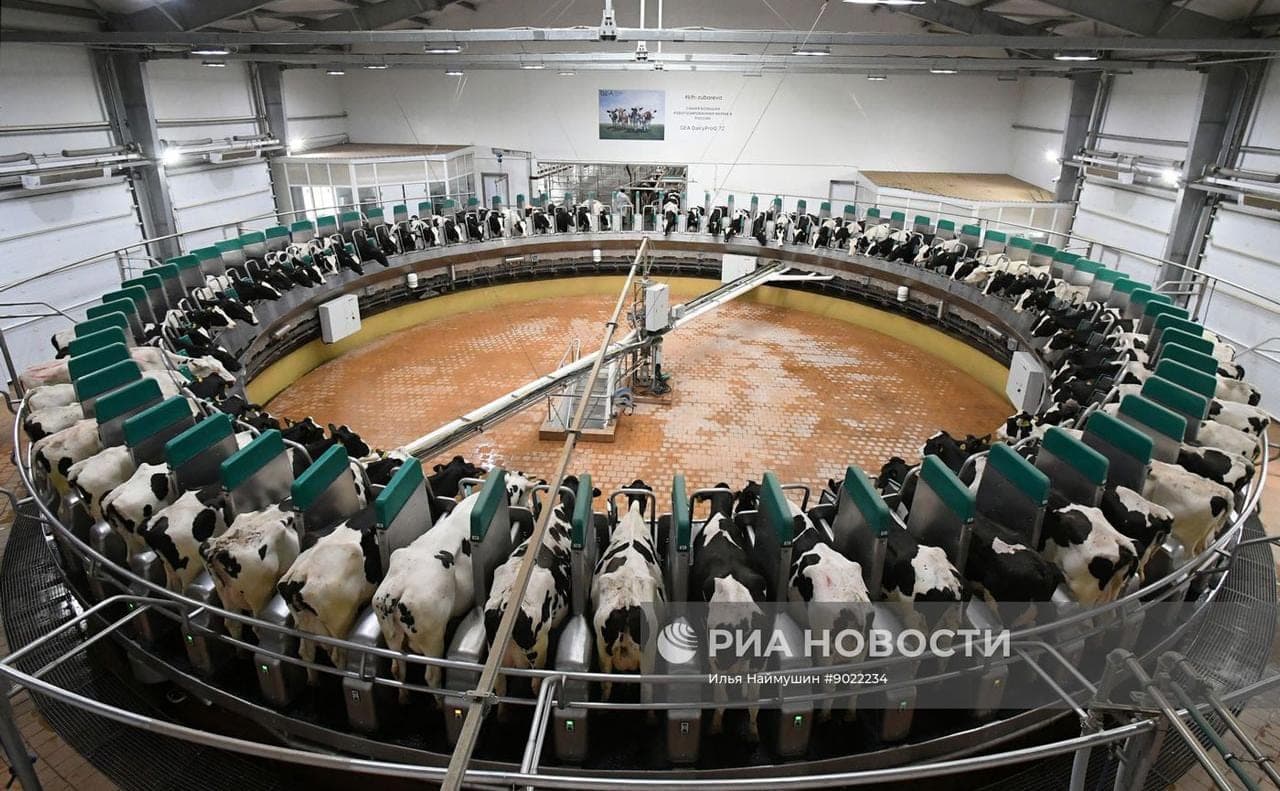
"Republican Information and Computing Center" (RIVC) from Kazan specializes in the development, implementation and maintenance of digital solutions for agriculture. One of the company’s products is an AI video analytics system for machine milking. “Cameras record the actions of the machine milking operator, and algorithms track how accurately the sequence of operations is followed. The system determines at what stages the operator makes mistakes, which allows not only to fix the violation, but also to correct the actions of the personnel, explains Niyaz Khaliullin, CEO of RIVC. When milking takes place in compliance with the technology, cows increase milk yield, improve the quality of milk, reduce the incidence of animal disease. Therefore, the introduction of our system allows to increase milk yield, increase the grade of milk and reduce veterinary costs.” According to the developer, after the introduction of smart video surveillance, the productivity of farms grows by 30% or more, milk yields by about 10%, and the incidence of cows decreases by a third.
“Depending on the scale and specifics of the economy, the implementation of the solution takes from six months to a year, and the payback period is six months, but the exact timing depends on the initial indicators of the enterprise,” says Niyaz Khaliullin.
How AI is used in agriculture
Agronout is an integrator of precision farming services that helps manage agricultural enterprises using digital technologies, geodata and an adaptive landscape approach to working with natural and productive resources. “The fields of even one farm may differ in soil cover, land position, hydrological regime and risk of erosion. Thus, the two neighboring territories often differ in yield potential, which dictates the need for an individual approach to crop rotation and soil treatment technologies, said Alexey Trubnikov, CEO and co-founder of Agronout.
The company’s True Fields complex uses artificial intelligence to determine the fertility potential of fields and identify areas of sustainable fertility. The system analyzes satellite imagery, soil survey data, agrochemical and meteorological data and marks the fields according to their fertility potential. “The payback period of our complex is not more than one season, in a number of projects – several months,” says Alexey Trubnikov.
Today, using the solution, the company analyzes 1 million hectares of land in more than 70 farms in 35 regions of Russia and Kazakhstan. “Among our clients are the largest agricultural holdings Rusagro, Steppe (RZ Agro), Agrofirm Pegasus, Rubin, the leader of the dairy industry Red Lighthouse, Irmen and Oktyabrsky breeding plants,” said Alexey Trubnikov.
Now the company's specialists are working to improve the accuracy of the yield forecast. “We are moving away from the role of an IT service provider and become a partner that gives recommendations on the nutrition of each specific field, soil treatment and placement of crops,” says the entrepreneur. The company is also developing AI modules that help optimize soil reclamation, plan crop rotation and create a feed base for livestock breeding.
According to Alexei Trubnikov, the demand for digital solutions is growing significantly in a large segment: if the share of fertilizers in the cost structure reaches 20-30%, then inaccurate application entails a loss of margin.
How startups automate agribusiness
The development of new technologies is impossible without startups – business projects based on innovative developments.
On the basis of the design bureau of Cherepovets State University (ChSU) created a robot for feeding livestock on farms. The machine regularly pushes the feed mass to the animals. The author of the project – a graduate of CSU Dmitry Kazakov – in June 2026 took the third place in the All-Russian competition “Startup as a diploma”.
“The robot moves along the stern table, orienting itself with the help of a technical vision system and special visual markers,” explains Dmitry Kazakov. One of the advantages of such a scheme is that there is no need to install many magnetic guides, stretch wires and mount other infrastructure elements.
The design provides a system of dosage feeding - liquid, bulk and granular. According to the developer’s calculations, one robot replaces four workers, helps reduce food loss and increase milk yields. The estimated payback period of the device is six to seven months.
A laboratory-polygon prototype is currently being tested. In the near future, the transition to pilot operation on farms is planned. “It is important for us to test the robot in the conditions for which it was created: with food, animals, pollution, humidity and daily operation,” says Dmitry Kazakov. In parallel, we are finalizing the feeding system, automatic charging and remote monitoring of the robot’s condition.
According to the author of the project, the strategic task for today is to move to serial production and scale sales of the robot outside the Vologda region: The level of readiness of farms for automation is heterogeneous. A number of farms are already using digital and robotic solutions, while others are either unable to purchase expensive equipment or need infrastructure restructuring.”.
Experts and entrepreneurs agree that the development of local production, the availability of equipment and high-quality service will accelerate the digitalization of domestic agriculture, the wider use of innovative technologies and, in particular, robots. This transformation is facilitated by the implementation of the national project “Food security”.
