
The temple that welcomes all or is famous for the Church of Basil the Great in Chelyabinsk
The appearance of this temple marked the beginning of a new era in Chelyabinsk, in which churches ceased to be destroyed, and began to build.
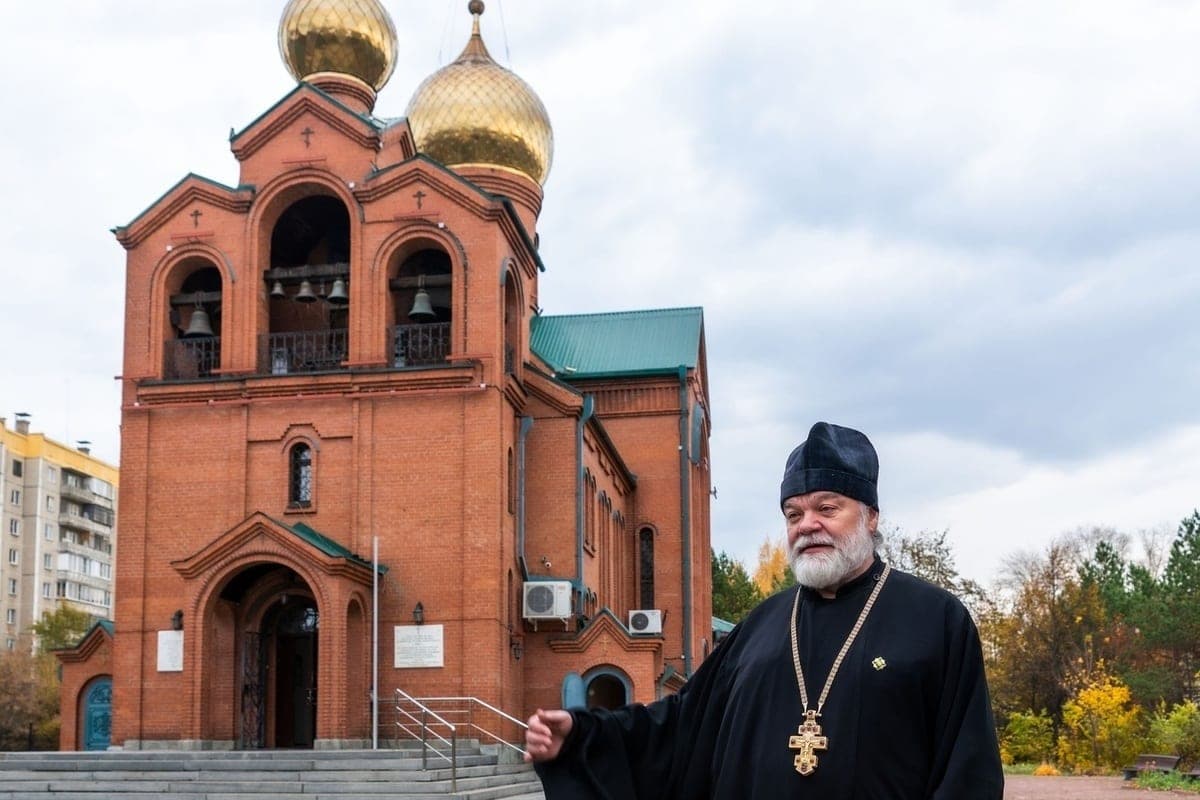
Father Sergius, the rector of the church of St. Basil the Great, meets us in a small room on the second floor of the building, standing a little away from the church. On the wall of the icon, the roots of old books peek out from the shelf, on the locker there is a large squat clock in a wooden frame, beating time clearly for decades. It's kind of homey and cozy. Going down a slightly creaky wooden staircase, we go out into a small square, as if with green palms hugging the temple from the back.
- Father Sergius, how old is the temple? He was in the nineties, I asked him.
Thirty years ago it was in June, since the pit was lit. And on December 1, it will be thirty years since they began to serve, Father Sergius speaks softly, but the autumn wind, which flies with spurts, does not succeed in drowning out his voice.
I remember those times well. In the evenings, the squares and courtyards of the city were plunged into darkness, the first floors of the houses were frightenedly doomed, the streets were drowning in mud and anger. And against the background of hopelessness and hopelessness in this corner of Traktorozavodsky district, an Orthodox church was suddenly built. I can be wrong, but I think it was the first Chelyabinsk temple of modern times. It seemed amazing at the time. To the fact that the old churches gradually begin to restore, by the mid-90s already began to get used to, but the temples, built from scratch, forced to shake up, because they like no other said — came a completely different era.
In Chelyabinsk, this new era suddenly began to sprout, perhaps, in the most Bolshevik district of the city. Nearby, the ChTZ plant is a giant born of communist construction. Around the architecture of constructivism with its reckless faith in the bright future of the Soviet dormitory and the buildings of the Stalinist Empire, crying about the inviolability and strength of the socialist empire. And it is here, brick by brick, that a new Orthodox church begins to rise.
- You know, I’m not Chelyabinsk — rural, from the region, admits Father Sergius. — And when I studied at the Pedagogical Institute, the building of our faculty was located on Bazhov Street. And in the mid-eighties, Traktorozavodsky district seemed to me somewhat uncomfortable. And when I became the abbot, I thought I should meet him again. Walked, looked, visited the museum, learned about history. And slowly began to perceive everything in a completely different way. And now I constantly catch myself thinking - I'm glad that this is where I live, I'm happy about it. Yes, and the district itself, the city changes every year for the good. I love, for example, to visit the Victory Garden, to stand at the monuments to soldiers there. I love our temple garden. It's open, people come here all the time, moms with wheelchairs sit.
This small green world at the ever-humming Lenin Avenue also appeared thanks to the temple. It was the parishioners with the rector who planted once very small pines and lindens taken from the nursery. Today, their crowns reach almost to the cross. Nearby, a monument to Russian soldiers was erected – a small stele with the image of George the Victorious, piercing a snake, and the words on it are simple, but so important: “We honor your bright memory with warm love.” A small dome rises above the stele, like a helmet of a Russian hero.
Behind the heavy doors of the church is quiet. In the corner sits a grandmother who, seeing Father Sergius, asks for his blessing. The temple inside is small, and there are many icons - old with salaries in the patina and completely new, sparkling.
- If I am not mistaken, do you have one of the oldest icons in Chelyabinsk?
Yeah. Icon of St. Basil the Great. She's older than Chelyabinsk. It is believed that it was created by the masters of the Armory. Now the icon hangs in the altar part, but once a year it is exhibited in the temple so that everyone can touch it and pray.
It looks very solemn. Saint Basil the Great is depicted on the icon (presumably it was created in the second half of the XVII century) in full growth. And on a holiday decorated with fir branches, meeting people in the temple, the image blesses everyone who came, gives hope. Being a learned theologian during his lifetime, at a time when Christians were persecuted by the Roman emperors, Basil the Great helped to convey his prayer to God to those who could not come to the temple - he was in the catacombs, worked in mines and mines. And today he is praying that he will help in business, give strength to continue to work.
The temple of Basil the Great is also amazing because in its lower limit there is a large number of icons with female images. It is possible that you will not find this in any other Orthodox Church in the world. These female icons, with a red belt framing the walls, were specially painted for this place. Here, in the lower temple, there is another rarity - a special font that allows you to baptize adults with full immersion. This parish is also famous for the fact that the Georgian diaspora goes here to take care of it, as they serve in their native language, serve in it and in sign language, in which deaf-mute people speak.
This temple in the last decade of the last century grew in this corner of the city. Small but welcoming. It fit so harmoniously into the Traktorozavodsky district, which was raised 90 years ago as a social city, that it is impossible to imagine without the Church of Basil the Great today. Like she was always here.


