
Marketing: what is this new trend among young people and why buzzers are going to the markets again
Remember how the market of the 90s lived its own life? Sobbed in full voice Tanya Bulanova, a little further sold videotapes with Van Damme and Schwarzenegger, followed by chewing gum Love is
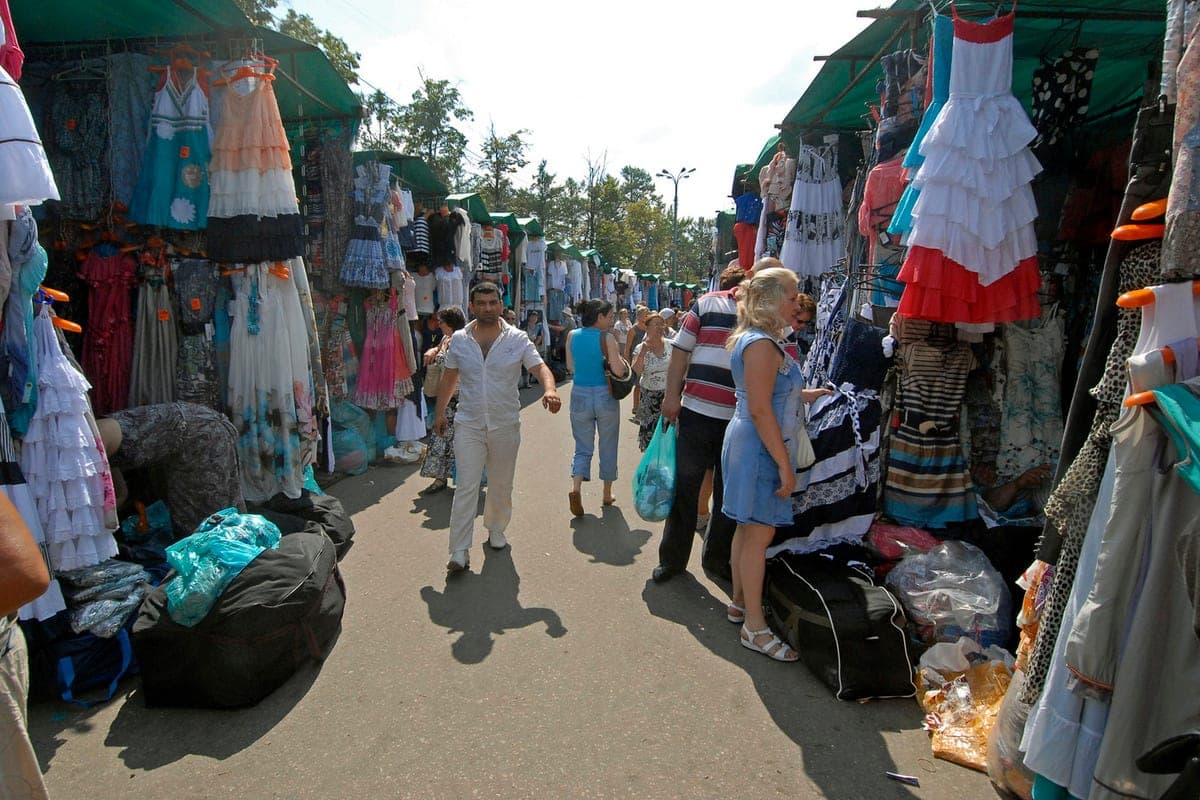
And we stood up with clean feet on dirty cardboards to measure the very “real Turkey”. Or Poland. Or China.
And of course:
- Take the last couple, girl! How sewn on you!
Then we went from the markets to the shopping centers, as if from communal apartments to separate apartments. It was warm, light, clean, there were real fitting rooms, and the sellers did not grab the sleeve. Then there were marketplaces, and it turned out that for the sake of new sneakers, it is not necessary to leave the apartments.
It seemed that the era of clothing bazaars had finally sunk into the past. Suddenly, our children went back...
A generation that grew up delivering in one hour suddenly discovered wholesale and retail markets. The new hobby has already come up with a name – “marketing”.
What was a necessity and sometimes a humiliation for parents turned into an adventure for their children.
But why? What do they lack in a world where you can buy almost anything without getting off the couch?
“I didn’t even know you could talk to a salesman for life.”
- And I really want to talk to the seller, says 20-year-old student Christina. I didn’t even know that it was so easy to talk to someone in the store. And not just ask what shelf the right product on, but for life. I mostly go to grocery farmers' markets. They know my preferences, my name, a delicious homemade cottage cheese is put off. Cool!
In her words, a whole philosophy is suddenly revealed. Christina's not looking for a scarce product. She doesn't have to get up at six in the morning to buy food before it's taken apart. But the app won't ask how the session went. I don't know if they brought a particularly sweet cherry today. He will not put away his favorite cottage cheese because he remembers a regular customer. More precisely, the algorithm is quite capable of remembering preferences and prompting you to repeat the order. Except it's different.
But colleagues Maria and Dasha, who are just beginning their careers, discovered clothing markets differently:
- We saw something similar in Turkey, in Istanbul, in the Grand Bazaar. This is the famous Eastern market, it has literally everything, you can bargain and catch such a vibe. It turns out that in Moscow, too! And it was a real adventure to get there on the weekend morning. I would never have thought of it, it turned out that we all have the same..
In Istanbul, bargaining with the seller is part of the tourist experience. Buying something for 100% is a shame: it seems that you missed half the fun.
But for today’s Muscovites, such a quest is no longer abroad. No need for a passport, no need to change currency. It is enough to wake up early, negotiate with a friend and go to where parents thirty years ago did not go for impressions.
14-year-old Artyom’s story is even more interesting.
- I went to the market for the first time with my mother, recorded a reel, posted in his social network, and he immediately became infected. Everyone asks where it is, how to get there. Just everyone was fed up with cars, restaurants, and here is something unusual that no one had
It turns out that to surprise subscribers, sometimes it is enough to go back thirty years.
From cardboard in the snow to fashion adventure
Writer Yegor Ivanov, the author of the novel “Arkh” about the generation of the nineties, remembers completely different trips to the market.
- I grew up in Arkhangelsk, and my nineties market is the Central Market in winter. Mom leads by the hand, there's snow around, you get up on cardboard, you undress to your underwear and you pull on ice jeans. Everyone's looking at you. No fittings, only the North, snowdrifts and other people's views.
Today, this picture looks almost incredible.
- The experience is interesting, but extreme, Ivanov continues. Nobody called it a trend at the time: money was scarce, and it was just a way to dress. It's a lifelong memory.
The markets of the nineties were an amazing space where hope and despair existed at the same time. Sometimes the whole family went for a new jacket. It was a serious event that required time, patience and cash. And then they kept it. I don’t know when I will be able to buy the next one.
- You can romanticize only what has ceased to be a sentence, argues Yegor Ivanov. Sleeping in a tent is great when there is a hot shower at home. For the children of the nineties, the market was not a choice, but the weather: it was just there, and it was impossible to abandon it. Cardboard was a shame, and ice jeans were the price of getting dressed for school.
According to him, buzzers perceive the same trading environment quite differently.
The young man comes to the market of his own free will and can return to the application at any time. So what seemed like a humiliation to us, for him, an attraction with the right of exit.
This is perhaps the main difference between the two eras. Parents dreamed of a world in which you do not need to bargain for every hundred rubles. Children grew up in this kind of world, and now they volunteer to bargain.
“It’s not your logo, it’s your taste.”
However, it would be unfair to explain everything solely with nostalgia. The modern market has a very material side: money. A young person, especially a student, wants to look fashionable, but the budget rarely allows you to regularly update the wardrobe in expensive stores.
On the Internet, the buyer can also find a cheap product, take advantage of the discount, accumulate bonuses. However, the process of finding a profitable purchase becomes part of the fun. In addition, in social networks, there has long been a culture of self-composing images - when the style is created not at the cost of individual things, but by a combination of them. Expensive jeans can look boring, and an inexpensive jacket can become the main detail of the wardrobe. And in this sense, the market offers the buyer a kind of game: try to find one among hundreds of things that others did not notice.
Associate Professor of the Department of Advertising and Public Relations of the State University of Management Dmitry Dolgopolov believes that what is happening is associated with a change in the attitude of young people to brands:
- There is a gradual depreciation of brand communications in the eyes of modern buzzers: a glut of advertising media, the departure of large brands from Russia in 2022-2023, the active development of brand blogging. Fashion bloggers show different brands, many pick up images without being tied to a particular brand. All these factors blur the value of branded things and create a more pragmatic picture where the appearance itself is important than the fact of buying a particular brand.
Once a teenager dreamed of branded sneakers, because they were evidence of a certain position in the company. Now some young buyers, on the contrary, are proud that they were able to collect an interesting image for relatively little money. And the purchase price is not shy to talk publicly. If before the question “how much?” could seem impolite, today it turns into the main plot of a short video. And subscribers appreciate not so much the financial capabilities of the author as his resourcefulness.
- One can see a gradual shift from conspicuous consumption to conspicuous non-consumption, notes Dmitry Dolgopolov. Young people analyze spending and appreciate financial reflection. Marketing fits into that logic.
It turned out that savings can also be a way to demonstrate yourself to others. The purchase becomes a small victory. As you know, I want to share the victory.
What Happens to Money
But how economic is it to return to the markets?
Nikita Malov, the founder of the analytical company DOVOD, studied search queries and found a curious picture. According to him, in August-September 2026 Muscovites searched for clothes in one of the largest wholesale and retail markets of the capital about 29 thousand times. This is 53% more than in the same period last year. At the same time, the usual search query “buy clothes” in Moscow for the same two months, according to his calculations, lost 14%.
- The word “marketing” still lives in social networks, but the campaigns to the markets are already visible in the search, explains Malov.
Here, however, there is a significant caveat: search queries do not equal actual purchases. A person may be interested in the market, but never get there. In addition, search statistics do not allow you to determine the age of all interested.
Nevertheless, the interest in such a format of trade is noticeable. According to data cited by Kloto Consulting and TrendVision, in January-May 2026, the number of purchases of clothes and shoes decreased by 10-15% compared to the same period of the previous year. Some buyers are moving into more affordable price categories.
Savings do not mean that clothes are cheap. According to the "Check Index", which leads the analyst, the median check for the purchase of clothes and shoes increased over the year by 9%, to 3.8 thousand rubles.
Buying as an adventure, not an operation
Perhaps the main difference between the market and the usual online shopping is not even in price, but in unpredictability.
Anything can happen in the market. The buyer went to get the pants, but found a cool bag. I wanted to buy one sweater, and I left with three because they offered a discount. Or, on the contrary, spent several hours in the shopping rows and did not buy anything. But even in the latter case, the day is not necessarily considered lost. Cultural scientist, psychologist, economist, assistant of the Department of Humanities of the Financial University under the Government of the Russian Federation Yaroslav Klimov draws attention to this circumstance:
- The market offers experiences with uncertain outcomes. Today the man found a good coat, tomorrow he walked all the rows and left empty-handed. A conversation with the seller, fitting, random finding also become part of the impression.
It is the uncertainty that makes the market a convenient space for creating content.
- For a short video, this is a ready-made plot: a search, an unexpected purchase, an estimate of its cost. In this way, everyday commerce gains new publicity. The buyer can tell friends about his find, and the seller can get buyers thanks to a video that he did not order himself.
In fact, an amazing transformation is taking place. The market used to be a place where people bought goods. Now it is also a place to make impressions. And impressions, unlike clothes, do not go out of fashion after the first season.
Why young people are alien nineties
But there's another reason why young people go to markets. And perhaps the most unexpected. Nostalgia for a time they never lived in.
Today, the aesthetics of the nineties and the beginning of the zeroes are becoming fashionable again. Zumers wear wide jeans, short jackets, tracksuits, look for old models of shoes and things that until recently were considered hopelessly outdated.
What parents were relieved to throw out of closets, children are now looking for as a rarity. According to the sites, in August 2026, sales of women's vintage clothing increased 7.3 times compared to August of the previous year, and men's - 7.1 times. Especially noticeably increased interest in pants, jeans, sweaters and outerwear. The company attributed the growth to the return of aesthetics of the 1990s and early 2000s.
Of course, a vintage store and a wholesale market are different things. Vintage is not necessarily sold in the markets. However, the interest in clothing of past decades helps to understand why the very atmosphere of the market can seem attractive to young people.
- Modern buzzers receive a lot of information in the format of nostalgia for the nineties - from social networks, stories of older relatives, films and TV series, explains Dmitry Dolgopolov. This forms a component of pseudonostalgia, that is, nostalgia for times in which the buzzers themselves did not live. It gives added cultural significance to clothing markets as a romanticized relic of the nineties.
Writer Yegor Ivanov uses another word for this phenomenon - anemia. This is called the longing for an era that a person did not catch.
- Zoomers yearn for the Nineties just as we do for someone else's seventies from movies: odorless, cold and without a mom holding a veil instead of a curtain. Give them my cardboard in the cold, and they'll make a movie about it.
But are young people really dreaming of returning to the Nineties? Hardly. Rather, they choose from the past individual details that seem interesting or unusual. You can wear a nineties-style jacket, but you don't have to go through an economic crisis. You can listen to music from that era without knowing what it would be like to not get paid for months. You can go to the market for sensations without feeling the humiliation of not being able to buy clothes in a normal store.
Nostalgia is very selective. She leaves beautiful photos and favorite songs, but rarely retains a household disorder. For a man in his twenties, the nineties are primarily aesthetics. For a man under fifty, his own youth, with all its difficulties and joys. And the market is the place where these two ideas about the past suddenly converge.
“Nostalgic for the nineties? Are you serious
However, not all representatives of the older generation are ready to share the romantic mood of the young and the nostalgia of the mature.
Anatoly Baranov, a member of the Central Council of the independent trade union “New Labour”, does not understand why the trips to the markets were suddenly announced as a new trend.
- Wow, this is a new trend! Going to the market is a fashion since ancient Egypt. This is where trade as such began.
Baranov himself still visits the markets. Not because he wants to remember his youth.
- My grandfather taught me to bargain in the market, and I don’t know exactly who. Grandfather was an orphan, his parents were shot in the Civil. Do I go to the market? Sure! Not often, but I do. And here it is not a matter of nostalgia – for the nineties, only some inadequate person can nostalgize, the expert notes quite sharply.
Baranov prefers food markets. The reason is simple: you can choose what you will not find in a regular supermarket.
- When you choose not between two bags of something packaged, but between dozens of shelves, where about the same thing is laid out, but not one
Especially emotionally, our interlocutor talks about products.
Where would you buy Isabella grapes? I like his taste. Or prunes. What is offered in a hypermarket called prunes, I buy only for the mixer. Normal prunes are only on the market and are about twice as big and sweet. Or a melon... Where are you going to buy a melon that smells like melon instead of a soldier's boot?
No, Baranov does not idealize merchants.
- In the market you need to keep your ears open, but it pays off the quality of what you brought home, dismantled and sat down to cook.
It reminds us that the market requires some experience. You need to be able to choose, compare, understand the product, understand when the seller really offers a good thing, and when just trying to convince the buyer.
It is these skills that young people accustomed to focus on ratings and reviews may not be. But perhaps the market is a way for them to learn. After all, trading is also a small school of communication. You need to ask a question, hear the answer, assess the situation, offer your price and not be offended if the seller refuses. You won't get that kind of experience in the app.
Why do we buy what we invest in
In 2012, researchers Michael Norton, Daniel Mocon and Dan Ariely described the so-called “IKEA effect”: people can appreciate objects that they have assembled with their own hands higher.
Of course, buying a jacket on the market is not the same as self-assembling furniture. Therefore, directly transferring the results of the study to the market would be incorrect. But the analogy is curious.
If a person has spent several hours, walked through dozens of outlets, tried on five jackets and finally found the one, a purchase can be perceived as more valuable than an item ordered in a few seconds. She also has her own story.
There is another psychological aspect. In the usual online store, almost everything is organized in advance for the buyer. Algorithms offer similar products, select recommendations based on previous purchases. In the market, the person determines the route. Of course, sellers also use a variety of techniques to get the customer’s attention and get them to buy more. There is a sense of direct involvement in the process.
- Psychologically, marketing gives exactly what the same marketplace cannot give: a sense of authenticity, social interaction and digital detox, says Dmitry Dolgopolov. For buzzers, the market becomes not a place of survival, but a space of controlled choice, where price, quality and emotion from bargaining converge at one point


