
Stas Namin: "I forgot about rock 'n' roll and thank God!"
Stas Namin celebrates birthdays every five years - that is, anniversaries and half-birthdays
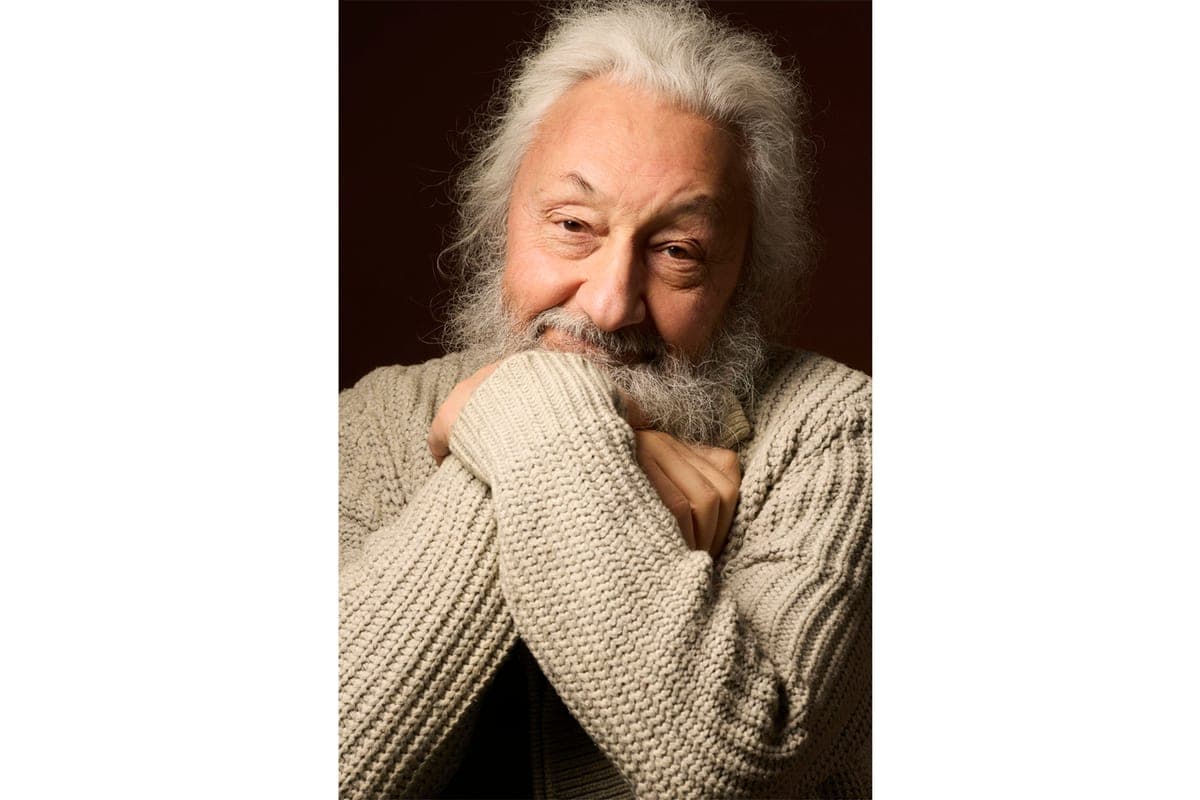
The man-legend spent the anniversary year, it should be noted, very fruitfully - however, as well as all previous years. And the concert of the group “Flowers” in the Liverpool club Cavern Club (as told in detail “ZD”) – “Beatle” alma mater and the main “temple of music” for all rockers in the world – was a real miracle for both spectators and musicians, as well as a truly anniversary gift to the master. We can say that this concert was a symbolically closed logical circle in the big business to which the master dedicated his life.
Between the first group, assembled in the 60s of the last century in the Suvorov School, and modern projects, Stas Namin laid out an impressive art solitaire from a variety of genres, styles and trends. Musician, composer, producer, artist, photographer, director. There may be something else that few people know about.
Even his weekly is somewhat like an art object. The pages are not only densely written, but supplemented with stickers and are sometimes full of bizarre handwritten fonts. In his library, these weeklies filled for many years of stormy and fruitful activity a long shelf - priceless folios of rock chronicles and not only rock.
Namin’s office is richly filled with photos of his large family, faces of pop-rock celebrities – his friends, and a variety of artifacts brought from different parts of the world. Add to this the reputation of one of those who started Russian rock, staged in the early 80s something similar to Woodstock in the capital of then Soviet Armenia (which we also recently recalled on "ZD"), finally muddyed in 1989 superstar "Peace Festival" with unthinkable for that time in Soviet reality "monsters of rock" - from Ozzy Osbourne to Mötley Crüe, which, unfortunately, began, not very long era of local free touring life, and you get a situation in which it is extremely difficult to show self-irony. However, angry moralists refer to what the anniversary did not succeed in, and he does not regret it at all.
Such people certainly have something to say and something to remember. On the eve of his 75th birthday, Stas Namin tells and recalls in an anniversary interview with ZD.
- You still lead a very intense lifestyle. Many projects - and musical, and theatrical, and visual. Do you sometimes wonder if I’m working too hard?
Work in my case is something relative. My life was such that I never worked. At all. In the sense that he had to do something. I work in high all the time, for my own pleasure. It's the same now. How much I work, I don’t even think about it. But I get carried away, and it takes me a huge amount of time. What's the downside? There are no bosses, and no one to take a day off.
— Surely the “high” of the sample of 1967 or 1969 is different from the high of Stas Namin of the sample of 2026? That high, apparently, brought performances on stage?
- Not necessarily on stage. Rock 'n' roll was just a window into freedom for me.
- Is she still high?
- Now? No, of course not. I forgot about it, thank God. Now I get high, primarily from life. From people – relatives, friends, from those I respect, with whom I communicate. Life is first, art is second. Sometimes they say: “I am ready to sacrifice anything for art!” And I'm not willing to sacrifice anything for art.
- However, art continues to be your main occupation. In your childhood and adolescence, creativity and music in particular, however, were rarely seen as a way to make a living
- Initially, my mother wanted to give me a classical music education. She graduated from the Conservatory, we had many serious musicians visiting, and my first teacher was Arno Babajanyan (an Armenian composer from the clip of Soviet classics - approx. "ZD"). He tried to instill in me a love for symphonic music, but rock and roll won. Dad had a reel tape recorder on which he loved to listen to Okudjava and rock 'n' roll - Little Richard, Elvis Presley. Then when I went to Suvorov school and, already knowing the old rock and roll, heard The Beatles, and rock music became my serious hobby. n
- Can it be considered incredible luck that your ensemble, created in student days, got the opportunity to sign up for Melody?
- This opportunity was given to three student ensembles: “Lingua” from the Institute of Foreign Languages and two groups from Moscow State University – “Trio Linnik” and us. All three groups became laureates of the student festival at the Luzhniki Sports Palace. And Flowers, like the others, got the right to record a small flexible record. But neither we nor Melodiya could even imagine that a circulation of seven million would be sold. And when it turned out that we became super-popular, the Moscow Regional Philharmonic, of course, pulled us into the professional Soviet concert system, hired us and sent us on tour. Since the autumn of 1974, for six months we have worked out a frenzied number of concerts. Four to five a day. Can you imagine? In winter - sports palaces, in warm weather - stadiums.
- Perhaps this is one of the wonders of the Soviet system of cultural management. Musicians are banned on radio and television, but on their songs, this most prohibitive state earns very well by the hands of its agents - the company "Melody", philharmonics, minions are produced, there is a tour. You have all-Union popularity, the state has “millions” in the bins
- Well, some of these "millions" fell to us, after all. We, as young people, were not charged and we received the least in the country, but at the stadiums we had a double rate, each musician received eleven rubles for a concert. Given the number of concerts, there was a lot of money. But the conditions were just terrible. Twenty-five days a month, we performed 4-5 concerts daily, and at night moving to another city, home comfort is zero (if anyone remembers what Soviet hotels were like), equipment – no. At some point we just didn't have the strength left and we rebelled. We went to the Philharmonic and said we couldn't do this anymore, and if they don't change our schedule, we're leaving. They say, OK, leave, just sign the application. We signed. And it turned out that I, Sasha Slizunov and Kostya Nikolsky, having signed a statement, left the ensemble and stayed on the street ... and the name "Flowers" and formally the ensemble remained in the Philharmonic. This, they say, is a “state team”, its concerts are on schedule. Well, some musician left, and that's terrible. We recruited others and moved on. But gradually it came to the Ministry of Culture that the ensemble “Flowers” does not sing about the Soviet government, records songs about some star (“My Star is Clear” – one of the “loudest” hits of the 70s – approx. And they banned the name "Flowers" as hippie propaganda.
- Despite the bans, you still managed to return at the turn of the 70s - 80s already as the Stas Namin Group and record many hits, sold in huge circulations - on the same minions of the company "Melody". But in the early nineties, after the "Flowers" on the wave of perestroika traveled half the world, you yourself stopped the activities of the group. Why?
- I saw a different culture starting in the country. In general, everything that happened in the nineties was, in my opinion, a serious blow to popular culture. Of course, the Soviet censorship killed all living things, but, nevertheless, there were some criteria of good and evil, as in Hollywood - in many ways exaggerated, but in the 90s everything disappeared overnight. There was an emptiness and an absolute freedom without any rules – a freedom in the most vulgar sense of the word. I think that after all, freedom is the necessity of the life of civilized people, and if it falls into the hands of the “gateway”, it is no longer freedom, but rather lawlessness, killing the culture of society.
- Do you see any bright moments now, or are you still pessimistic about the dynamics of music?
- I don't follow today's light music. But I know good musicians, and there are just great, world-class musicians. For example, the leader of the group and vocalist of Gorky Park Oleg Izotov or the virtuoso Roman Miroshnichenko, who became the guitarist of 2026 in the world ranking. Speaking of groups... They also exist, but not on TV, but on the Internet, but very professional. But rock music is not just musicians who play professionally. It is primarily self-expression, a genre that emerged because it was rock music that chose society as the cry of the soul of postwar youth. Protest against philistinism, cynicism, against the political establishment of the time. That is, they opposed the state quite harshly and openly, expressing the opinion of the whole society. Moreover, few people know this, but in America at one time there was a blacklist of musicians compiled by the CIA. Pete Seeger and Gary Belafonte and many others got there, and then of course John Lennon and Bob Dillan.
- Yes: rock music and blacklists seem to be “eternal companions of each other”, as sung in one song. And not just in America. Perhaps the Soviet rock of the seventies and eighties can also be called the cry of the soul?
- Sure. I’m not talking about who played well and who didn’t. Yes, Flowers is probably the most professional band of all that was then. But when we talk about self-expression and the cry of the soul, then, of course, we mean the Sound of Mu, and Kalinov Bridge, and Aquarium, and DDT, and the Time Machine. In the culture of the country and society, our rock music in the seventies and eighties played a very important role. I don’t want to compare it to the West, because musically it’s different and maybe not as innovative. But for us, it was all very serious.
- In your opinion, is such a cry of the soul possible now?
- I think the voice of self-expression from rock music is gone. It's probably possible now, but more online, in other forms of expression. The cry of the soul is not only in music
- So time dictates the form of such a cry?
- I think so. There was a time when Andrey Voznesensky and Yevgeny Yevtushenko could read poems at the stadiums crowded with people. Where's the poetry now? Who cares? The masses are not interested in poetry today. The cry of the soul, the mouthpiece of self-expression, was once in the theater, but today there is no more that “mouthpiece”. When jazz was banned, not even the text, but the sound was censored. If you sound like that, you're protesting. "Today you play jazz, and tomorrow you will sell your homeland", "From saxophone to knife one step" - if anyone has forgotten these wonderful party and cultural shouts-directives
- In your opinion, rock music as a phenomenon is already an established construction, or will something else happen to it?
- I think it's over, just like jazz. That doesn’t mean there’s no more rock music. It is, but it is more pop rock, that is, an entertaining genre. Even if it sounds like heavy metal or hard rock, nobody cares. Because it doesn't have the deep drive, the drive that John Lennon and other serious guys had at the time. Rock music started with The Beatles, The Rolling Stones, Led Zeppelin, Pink Floyd, and ended, in my opinion, probably with Nirvana.
- If you think of your production projects and the group Gorky Park as one of the brightest, then here we are talking more about commercial potential than about the cry of the soul. Or are we wrong?
- In Gorky Park, there was never a cry of the soul. It was my production project, the goal of which was to break the Iron Curtain into global popularity. There, self-expression could only be from Nikolai Noskov, because, frankly, he is the only one of the first composition, who by nature had and still has a soul, heart and real talent. The rest are good instrumentalists, who competently accompanied him. Played professionally.
- And what was the task?
- To conquer America. In rock music, I only did two projects from start to finish: Flowers and Gorky Park. In the Soviet Union, in Russia, when I created Flowers, I was, as it were, very good among the sheep. And when I got to the West, at some point I thought: “Well, I studied this music, let me try my hand, how are we worse than them?” And I made an export team, but it wasn't real rock music as I understand it, so I chose glam rock, which was fashionable at the time, which was originally a commercial entertainment genre.
- So you've completed your assignment?
- I must have done it for myself. It was just possible to make this project even more successful, and it would still exist to this day, as Bon Jovi, Motley Crewe and other teams in this style have. If Belov had not seduced the musicians to run away and stay in the United States and destroyed the band, then Gorky Park could now be like Scorpions. But the town mentality of stealing and running away stopped the serious potencies of my project. It is a pity, of course, of time, a pity for the effort spent on a lot of money, but what happened, happened. I have long forgotten this sad story!
- Can this be repeated theoretically and theoretically?
Nope. It is not possible to enter the same water twice. Although, of course, the current composition of Gorky Park is so strong that its stable career in the world at a decent level has already been determined.
- In the massive documentary Free to Rock that you produced, it is clear that rock is the choice of free people. Are you still sure that rock music really changes people for the better? That she can stop wars?
- This is a very serious matter. I think it's not like it used to be. Once it was, rock played a huge role and influenced a lot. The Vietnam War, for example. Rock music was feared and banned, even in America. And then they stopped banning it because it became toothless and had no effect on anything else. She was interrupted by entertainment pop. It is known that people love and desire primarily bread and circuses
- Sometimes it seems that even if a person listens to the right music in his youth, it still does not give him a kind of moral immunity for later life. Subsequently, he can do monstrous things that go against everything that is inherent in proper music
- This applies not only to rock music, but also to any art. Art can affect the state of your soul, or it may not. It's an ephemeral influence. It depends on what kind of soul a person has and whether it is at all. You feel and change something in yourself, or feel and do not change, or do not feel at all. That's what it's about. In the 70s – 80s, rock music in Russia spoke a language tougher and bolder than any arts that were here – in the theater of a continuous aesop language, and the group “Televisor” sang “my dad is a fascist” in plain text. And that was, of course, a real breakthrough from the existing censorship. And now there is the Internet, where you can do anything you want. On the one hand, the Internet removed Soviet censorship, and on the other hand, it gave rampant, unlimited freedom, which proved dangerous for people who do not have a culture. Freedom is good when it is enjoyed by people of inner culture, nobility and dignity. And if freedom is given to Sharikov, then little will appear. What was he doing in Professor Preobrazhensky's apartment?
Success in music and in art in general is very often associated with luck, with well-established circumstances. Do you consider yourself a lucky person in life?
- I've lived a fabulous, romantic life for a long time. My loved ones did not leave, there were no serious conflicts at all, there were no scandals and gossip around me, no judicial conflicts, no serious negativity, by and large, I did not have in my life. I guess you could say that I was lucky, because somewhere after seventy, God decided to test me and see what I had. I suddenly saw life from a completely different, very unsightly side. Over the past three years, there has been so much dirt and negativity around me that it would probably last a lifetime. There were very serious things that turned out to be very difficult to survive, and less serious, but unpleasant, since it is not a great pleasure to face false, dirty and cynical people. Suddenly this dirt came from all sides. My name was dragged into some public scandals, although I was never a public person. But at some point, I calmly looked at everything from the outside and realized that I probably had to go through it for something. There are no accidents. After analysing my entire life in detail, I have come to the conclusion that today, even after all I have experienced and experienced, I have no anger or hatred inside me. Inside myself, I do not participate in all this and seriously do not even notice the negativity that is trying to drag me in and provoke me. I am really happy with my family, with my friends, with all the kind and decent people who work with me and with whom I communicate. It gives me strength, joy and love, which I try to convey in my work.
There is a letter from Einstein to his daughter, in which he writes that he managed to prove the theory of relativity in his life, but there is another theory that he could prove, but did not have time. It's the theory of the eternity of love. Love is the only thing that is eternal in life. I completely agree with him, people leave, and their love remains. I truly feel that if you have love in your heart, if you give warmth and kindness to all who need it, then that is the only value that exists. Everything else is ephemeral. I try to do this through art, I try to look for beauty, to formulate it subjectively. And that, in my view, is the meaning of life.


