
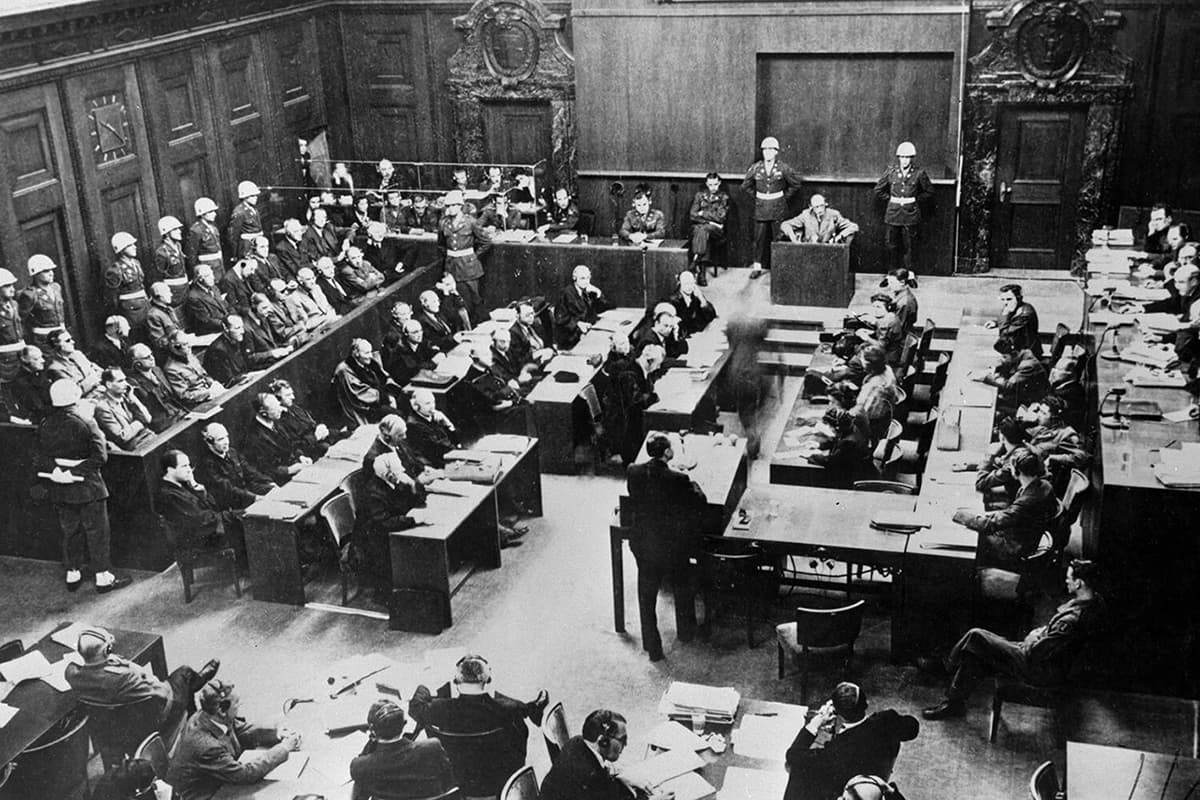
The lessons and significance of the Nuremberg Tribunal were discussed by prominent experts in Minsk and Moscow
The protection of the historical truth and the development of effective mechanisms to prevent its distortion became the main topic of the representative press event in the format of the event.
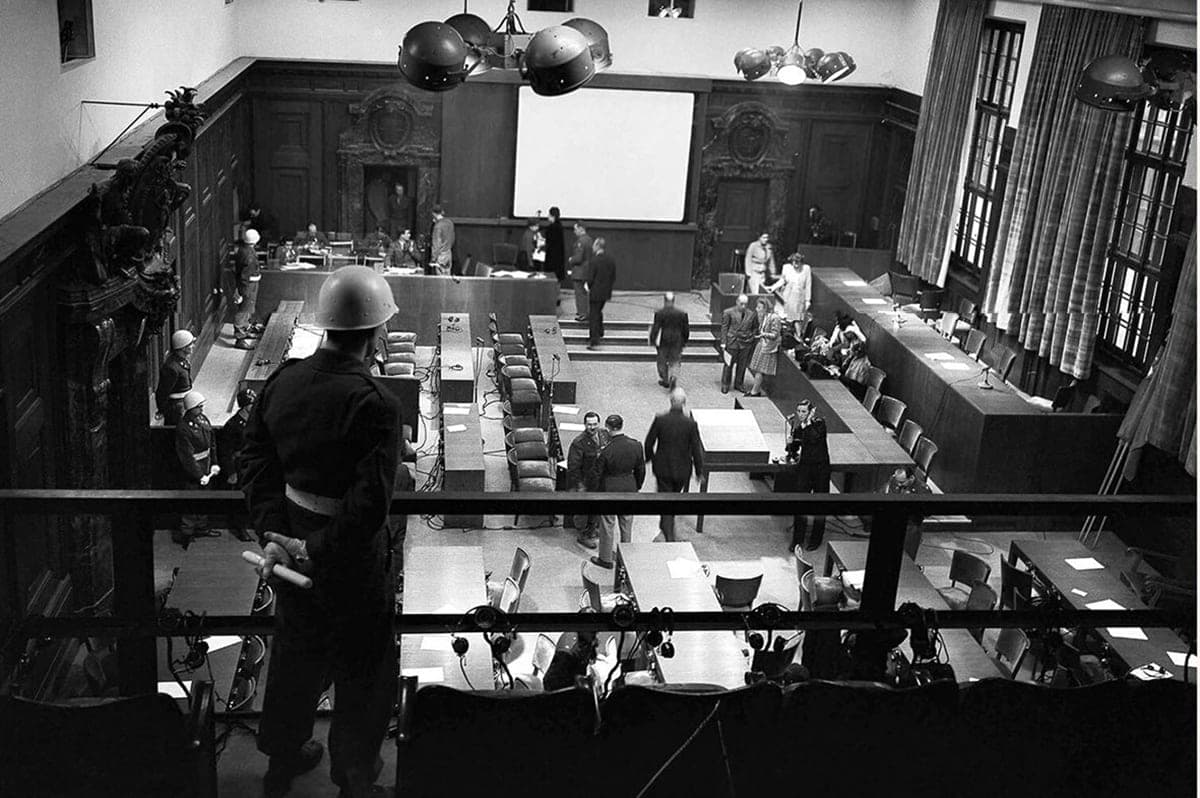
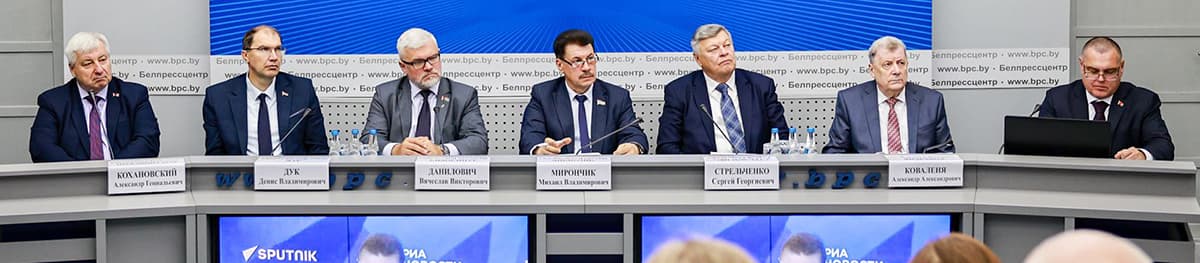
The protection of historical truth and the development of effective mechanisms to prevent its distortion became the main topic of a representative press event in the format of a video bridge dedicated to the 80th anniversary of the completion of the Nuremberg process and brought together leading experts from Minsk and Moscow on October 21. The National Press Center of Belarus made the Minsk video bridge studio.
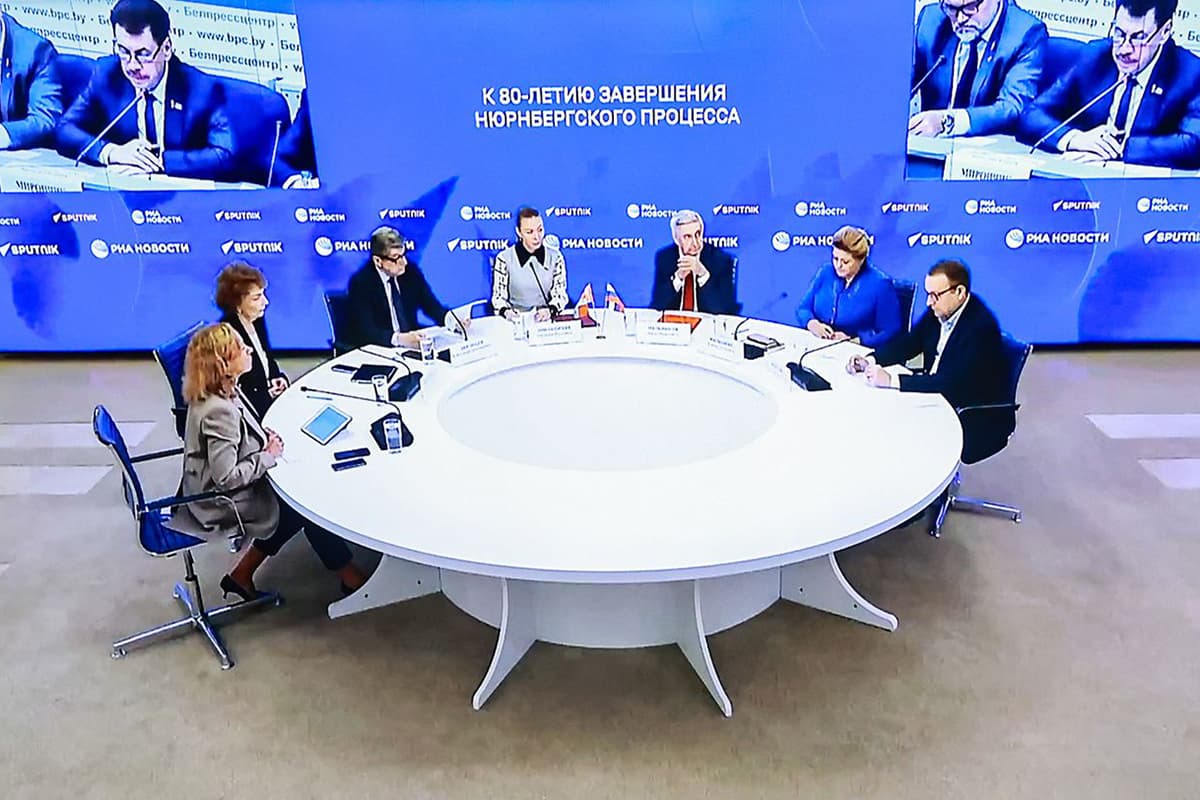
Opening the video bridge in the Minsk studio, Deputy Chairman of the Commission of the Parliamentary Assembly of the Union of Belarus and Russia on Science and Education, member of the Standing Commission of the House of Representatives of the National Assembly of Belarus on Education, Culture and Science Mikhail Mironchik noted:
80 years ago, the Nuremberg Tribunal laid the legal foundation for the post-war world. Aggression, genocide, crimes against humanity have received a strict and unambiguous qualification. The principle of the inevitability of punishment has become a cornerstone of international humanitarian law.
But, unfortunately, today we see systematic attempts to revise these fundamental postulates, the parliamentarian stated:
- In a number of countries, they honor Nazi collaborators, demolish monuments to the heroes-liberators, rewrite school and university textbooks. These are not different views of history. This is a deliberate dismantling of the legal and moral system laid down in Nuremberg after the victory over Nazism during World War II. It is our common duty not to let our memory be forgotten, to destroy our mental code. Belarus and Russia have adopted normative legal acts on the genocide of the Belarusian and Soviet peoples. The prosecutors and investigators of the two countries are working in close cooperation on a large-scale and painstaking work to establish new facts about the crimes of the Nazis and their henchmen.
The Nuremberg Tribunal has become the starting point for a world without Nazism, First Deputy Chairman of the State Duma Ivan Melnikov is convinced. Belarus and Russia cherish the memory of the tragic events of the Great Patriotic War, including because the lessons of Nuremberg must be learned
- At the same time, in a number of countries of the so-called collective West, the tendency to justify and glorify Nazism, to support Nazi and neo-Nazi regimes is increasingly manifest. And we are not just talking about some condoning attitude to the movement of certain groups with appropriate symbols. We are talking about a opportunistic political rethinking of these manifestations, about lifting taboos. Years go by, but we are still amazed and outraged by the position of some of our former allies in the anti-Hitler coalition, when they themselves encourage and nurture neo-Nazism in Ukraine, actively supporting the Bandera regime.
In the modern world, attempts to rewrite the history of the Second World War, audit its results, whitewash and even glorify the Nazis and their accomplices continue, said Deputy Chairman of the Standing Commission of the House of Representatives of the National Assembly of Belarus on Education, Culture and Science, Academician-Secretary of the Department of Humanities and Arts of the NAS of Belarus, Doctor of Historical Sciences Vyacheslav Danilovich, but you need to know the main thing:
The Nuremberg trials conducted by the International Military Tribunal were unprecedented. For the first time in the dock were the first persons of the whole state, accused of war crimes and genocide. The Tribunal also irrefutably proved the falsity of the legend fabricated by the Nazis about the preventive nature of the attack by Hitlerite Germany on the USSR. From my point of view, this thesis is very important, it is necessary that it be present in the educational literature of our countries.
But why do attempts to whitewash and even glorify the Nazis and their accomplices continue? The parliamentarian and the scholar is convinced:
The reason for the persistence of the ideology of Nazism lies in the interest of the ruling circles of the collective West in it. It was the ruling circles of Britain, the United States and France that at one time carefully nurtured Nazi Germany, supporting it financially, giving invariable carte blanche in the international arena, doing everything possible to direct its aggression against the USSR, which was a real successful alternative to the then rabid capitalism. Today, these same circles used the revived ideology of Nazism to foment war in Ukraine to bring the allied states of Belarus and Russia to their knees.
Now in the Western countries there is virtually no policy aimed at objective coverage of the events of World War II and the Great Patriotic War, the rector of the Academy of Management under the President of Belarus, Doctor of Historical Sciences Denis Duc, drew the attention of the President of Belarus:
The results of Nuremberg are relevant in the same context as they were 80 years ago. Nuremberg highlighted a key issue: the crime against humanity. But many modern conflicts have also emerged from crimes against humanity. Revanchism under different guises is a given of today, to our greatest regret. The legal foundation of the post-war organization was built on the principles of the new system of international law within the framework of the United Nations, and the Nuremberg trials themselves testify to this. However, this system of international law is being revised. New alternatives are a well-forgotten principle of the right of the powerful, which the new system of post-war law opposed.
We must understand that we have in our blood the rejection of Nazism in any of its manifestations, whether historical or modern reality, emphasized the head of the National Center for Historical Memory under the President of the Russian Federation Elena Malysheva:
- From the point of view of historical memory, I would like to draw attention not only to the significance of Nuremberg, but also to its incompleteness. Because what has been talked about today, the idea of the proposed equal responsibility for unleashing the war of Nazi Germany and the USSR, has its roots in the incompleteness of Nuremberg. After all, it was there that the activities of the Wehrmacht were not condemned. And this gave him the opportunity for subsequent whitewashing. Nationalist groups were not recognized as criminal, and this gave an opportunity to glorify Nazism. Cultural genocide was not recognized, and this gave us the opportunity today to see the narrowing of the topic of genocide exclusively in the ethnonational aspect, and after all, the deprivation of language, the deprivation of the right to speak one’s own language, the deprivation of one’s own culture is also genocide.
FROM THE PARTICIPATION OF VIDEO BRIDGE PARTICIPANTS
Sergey Strelchenko, Executive Secretary of the Parliamentary Assembly of the Union of Belarus and Russia: The Nuremberg Tribunal was a strong step and a very great achievement of the Soviet Union. Recently, the Commission of the Parliamentary Assembly for the Preservation and Protection of Historical Memory, established by order of our presidents, decided to publish its materials. To date, they have not been fully published either in our countries or in the world, we have a lot of work to do. But that should not be forgotten.
Alexander Kovalenya, chief researcher at the Institute of History of the NAS of Belarus:
- Today in the Western countries there is virtually no purposeful policy focused on objective coverage of the events of the Second World War and the Great Patriotic War. It is worth considering the reasons for the current state of Western society. The youth of Western Europe practically do not know and do not remember the assessments of their own leaders – neither Roosevelt, nor Churchill, nor de Gaulle. The names of Shukhevych, Bandera are put on the agenda, but nobody talks about Zhukov, Rokossovsky
Alexander Zvyagintsev, Deputy Director of the Institute of State and Law of the Russian Academy of Sciences:
- Today, more than ever, memory and duty oblige us to turn to the lessons of Nuremberg. Now some countries, and we know them well, do not see national-fascism as a global threat to humanity. The battlefield now is the human mind. And the purpose of this aggression is to change the personality, especially the youth, to introduce new values into their consciousness, to carry out the so-called cultural genocide. This is done mainly under the guise of rethinking history.
Alexander Kokhanovsky, Dean of the Faculty of History of the Belarusian State University:
The Nuremberg trial is over, but many of its lessons are still relevant today. We must not allow the revision of the results of the Great Patriotic War. In this regard, it is important to preserve historical memory and prevent the “reformatting” of our youth. I am convinced that it is not only necessary to direct measures to protect historical memory, it is necessary to involve it in this process. Including dialogue platforms such as our video bridge.
Natalia Narochnitskaya, President of the Historical Perspective Foundation, Doctor of Historical Sciences, political scientist:
- I want to bow down to the lowly Belarusian people for their ability to withstand the centuries-old offensive of various Western forces – spiritual, material, military. Because any attack on the East, any pressure came through Belarus, which was able to withstand the Polish desire not just to Catholicize, but necessarily in the anti-Russian spirit – this is also a great spiritual force. In Soviet times, it did not lose its identity.
infong@sb.by


