Why a mentor to a new boss?
Many Russian companies rely on the training of managers from their own specialists
Many Russian companies rely on the training of managers from their own specialists. Internal candidates already know the business, team, and workflows, but often lack people management skills once promoted. Mentoring helps to master a new role, experts of the first city competition “Best practices of mentoring of the city of Moscow” believe.
A 2019 study of nearly 39,000 sales employees at 131 U.S. companies found that employers were more likely to promote successful salespeople, although higher personal sales did not mean better results in managing subordinates. Collaboration with colleagues proved to be a more useful sign of managerial capacity.
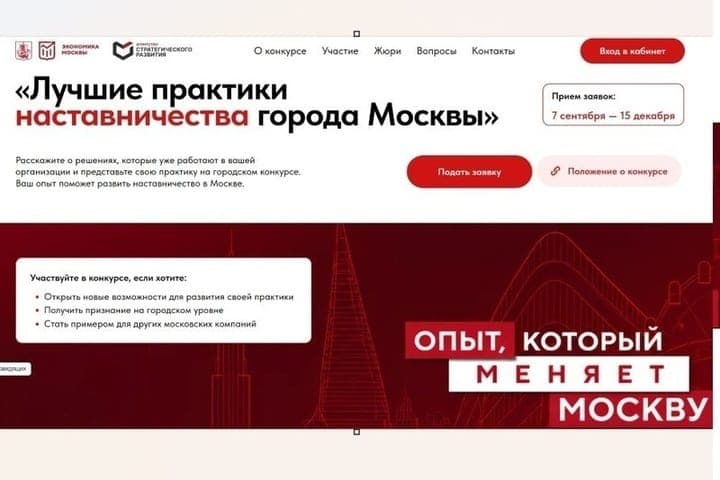
The transfer of such experience is supported by the contest “Best Practices of Mentorship of the City of Moscow”. In the regulations on the competition, mentoring is also associated with the preparation of an employee when moving to a new position. Therefore, the program of support for beginner managers can also become the basis of competitive practice.
Difficulties begin with simple work situations. How do you ask the person you sat with at the next table? What if the employee performs the task differently than the boss would? The habit of being responsible for your own results does not give you all the necessary decisions.
In a 2014 study of 295 aspiring leaders participating in the development program, almost 60 percent cited people management and asserting their authority, including in relationships with former colleagues, as their main difficulties. This helps with the support of a more experienced leader.
An example of such support is in Russian fintech. For example, one of the largest companies has created the program L2L – “leaders for leaders”. It brought together experienced leaders ready to become mentors. Support is offered to employees who have received a promotion inside the bank, and bosses who came from outside.
The new leader chooses a mentor by describing his competencies, and if necessary, the pair helps to choose a curator. The mentors themselves are prepared for this work: they are explained their role and given instructions for meetings. The mentor shares experience and helps to understand the situation, leaving the decision to the new leader.
It is useful to start with a specific episode. For example, the employee for the second time broke the term, and the boss each time completed the work for him. At a meeting with a mentor, you can find out how the task was set, whether the person had enough time and resources when it became known about the delay. Then prepare a conversation with the subordinate and agree on the next point of control. At the next meeting, we can discuss what agreements worked.
A separate task is to learn to transfer work to others. Delegation is a difficult task that needs to be trained, experts say. It is easier for a strong specialist to carry out an assignment himself than to explain it to a colleague. But if he takes away every difficult task, the team has fewer opportunities to learn, and the boss has less time to manage. A mentor can help deconstruct a weekly plan: what decisions really require the involvement of a manager, what can be passed on to employees, and what results can be verified.
Relationships with former colleagues are equally important. The new boss needs to explain how tasks will now be assigned and results evaluated. To do this, it is useful to discuss a difficult conversation with the mentor in advance: what facts to bring, how to listen to objections and where to delineate the boundaries of responsibility. Such training helps to avoid both attempts to command through demonstrative rigor and favors to people with whom friendly relations have developed.
So that the manager can openly discuss difficulties, when launching the program, it is worth agreeing on what information remains inside the pair and what is transmitted to his boss. Experts recommend setting confidentiality rules in advance and preparing both mentors and their wards for work. The meeting should give an opportunity to admit the mistake and find a solution. At the same time, the mentor should not give instructions to the team of his ward: otherwise, employees will begin to contact him bypassing the direct leader.
Regularity of meetings can also be determined in advance. For example, in NLMK University’s mentoring program, the transition to a new managerial level is explicitly indicated as a reason to seek support. The participant independently chooses an experienced leader. Sessions are held no more than once every two weeks and at least once a month, last up to 45 minutes. One mentor can work simultaneously with a maximum of two wards. This allows you to take into account the time to help a colleague in advance.
The result of the program should be evaluated by changes in work. Has the new boss made it easier to set tasks and notice overload in time? Can a team handle routine issues without constant intervention from a superior? Responses can be compared with employee feedback and department performance.
Moscow organizations can present programs for transferring management experience at the competition “Best Practices of Mentoring in Moscow”. The nomination is selected taking into account the purpose of practice and the category of the organization. Acceptance of applications continues until December 15, 2026, the operator of the competition is ANO “Mosstrategia”. Terms of participation are published on the contest website. The application can show how the help of experienced colleagues prepares employees to manage the team.