Portrait of the burnt soul of the artist
On November 7, 1941, 85 years ago, a parade took place on Red Square, which became one of the symbols of resistance to evil, invincibility before the enemy, invincibility not only of Soviet troops, but above all of our spirit
Sitting on the train, I flip through photos from a recent exhibition held by ROSIZO in the walls of the Tretyakov Gallery on Kadashevskaya Embankment – “The Heritage of the Epoch”. Mikhail Savitsky. From Belarus, the birthplace of the artist, there brought his early paintings, which are not so widely known, a small part of the terrible cycle “Black story”, dedicated to the tragedy at the Chernobyl nuclear power plant, as well as rare works – illustrations for children’s books and youth Soviet magazines. Were on the exhibition and group portraits of partisans, which, by the way, the Belarusians themselves have not seen for a long time (the paintings were taken from the museum funds, and when the public will be able to see them again – a mystery), and the most important cycle in Savitsky’s work, “Digits on the Heart”, was presented modestly – a digital reproduction of the artist’s self-portrait “Prisoner 32815”. The work, widely known around the world, is actually one of 16 paintings that can be seen in the Belarusian Museum of the History of the Great Patriotic War, where we will consider some of them according to Beethoven's formula "From darkness to light, through struggle to victory.".
The exposition in the Minsk Museum of the Great Patriotic War is built chronologically, and almost at the beginning of the inspection, passing by military equipment, on the left you notice a "wing" with Savitsky's paintings - the eye catches. Before you have time to consider the canvases, and the heart already begins to beat more often from the views of the characters of the paintings. But the audio guide leads in the other direction - it is not yet time for the viewer to get acquainted with the visual reflection of the most cruel manifestations that, it turns out, can be characteristic of people. The narrative is based on the principle of a spiral, each level of which is more terrible than the previous one.
Mikhail Andreevich Savitsky said: “To excite a person, you need to burn your soul yourself” – a phrase that he, alas, confirmed in his life, but not of his own will. The artist graduated from the Surikov School in Moscow when he was already under 40. This has been prevented before by war. After school - the army, then - the defense of Sevastopol, wounds and captivity - Dusseldorf, Buchenwald, Mittelbau-Dora. Eyes looking at us from the self-portrait “Prisoner 32815”, saw falling from impotence of prisoners on the quarry “Blood” in Thuringia, the dampness and cold of the penalty cells, living corpses in the death camp of Dachau near Munich – there and found a man with figures on his heart, encrypting the name of Mikhail Andreevich Savitsky. He himself looked more like a dead man - the Americans, who liberated the camp on April 29, 1945, found Mikhail Andreyevich unconscious, he was barely breathing. However, the portrait itself is made against the background of the forged gates of not Dachau, but Buchenwald, where in front of the entrance to the hellish cauldron it is written “Jedem das Seine” – “To each his own”. And above the figure on the chest - an inverted red triangle with the letter "R", so marked political prisoners from the Soviet Union. The wooden shoes on the hero’s feet, which today we perceive as one of the symbols of the Netherlands and carry them as a souvenir, were actually the shoes of prisoners – extremely uncomfortable and impractical, which only complicated the already unbearable work.
Guides with excursionists pass the "wing" with "Digitals on the heart" quite quickly, talking about each work by phrase - not out of disrespect for the artist, as it might seem, and not out of a desire to quickly complete the tour of the exhibition. We came here specifically to stand at each canvas and consider all the details, and it is morally difficult for people in groups, especially those who are here for the first time, to get acquainted with every nuance of the terrible tragedy experienced by the long-suffering Belarus, painstakingly collected here by particles. There are tears in the eyes of men and women.
We have been standing in the hall for some time and repeatedly hear the same question of visitors: “Why are these works written so late?” "Late" is almost 30 years after the tragedy, from 1974 to 1979, and then back in 1987.
At the end of the metropolitan "Surikovka" in 1957, Mikhail Andreevich began his career as a socialist artist. To the truth, through which he passed himself and the silence of which he considered betrayal, he turned already being a recognized master. Behind the shoulders is the great success of the “Partisan Madonna” of 1967, which was immediately acquired by the Tretyakov Gallery, his recognizable harsh style has already appeared, because of which the masters were accused of blackness, gloom and even removed works from the exhibition (to which he said: “Do not care”). The eyes of his heroes found their way to the hearts of the audience in spite of it.
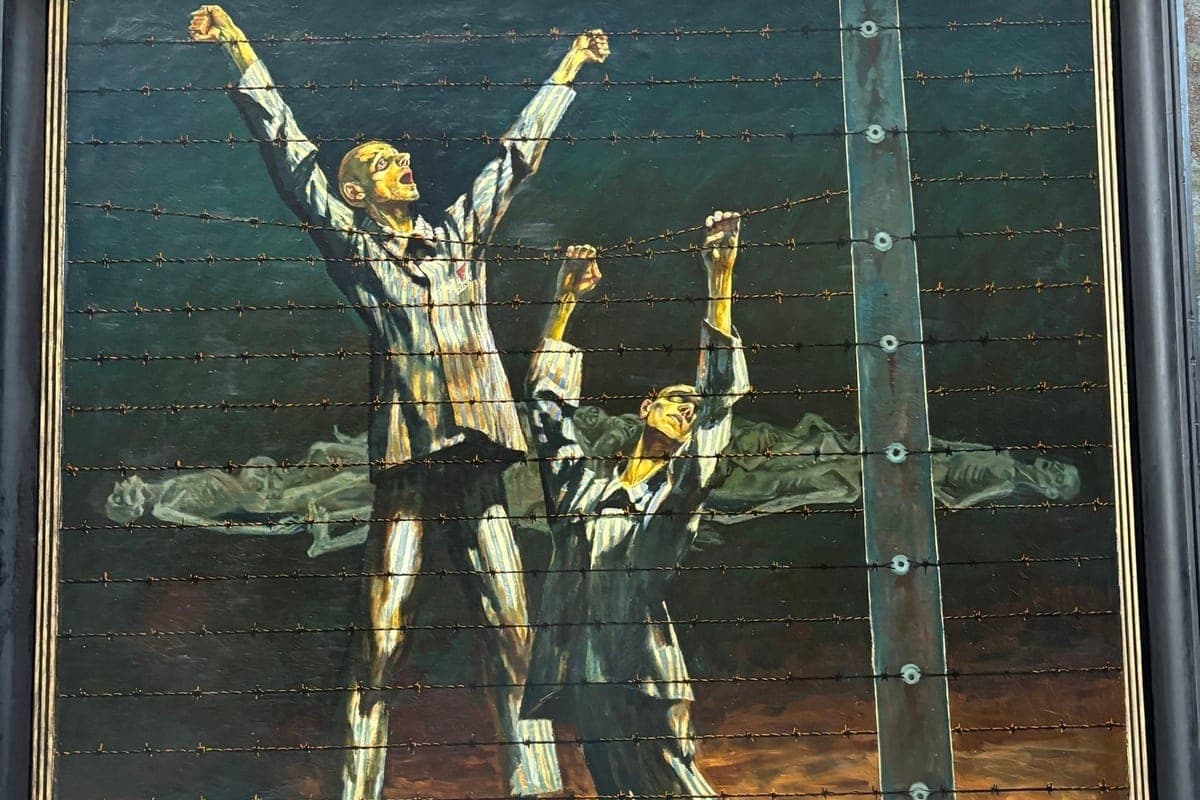
Most of the works of the artist-philosopher are saturated with symbols, which the viewer will have to consider and decipher, but “Digitals on the Heart” requires more knowledge of history (and otherwise prompt to study every micro-detail of the events of those years). The painting “The Curse” (1979) is about this. At first glance, it seems that the prisoners of hell are trying to escape by breaking the barbed bars of the fence, and the hypothesis is confirmed, but only partially. This is an escape not to earthly freedom, but to heavenly freedom. A fairly everyday practice in a concentration camp is to “get on the wire”, when prisoners, unable to withstand torture, preferred to lie on high-voltage wires with the words of curses against the Nazis on their lips.
Consider the scandalous canvas “Summer Theater” (1974), for which Savitsky was known as an anti-Semite. In the name – a terrible metaphor, which the Nazis called the pits where burned the bodies of the dead. Behind is a terrible and soulless machine with burning eyes, whose cold metal “mouth” in a few seconds will throw the bodies of the dead into the pit (on some faces mouths are open, but their expressions are calm and humble). Only children's bodies are exhausted by hunger, and the relief of muscles is visible on the bodies of adults, they more resemble not dead tortured people, but beautiful ancient statues. But the main thing is not corpses. The hero in the foreground on the left is a Nazi, whose eerie laughing face the artist deliberately caricatured, and on the right, with an equally ugly smile, is a prisoner-servant, on whose heart we see a patch of yellow rectangle and a blue inverted triangle: this is how Jews-immigrants in the camps since the second half of 1944 were designated. For this reason, Mikhail Andreevich was accused of insulting Jews. But the master was sure of the truthfulness of the depiction and replied that among the intra-camp authorities, among those who burned the corpses, there were actually many Jews (as people tried to survive in hell), and continued to insist on their own. There is a version that the sign on the chest of this prisoner denotes a rabbi and in fact he appeared later in the place of the Star of David at the personal request of Pyotr Masherov (then - First Secretary of the Central Committee of the Communist Party of Belarus).
The title of the canvas “Singing horses” (1979) will be more correct to write differently – “Singing horses”. So cynically called the teams in the camp, who were engaged in the cleaning of corpses from the territory. In the cart with bodies harnessed prisoners, which the Nazis drove with whips. In order to work more fun, prisoners were forced to sing under pain of death. And again, look at the faces: the master remains true to himself. The smiling faces of the fascists are ugly and disgusting, the cheeks are blushed, the eyes are not visible (as you know, it is in them that the human soul is reflected). The faces of the corpses again do not cause horror and even look beautiful. However, the artist works out the views of the men dragging the wagon - they look through the viewer, there is no submission in them. It is resilience, struggle and acceptance of their dreadful path, which they intend to overcome. They, unlike those that have already become their “cargo”, are still alive, which means that there is still a chance to get out of here on their feet, not on a wagon, and not just go out, but with a victory over evil. The hands and bare feet of the prisoners are bones covered with skin, the overseers’ feet are warmed in massive polished leather boots, the pink powerful hand of the one on the left keeps the whip ready, and the one on the right rejoices, listening to the choir of prisoners, but his hand is always ready to grab the machine gun behind his shoulder if there is a brave resistance.
Finally, one of Savitsky’s Madonnas, Madonna Birkenau (1978), is proof that the artist’s accusations of absolute, hopeless gloom of the paintings are untenable. It is worth considering it with the silhouette of a blackening crematorium, above which the body of a Madonna and a baby rises - in the cycle this is an example of a metaphorical canvas built not on documentary, but on figurative symbolism. Favorite masters of the Renaissance (and not only!) the plot Savitsky rethinks quite obviously. A symbol of love is a tribute to all the mothers who died in the camps. Like the other dead in the paintings from the cycle, we do not see the horror frozen on the face of the mother and child, before us again an ancient ideal human beauty that seems unattainable. We look down and see another symbol signifying a new life – modest wildflowers sprouted on the ashes of those burned in the crematorium – the Christian “death of rights”.
On the way to the side of the house from the museum, scrawled letters on the wall of the Brest Fortress are carried in memory (the museum exposition begins with its fake fragment): “We will die, but we will not leave the fortress”, the elegant handbag of the Hero of the USSR Elena Mazanik, in which she carried a mine into a mansion with the Nazis, many other objects are symbols of resistance to the Nazis, but above all – the heroes of Savitsky. During his lifetime, the artist was asked the question: why is it so realistic? It is difficult and painful to watch “The Numbers on the Heart” given the neighborhood of the cycle with the halls where improvised combs and children’s toys from strange improvised materials found on the sites of former concentration camps are stored, as silent proof of unimaginable cruelty, which, it turns out, is characteristic of representatives of homo sapiens. But among the thousands who were tortured, suffocated in gas chambers, burned or died of exhaustion, the artist survived. A kind of “luck”, “second chance” for life, Mikhail Savitsky used to tell the truth in artistic language, which cannot be forgotten.