Stitch by stitch: how folk embroidery became an independent art
The All-Russian Museum of Decorative Arts opened an exhibition “Shito-embroidered” – about how folk embroidery went from household items to an independent artistic language
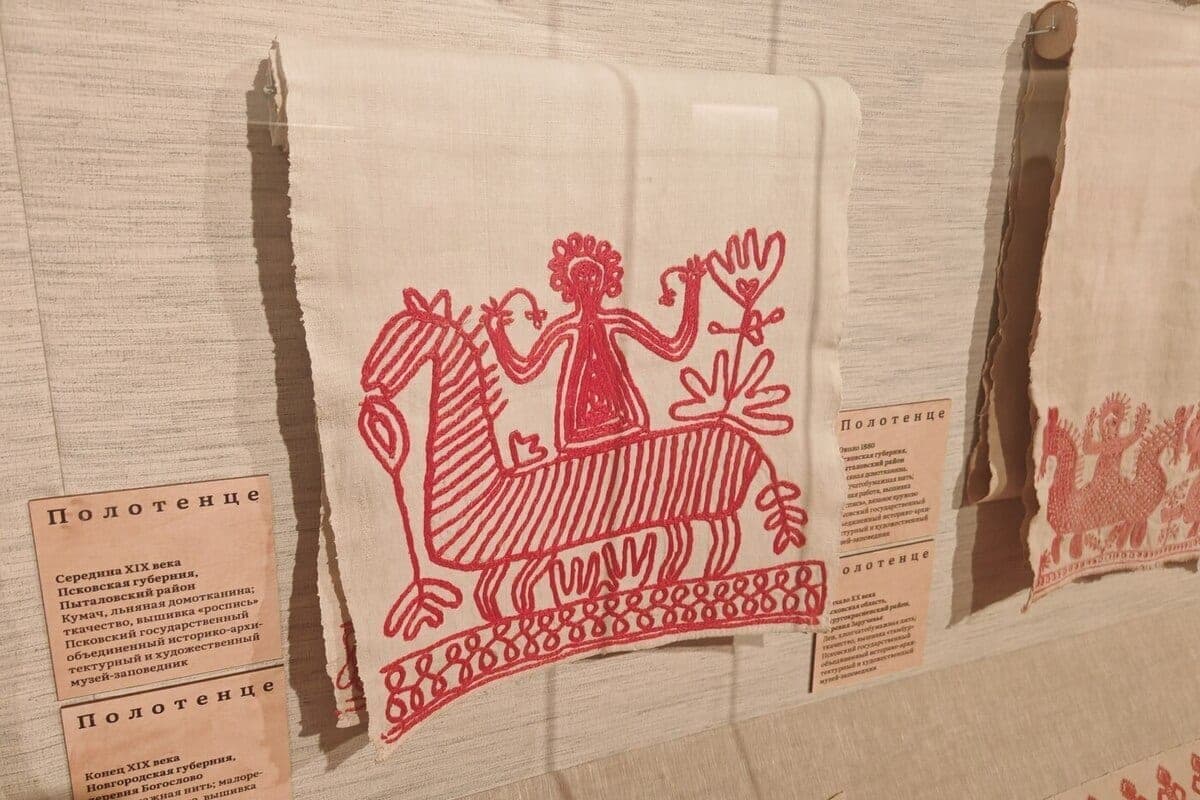
You can sew up at work in different ways. But there are those to whom this expression applies not in a figurative, but in the most literal sense. For a long time, man was drawn to embroidery, and this is also the desire for beauty. In the choice between a simple towel and a beautiful towel, our ancestors usually preferred the second. It is with him that the exhibition “Shito-embroidered” begins.
Art is all around us. Sometimes it is immediately created with a claim to greatness. But, perhaps, it is much more interesting to observe how a thing, which was originally assigned only practical functions, later gets into museum collections. Take the kitchen apron: it is designed to protect against pollution. The role of the apron is to take the blow of flour, drops of fat or accidentally splashed juice. The thing and in beauty does not need, but still beautiful - well, why for the sake of ancestors so bothered? According to modest estimates, machine embroidery of the apron takes at least two days, but before there were no cars. The heart asked for a beautiful thing, and the hands worked. Bizarre patterns and skillful ornaments covered towels, shirts and aprons solely for the delight of the eyes.
Embroidery is also a folklore that varies from region to region. Somewhere preferred bright colors: in Smolensk, Tver and Ryazan worked fiery threads - red, yellow and orange. In contrast, in Voronezh, they preferred to sew black on white. In Vologda, white canvases were embroidered with white threads - embroidery workers were drawn to plant bouquets-patterns. They were repeated in Novgorod, but the color range was expanded: blue, yellow and green flowers and trees invariably decorate wedding whirlpools.
Folklore consists of myths and legends, and, of course, they could not but be reflected in the craftsmanship. So the embroidery appeared Slavic birds of paradise Sirin and Alkonost, and as a result of acquaintance with foreign culture - Byzantine double-headed eagles, Persian snow leopards, European unicorns, Indian elephants and African camels. We must not forget about the ceremonial component: images of "hospice" and "birthdays", brides and their grooms. The patterns changed under the influence of time: the Enlightenment era brought to them luxurious palaces, gallant gentlemen and their beautiful ladies, and the Soviet Union – a mausoleum and red stars.
Development has not stopped in the era of digitalization and automation. Modern artists are increasingly turning to manual labor, and a large part of the exhibition is dedicated to our days. Simple wordplays take shape on the embroidery of Alexander Braulov; the red touches of Daria Neretina reinterpret Soviet reality captured in black and white photographs; and the ballet Swan Lake in the works of Natasha Yudina freely wanders through forests and fields. The black and white threads on the canvases of Maria Arendt transport us to the realities of domestic industrial zones: all familiar power lines, factories and construction cranes.
So embroidery goes from household necessity to independent artistic expression: it began with simple household items, absorbed regional traditions, myths and images of different eras - and continued in the works of modern artists. Man has always sought to leave on the fabric a trace of his time, feelings and ideas of beauty. And today, as manual labor increasingly coexists with the digital age, embroidery is not lost, but again becomes a language — slow, precise and very personal.